 Had I been living at the time Walter Felsenstein’s film of Verdi’s Otello was released in 1969, such then-innovative elements as the use of color on television and a vernacular translation might have given me new insights into this great opera.
Maybe.
But as I am, I have seen and heard Otello performed many times, in color, in the original Italian, and with much better singers. In watching Walter Felsenstein’s Otello now, its style feels hokey, overblown and alienating.
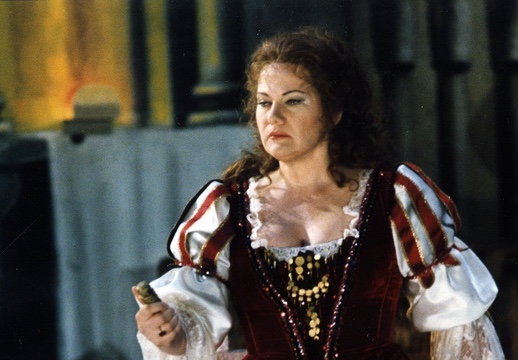
This telecast used a new German translation of the Italian text, created specifically so Felsenstein’s production could get closer to Verdi’s original intentions. “Just see how I show you my feelings” sings the subtitled Desdemona during her Act III confrontation with Otello. This line pretty much sums up the feel of the whole production: the emphasis is on demonstrating how characters are feeling with broad, choreographed gestures and large facial expressions. The result is a bizarre, alien landscape of contorted bodies and painted faces — sometimes strange, sometimes laughable, but almost always keeping me, the audience, at a distance.
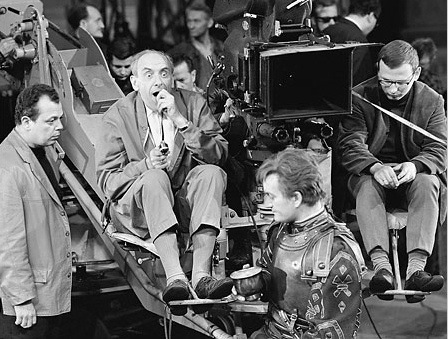
The tragedy is that this is the opposite of Felsenstein’s intention, as indicated in the interviews with him on this DVD (Arthaus Musik 101291 ). In his ideal opera production, every element — music, acting, design- would come together to emphasize the essential drama of a work above all else. His love and respect for the composer — and his modesty in their shadow — are palpable in these interviews. So perhaps this Otello is a step towards more dramatically compelling opera on film, compared with what came before. Maybe. But to me, a modern audience member who’s seen Zeffirelli’s big budget Traviata, Pagliacci and Otello, and up the nostrils of my favorite tenors in a movie theatre, it’s difficult to engage emotionally with opera depicted on film in this way.
Of course, all of this could perhaps be made up for if the singing was somewhere in between good and magnificent, but alas, here this DVD falls short again. Vladimir Bauer’s Iago is the weakest of the three principals, with a reedy, lightweight voice that sounds at times more like a character tenor than a Verdi baritone. Hanns Nocker’s Otello fairs only slightly better. Nocker certainly has the heft of voice for the part, but tends to bluster his way through key moments. Best of the three is Christa Noack as Desdemona, who succumbs to this style just as the rest, but has some very touching moments, and a sweet if unexceptional soprano.
Ultimately, if you are a Felsenstein scholar, or someone with a particular interest in the history of performance styles in opera, you may find much of value in this Otello. However if you are looking for a great performance of this greatest of operas, I suggest you look elsewhere. If you’re looking for a similar quality of filmed performance- that is, filmed with only so many cameras on a studio set- check out the 1974 filmed performance of Otello with Jon Vickers, Mirella Freni and Peter Glossop, conducted and directed by Herbert von Karajan. Alternatively, you can check out the 1958 filmed performance of Mario del Monaco, Renato Capecchi and Rosanna Carteri. Both are similar to the Felsenstein in terms of the style of performance — but both exceed it in dramatic impact due to the singers involve.
Latest on Parterre
parterre in your box?
Get our free weekly newsletter delivered to your email.



Comments