Cut! Print it!
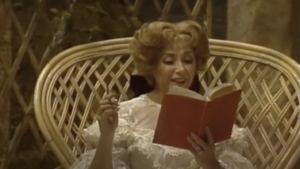
Erstwhile opera blogger Nick Scholl (aka Trrill) is currently live-tweeting the Poisson Rouge “Sacrificium” launch party! And this is what that party would look like if Cecilia Bartoli were actually there!
Please check back later (perhaps tomorrow, what with the free castratinis and all) for a full report from bel canto scribe Ercole Farnese!

Cocky, totally agree about Bartoli’s technique making her voice smaller – maybe shorter too. The low notes really got lost under the orchestra at the Met as Angelina in “Cenerentola”. I have noticed that in moderately high sustained soprano cantilena, Cecilia is much fuller sounding and has better vocal projection.
Bartoli has sung a high E in Genio’s aria in Haydn’s “L’Anima del Filosofo” or whatever that Orfeo ed Euridice opera is. I haven’t heard her Semele, Cleopatra and Fiorilla in “Turco” but her parts seem to be getting higher these days. She had no problems whatsoever as Fiordiligi in that dvd from Zurich.
Now Cleopatra if it is not embellished a la Sills and Sutherland is a pretty average tessitura soprano role – back in the early 18th century Cuzzoni was considered remarkable for having a high C – considered a very high soprano note.
A lot of the early bel canto sopranos were high coloratura sopranos which is the voice category that came to dominate and define the repertory later in the times of Lind and Patti and beyond. In the early 1800′s a prima donna soprano was just that and sang lyric, dramatic, seria, semiseria and buffa roles. The repertory wasn’t broken down into categories with different sopranos specializing in certain types of soprano roles – they sang everything. Naturally not everything fit equally well on certain voices. Malibran was famous for singing soprano and contralto and seria and buffa heroines. Malibran has been shown to have been a mezzo who couldn’t sustain soprano tessitura but could manage soprano high notes through hard work. But they weren’t natural and according to Verdi who heard her at La Scala were shrill. Her scores of soprano roles like Sonnambula and Puritani show the keys being lowered by as much as a third.
Isabella Colbran supposedly started out as a contralto but reworked the voice into a soprano. Her relationship with Rossini probably resulted in her contracting gonorrhea from him and this may have affected (or infected) her vocal apparatus. Her voice started to drop in range and ability pretty fast. Parts like Zelmira, Elena in “Donna del Lago” and Semiramide (if not embellished upward a la Sutherland) are moderate and can be sung by mezzos like Di Donato. Earlier Colbran parts like Armida are better with sopranos. Giuditta Pasta launched her early career taking over Colbran’s repertory before Bellini and Donizetti wrote her vehicles of her own. In fact there seems to have been some early friction between Pasta and Rossini at the time he was director of the Theatre Italien in Paris who was never a total fan of her singing – he complained of her pretensions and said she always sang a little false – referring to her intonation in certain areas of her range.
Blooper above – I meant to write that a lot of the original “bel canto” sopranos weren’t soprano leggieros. The voice type existed then but didn’t dominate the repertory as in the time of Lind, Patti and beyond such as Galli-Curci.
I’m glad you make that correction because it would annoy me to no end if that were true.
Would you call Patti a leggiero? I know she did a lot of coloratura roles and was capable of inspiring that derisory query from Rossini as to who had written the piece she just sang, but my impression of her from reading around and from her recordings is that she had more about her than the likes of Galli-Curci – something more akin to some of the famous C20th ladies who have sung a lot of bel canto, in fact. Before anybody tells me, I know full well those recordings are post-retirement from a singer who debuted at the age of 7 and hence cannot begin to reflect her at her best, but they still suggest, to me, a voice with more colour and weight than a pure leggiero.
I love all this history. Where did you find all this info (which books)? Thanks.
Hello CruzSF. I was afraid you had given up on opera after listening to Herodiade!
CK, making judgments from her recordings, but also from her repertory, I’d think Patti was a lyric soprano with a very fine coloratura technique.
She sang a very wide range of roles including Aida,
Trovatore , Marguerite in Faust and other roles that
wouldn’t seem possible for a pure leggiero.
And from those problematic records, I hear the remains of a voice with good color. But I love her sense of legato and that very fine grained trill.
Yes, well quite, that’s what I was driving at.
I didn’t mean to ask just Cocky, but also Gaultier and Javier. Thanks.
Hi No Expert,
I’ve been reading and listening, but a few of the recent items have been about things specific to NYC, so I haven’t commented. I finally finished the Gatti memoir. The last 2 chapters, where he opines on the singers with whom he’s worked, is especially entertaining. It made me realize that the “golden age” of opera was always 20-40 years before the “present.” As in, rarely can the contemporary singers compare favorably to the singers of bygone eras. LOL. I think that’s the nature of the human…
The “Heriodiade” hasn’t arrived yet! I should check on it.
I saw/heard Joyce DiDonato last night. Just astounding. I wish I had some grandchildren in my future to tell about last night’s recital. I’ll have to … er… befriend some young opera fans in 20 years so I’ll have an audience for my stories of the good ole days.
Don’t get me wrong, I love me some Massenet…but you know not everyone does. Back in the day of record albums, opera sets usually included great booklets with libretto, translations, photographs, blurbs about the singers, and frequently tidbits about the history of the opera and the singers who came before. Glad you got to attend a great recital. I’ll be seeing the New Orleans Opera’s Romeo & Juliette Sunday.
Which Herodiade recording are you expecting, Cruz?
You’re a big fan of Fleming, right, javier? Do you have this Herodiade?
I’m not just big, I’m morbidly obese. I literally can’t get out of the bed. Yes, I do have it.
javier, I ordered the Herodiade with Domingo, Fleming, and Zajick. It should arrive this week.
No Expert, I don’t mind taking a chance on Massenet, esp. when the disc is only $14. If nothing else, it’ll prepare me for his sound world in advance of the SFO 2010 Werther.
I’ve heard good things about Matt Worth, BTW. He’ll sing Mercutio for you on Sunday.
Cruz, enjoy the Herodiade. Massenet is a bit unusual though in that many of his operas sound very different. So Werther sounds quite a bit different, to me anyway, than Herodiade which is a bit lush sounding. Werther is mostly dark and soulful sounding except for the perky bits with the kids. And Esclarmonde , if you ever come across it, is very different again, pretty massive sounding.
I just got this Herodiade too. I really like it, overall.
Interesting. So you can’t ID one of his operas because of a “Massenet” sound, like say, Wagner, Mozart, Puccini, and Verdi with their operas?
A pity the conductor of that HERODIADE recording barely knew the score.
The best Massenet in modern times has been of course Dame Janet’s WERTHER in English with John Brecknock.
I was there in San Francisco for the Herodiade. It was quite a hodge-podge; looked like it had been assembled by Lotfi from several other productions, and the singing was very spotty. Fleming came out before the curtain to sing Il est doux, dressed as if she had just stepped from Bergdorf’s window — just in from the desert, dontchaknow! The baritone was fruitcake personified and his Voici donc was quite ho-hum. And the damned thing went on FORever. I got up to go after what I thought was the finale, and my seatmate pulled me back down and said, wait there is another act!
I am sorry; this is not first class Massenet; I adore most of what he wrote and I remain in awe of Manon and Werther and Thais — but Herodiade is the limit! Ugh.
Let’s see, I think Rudel conducted, no? it did not matter – who knows the damned thing well enough to figure out if the conductor was on or off. Ugh again!
Big Sony trucks were lined up outside the opera house with massive cables running in, and the lighting was screwball so I guess this is the one floating around on DVD. Be my guest.
No, Gergiev conducted. Oddly, there is no DVD. Either Sony only recorded audio or they just decided not to release the video.
Well, it’s too late now as the CD was waiting for me after work. Alas, there’s no libretto, just a summary (but in 3 languages). I look forward to trying to make sense of it all.