Cut! Print it!
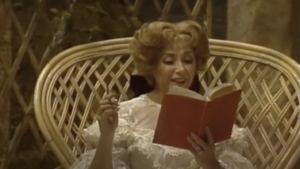
Erstwhile opera blogger Nick Scholl (aka Trrill) is currently live-tweeting the Poisson Rouge “Sacrificium” launch party! And this is what that party would look like if Cecilia Bartoli were actually there!
Please check back later (perhaps tomorrow, what with the free castratinis and all) for a full report from bel canto scribe Ercole Farnese!

What’s the surprise? Two crushed olives?
omg this party is 2 cra-z 2 B tru
I just noticed in Cecilia Bartoli’s schedule on her website that she will be singing Norma in a concert performance in Germany at the end of June in 2010. WTF! Can this be real? What role is she going to sing? Clotilde?
She’s going to sing Norma. She’s trying to challenge the notion that Bellini wrote Norma for a dramatic soprano, because he didn’t, he actually wrote it for a “mezzo” who was past her prime at the time she sang Norma. I’d rather hear a mezzo like DiDonato sing Norma. She’s been re-claiming a lot of the great mezzo roles that many people associate with sopranos and she could probably do it better than Bartoli. But I still think it’s interesting that Bartoli is doing this. She has guts. Of course it will only be a concert and she will probably use a microphone, but she still has guts.
She has guts. That is for sure. But i think she lacks many things that is required for Norma.
well, she must think she has something to offer, otherwise she wouldn’t be doing it. it should be interesting.
According to accounts, Pasta had a problematic voice, but if the writing in “Norma” is for an over the hill voice, she must have been positively inhuman in her prime. True, the decline came rather quickly, just a few years after the “Norma” premiere, but when she debuted that role, she was at the height of her powers. A lot of voices can do “Norma,” but before vocal categories became more rigid, you sang what you could sing well. It is just as wrong to say Norma was written for a mezzo, as it is to say only dramatic sopranos can do justice to it. After Pasta, Giula Grisi took on “Norma.” She was the first Clotilde, and again, according to accounts, more of a Sutherland type of voice. I think it was Mordden who said that in the golden age of the prima donna a singer defined the part, not the other way around.
I’ve read that Pasta had vocal problems on the opening night of Norma. Anyway, the most famous Norma of the past 60 years or so, Maria Callas, has about the ugliest voice I’ve ever heard, so when people say that you can’t have vocal problems and that you need to be perfect to sing the incredibly difficult bel canto opera that is “Norma” I just laugh. If Bartoli wants to do it, more power to her.
But having vocal problems does not mean being over the hill. Pasta, like Callas, had a manufactured voice. She asked too much from it, so it wasn’t a hundred percent reliable. Callas in her too brief and formidable prime was the same way. And Callas had a beautiful voice or at least, as Mordden said again, she sang like she had the most beautiful voice in the world. It just wasn’t pretty or conventional, but it revealed the music in a way very few have been able to do in her repertoire. So yes, she made ugly sounds here and there, but she forced you to expand your idea of what beautiful is. I am stumbling my way through Roger Scruton’s “Beauty,” a slim book about the philosophy of beauty. It is hell to read for a neophyte, but it is very rewarding in making you think about our appreciation for beauty as something intellectual rather than purely sensual. It has helped me understand Callas’ appeal better. Now Bartoli as Norma might be interesting, but I don’t know if she has the temperament for it to be truly satisfactory in the part. I do appreciate her for going her own way and bein serious about what she does, but that doesn’t mean she can do everything. We’ll see.
Perfidia, Grisi was the first Adalgisa, not Clotilde. Bellini was against Grisi taking on Norma, I think she only did it after he died.
Agree that from contemporary reports of Grisi’s voice, it seems like it was more like a natural,
as opposed to a manufactured Pasta, type of soprano voice.
Singers like both Bartoli and DiDonato are not typical mezzo voices so it’s quite possible that they would have taken on a much wider repertory back in the mid 19th century than would be considered appropriate for them today. Again, Perfidia, this sort of goes along with the Mordden quote you cited.
Cece bean looks and sounds like a rooster.
oops, capon, she’s been castrated, right?
LORDY, what a mess.
Two thoughts come to mind while watching the video:
That’s whatcha get from hanging around all those queens all those years, and
Cathy Berberian lives!
The overexposed Roman baggage is hardly likely to attain the Bellinian heights that Claire Rutter attained in the great role.
Jeez! Another clip from that Leander bag of sauerkraut, warooo-bling away.
Brutta, la voce della Callas?
Non e bello quel che e bello, ma e bello quel che piace.
To be honest, I’m more of a ???????????????????????? man myself, Anonymous.
Frankly I don’t think anyone really knows what Pasta really sounded like today. In the early nineteenth century female voices were divided into two categories – soprano and contralto. (Similarly the male voice was divided into tenor and bass with the baritone category coming into use in the mid-nineteenth century) Contraltos sang with mostly chest resonance and their upper range ended around F or G. The category “mezzo-soprano” came in later but was a term used earlier with a close cognate “soprano sfogato” to refer to darker sopranos with limited upper registers. Some of these singers may have been what we refer to today as mezzos, some may have been “falcons” and some may have been dramatic sopranos. But the training, repertory and voice classification was very different in 1830. Pasta sang some contralto roles like Tancredi but she raised the keys, which was allowed. When mezzo/contraltos like Alboni sang Amina in “La Sonnambula” the keys were lowered. You could do that then and no one complained. The role was made to fit the singer, not vice-versa as it is today.
I think that Bellini wrote the role of Norma for the Pasta voice in its prime but it became evident even in the first run, that her voice was starting to slip and she had trouble sustaining the part. Remember that Pasta wanted Bellini to drop “Casta Diva” and only relented when he lowered the key to F. Also supposedly at the premiere of “Norma” all the singers were in wretched voice due to the strain of rehearsing. The great success came later in the run. By the time Pasta repeated Norma outside Italy it was said that her singing was worse though her acting was even greater. Clearly, Norma was Pasta’s apogee and downfall as an opera singer – it marked the high point on the parabola and the beginning of the descent.
I suspect she was a dark soprano with a few holes in the voice. Supposedly Pasta only sang up to a D that she touched in runs, not sustained. However the part of Norma has several sustained high C’s that most mezzos would struggle with. Many sopranos have struggled with them.
Bartoli I think is a dark soprano with a limited, weird technique. At the Met I had trouble hearing her in real mezzo roles like Angelina but no problem as Susanna, a medium soprano role, across from the big-voiced Terfel.
Hey, Gualtier M. Nicely written. I think the whole thing is very fascinating (how vocal categories have changed and transpositions are now frowned on). I have a lot more reading to do on the subject.
I think you’re probably right about Bartoli being a dark voiced soprano, although it has never occurred to me before. Very perceptive. Her technique is weird, and makes her voice even smaller than it really ought to be as part of the trade-off for being able to sing such fast coloratura, but I don’t think she is actually uncomfortable in soprano tessitura.