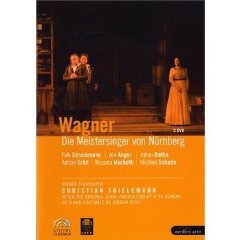
 There are several reasons to purchase the new DVD of Die Meistersinger from Vienna (EuroArts EUA 2072488), but the main one is Christian Thielemann. This production will most likely come to be known as “Thielemann’s Meistersinger,” because his sense of the overall architecture of the work is, pardon the pun, masterful. You sense this in the Prelude to Act I in the manner in which he pulls back and slows down the orchestra during the final moments to ensure the climax will be overwhelming when the big C major chord finally sounds. The orchestra playing is exceptional throughout with special mention to the winds and the brass. Thielemann conducts a Meistersinger that has a lot of heart. At the end of the performance, you feel as though you have grown by the experience.
The curtain goes up on a rather stodgy looking production by Otto Schenk. The production dates from 1975 and looks it. The costumes throughout the opera are mostly of the color scheme of brown, sage green and burgundy. I was concerned as the curtain rises and we see Johan Botha as Walther pacing back and forth waiting for the church service to end. His very large frame does not permit much movement and his acting is primitive at best, but once he starts singing, you understand why he is there. Throughout the evening, his clear singing is first-rate. He still sounds as fresh when giving us the Prize Song as he does at the beginning of the opera.
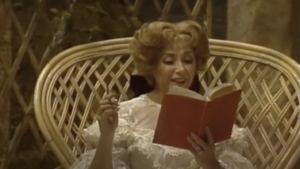
Eva, Ricarda Merbeth, is likewise not telegenic. She has a way of producing her sound that distorts her features and makes her appear startled when she sings. It is most unfortunate as her singing is good and she is obviously a musician. She has a bit of a Behrens-like sound with a more pronounced vibrato although without Hildegard’s great insight into character. She was also given the most unattractive yellow dress and hat for the last act. During the final bows, the audience obviously agreed as her ovation was not anywhere near the great adulation accorded of the rest of the cast.
The Magdalene and David of Michaela Selinger and Michael Schade make a fine couple. She is one of the youngest and prettiest looking Lene’s I’ve seen, and her mezzo-soprano voice was well focused and appealing. Schade brings his lieder singing expertise to the long section describing the many different rules of singing to Walther. This part of the opera can be a bore, but listening to the subtle musical nuance he brings, I was right there with him for the entire section.
With the entrance of the Meistersingers, we get two of the outstanding performers of this set, Ain Anger as Pogner and Adrian Eröd as Beckmesser. They are both members of the Vienna ensemble and deserve to be much better known. Anger brings great voice, looks and dignity to the role of Pogner. You see and feel his soul searching about offering Eva as a prize in the song contest.
Every time Eröd takes the stage, the performance ratchets up a notch. His is a Beckmesser free of caricature, funny without being offensive. There is also depth. When he enters Sachs’ house in Act III, sits on the stairs and fondles his mandolin, you feel his loneliness. The timbre of his voice sounds more tenor than baritone. Checking his biography, I see he recently introduced his Loge in Vienna to great acclaim, so he may be moving into some of the tenor repertoire.
Falk Struckmann as Hans Sach presents a performer with deep understanding of the man. His voice is a bit worn at this point, but he is in better voice than he was as Wotan at Bayreuth in 2006. His two monologues are definite highlights of the set. His Fledermonologue is exceptional. Here is a man in existential crisis and I was spellbound. When Eva enters, you feel the sense of interruption as you are with him in his thoughts in another space. I re-watched this scene to see if I still had the same impression and I did.
With the start of his Act III “Wahn” monologue, we are once again plunged into darkness and despair. This is lifted artfully when Sachs, who has been seated for much of the time, stands up, opens the window, and lets in the light as the music brightens. His facial expressions as Walther creates his Prize Song in Act III shows a man that sees something exciting and new and wants to help Walther succeed. I was moved by his performance. He begins to tire toward the end of the evening, but with the amount of singing Sachs has in this opera, I was not surprised.
[kml_flashembed movie="http://www.youtube.com/v/jMz2NtUyP7w" width="425" height="350" wmode="transparent" /]
Act II takes place on the street in front of Pogner’s very large house with Sachs’ workshop on the left side of the stage. Once again, Eröd steals the scene with his entrance to sing his wooing song to Eva. The palpable antagonism between Sachs and Beckmesser is well acted and convincing. As all chaos breaks loose in the last scene, you sit and marvel at how Thielemann keeps this huge ensemble together.
After a moody prelude to Act III, we are in Sachs’ house. The set is reminiscent of Flemish painting with browns dominating in costumes and set. By this point in the opera, all of the performers are on and it is one great scene after another. Merbeth’s lack of charisma really mars her scene with Sachs and the great Quintet. Her singing is not bad, but she lacks the inner radiance that Mattila brings to this role.
As the scene switches to the meadow, we get shots of Thielemann whipping the orchestra into a real frenzy. It is wonderful to watch as he builds momentum for the final scene. The set for the meadow is not nearly as impressive as Schenk’s later production for the Met. The different Guilds of the Apprentices are noted by their costumes, which are a bit on the garish side. The singing of the chorus is of the highest standard throughout especially in the finales of all three acts. Then, we are treated to one of Thielemann’s famous pauses in the “Wach auf” chorus. The chorus sings “Wach” – long pause – “auf”. It is certainly effective!
Eröd once again wows us as Beckmesser mutilates Walther’s song he pilfered from Sachs’ writing desk and then Botha enters and delivers a truly majestic Prize Song. I enjoyed seeing the chorus watch Walther sing this section as they are very engaged in the action of the scene. As Sachs delivers the final section of the opera following Walther’s rejection of the Masters, one cannot erase the fact that what he sings has been tainted by history. His talk of German “Kunst” makes one uncomfortable.
This DVD would not be my first choice for Die Meistersinger. For that I would go with Wolfgang Wagner’s Bayreuth production with Bernd Weikl and Horst Stein conducting or Schenk’s later production at the Metropolitan Opera
 with James Morris and James Levine. All three are traditional productions.
But if you love Meistersinger, you will want to hear this production for Thielemann’s conducting.