
Eugene Onegin at the Komische Oper
Barrie Kosky‘s Eugene Onegin at the Komische Oper Berlin still devastates a decade on.
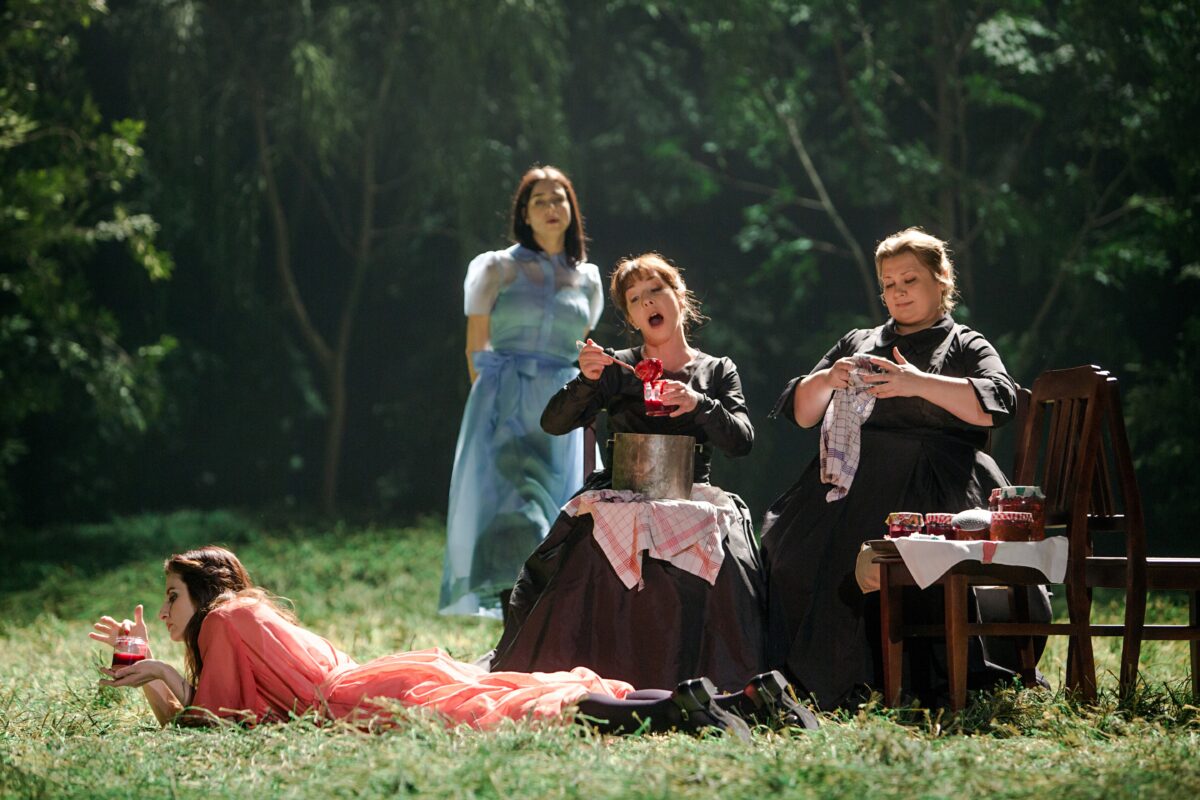
Photo: Iko Freese
Any American opera queen would be tempted by a vintage Barrie Kosky staging of Tchaikovsky’s Eugene Onegin at the Komische Oper, but it took a viral Instagram reel from baritone Hubert Zapiór (Eugene Onegin) to get me through the door. Watching Zapiór choke on torn-up pieces of Tatyana’s letter during rehearsal with Penny Sofroniadou (Tatyana) in a 25-second clip triggers, I imagine, the same fervor with which the Russian literati absorbed the serial installments of Alexander Pushkin’s novel two hundred years ago. In any case, a viral clip triggering the purchase of opera tickets would probably make a cultural theorist run to draft an abstract.
Luckily for us, cultural theorists didn’t design this 2016 production. Ten years later, it remains a love letter to the opera and its most sentimental qualities. Kosky leaned into what has historically been understood as a fault in the libretto, namely the lopsided emphasis and space granted to Tatyana and her girlish longing for the titular character. The minimalist pastoral staging, designed by Rebecca Ringst, anchors the performance in a verdant meadow, which initially serves as a charming backdrop for the cute peasant chorus numbers and Maya Gour’s coquettish gallivanting as Olga, but transfigures into a bleak field once Eugene and Lensky (Pavel Valuzhin) appear. Before there’s any indication of the looming duel, the framing of Lensky’s arioso “Ya lyublyu vas, Olga” presents us with an overeager, lovestruck tenor and despondent mezzo. The first scene of act one ends with Olga staring drearily into the audience seated next to Lensky, who, seemingly unaware, gazes upwards with a goofy smile on his face. Under the conductor Anna Skryleva, the orchestra plays with a taut, focused balance supporting an impressive principal cast. Gour possesses a remarkably sultry tone that clashes with Valuzhin’s radiant timbre in a way that perfectly encapsulates their two characters’ unsuitability for each other.
Rather than transport us into Tatyana’s bedroom for the second scene, Kosky is uncharacteristically restrained. He opens it in the same sparse field, with only a wooden chair for Tatyana’s nurse, Filipyevna (Ulrike Helzel). The buildup in Tatyana’s letter scene is elevated by what should be an illogical decision: she turns away from the audience, sings towards backstage, and fidgets with her hands behind her back while singing some of the most gorgeous descending chromatic lines ever written. There is something so earnest about Sofroniadou’s teenage Tatyana that makes you want to climb on stage, snatch her love letter to Onegin away, and shake her free from her unrequited crush. The Greek singer’s balanced, full-bodied soprano is a welcome reminder she is, in fact, not 17 like her character.
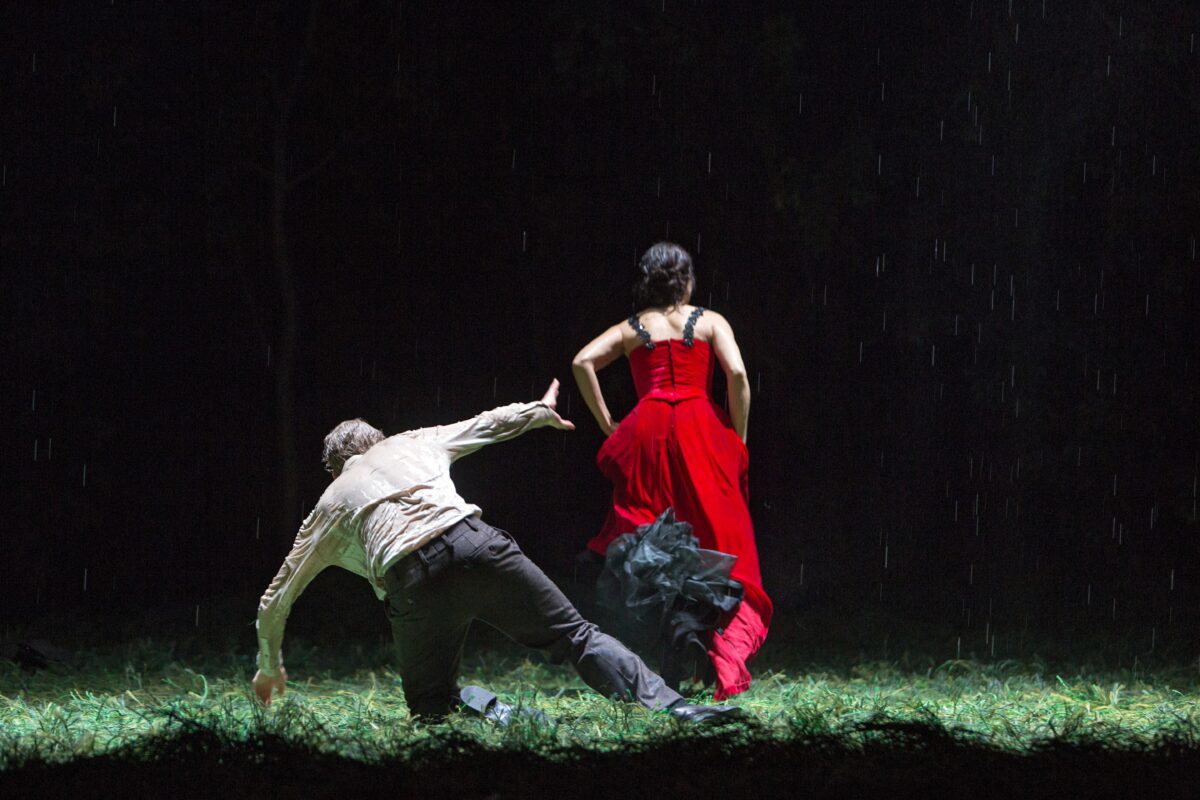
Photo: Iko Freese
If that fact that Onegin responds to Tatyana’s passionate letter professing his aversion to marriage and offering only fraternal affection to her isn’t devastating enough, the fact that the debonair Zapiór is the one to deliver it crushes the whole house on her behalf. As the erratic and aimless Onegin, Zapiór possesses a gracefully burnished baritone whose delivery of Onegin’s aria at the end of the first act captures the character’s detached attitude towards Tatyana completely.
Valuzhinh has a handsome lyric tenor, and his “Kuda, kuda” showcases an impressive cantabile and a singer who has control over his upper passaggio. The aria is, in many ways, the vocal heart of the opera, and after Lensky’s death the demand rests on the two leads to carry the conversation-heavy plot of the third act. Sofroniadou appears in the grand ballroom—a makeshift set superimposed onto the lush meadow—with an entirely new physicality fit for an older, more mature Tatyana. Her transformation is mirrored by a now remorseful Onegin whose mental breakdown is conspicuously marked by a rush of stagehands who begin to dismantle the ballroom during Onegin’s act three arioso. Taking place underneath a downpour of actual water, the final duet is an exemplar of staged intimacy—especially as Zapiór rushes to embrace the soprano while effortlessly hitting some of the highest notes of the night.
I can’t say whether the Komische Oper’s marketing team planned on a baritone’s Instagram doing their work for them, but I don’t regret my purchase.
-
Topics: Review, revival, tchaikovsky
-
People: Anna Skryleva, Barrie Kosky, Hubert Zapiór, Maya Gour, Pavel Valuzhin, Penny Sofroniadou, Rebecca Ringst, Ulrike Helzel
-
Works: Eugene Onegin
-
Places & Organizations: Komische Oper Berlin



Comments