
Mysterious skin
Einstein on the Beach, in a production celebrating the opera’s 50th anniversary, is thrilling and tender in concert at the Brooklyn Academy of Music.
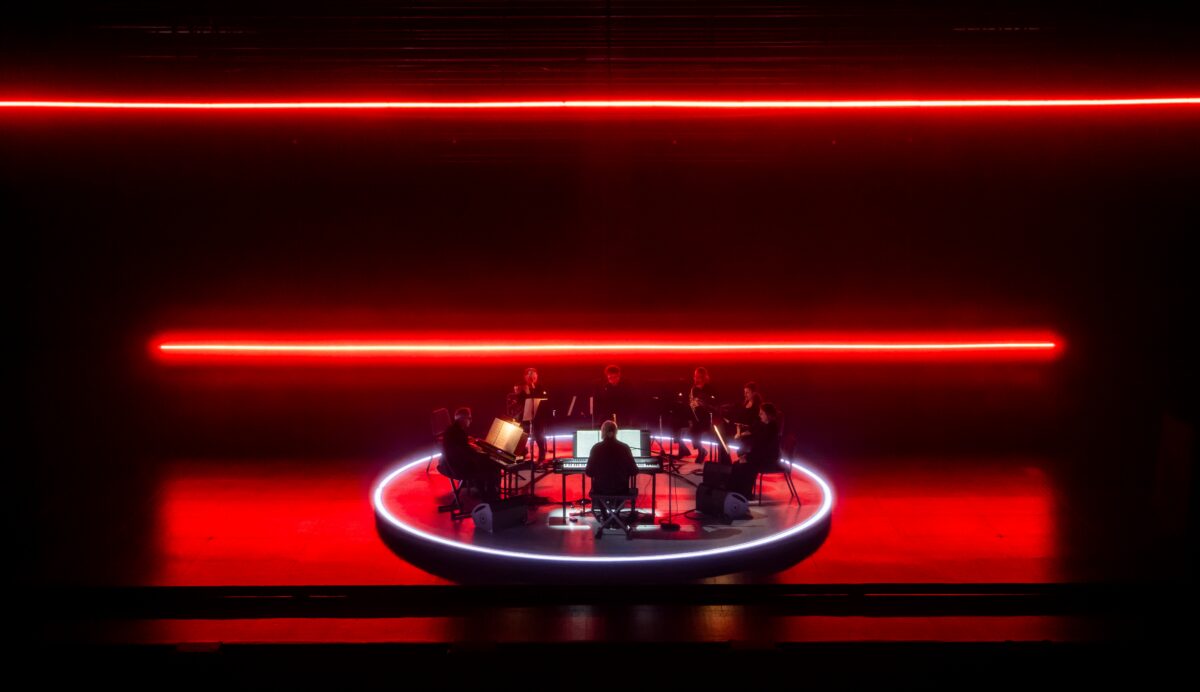
Einstein on the Beach, in a production celebrating the opera’s 50th anniversary, is thrilling and tender in concert at the Brooklyn Academy of Music.
Einstein on the Beach, when it is fully staged, is five hours long and contains no intermission. The audience is invited to come and go quietly throughout. Phillip Glass‘s opera has no linear plot or characters and is held together through thematic imagery and repetitive rhythms and melodic cells. The condensed concert version, recently performed at the Brooklyn Academy of Music to commemorate the opera’s 50th anniversary, is structured like a conventional opera, coming in at under three hours with a 20-minute intermission.
Michael Riesman, an original member of the Philip Glass Ensemble, conducted the opera. With what appeared to be minimal effort, the 83-year-old played electric organ, directed the ensemble, and conducted the chorus. He and the ensemble—two electric organs, flutes, saxophones, piccolo, clarinet and vocalists—sat within a blindingly bright circle of white light. Throughout the performance, horizontal bars of white or red light moved up and down the proscenium, framing the ensemble, the choir and solo performers in sharp boxes, like a Mondrian.
The musicians, like much of the audience—with their white hair and thick black glasses—seemed like members of a priest class from an alien species who are visiting Earth on a mission of cultural exchange. You sit among them, anticipating an evening of boredom and endurance, but before long you are bobbing rhythmically to the waterfall of arpeggios. You enter a trance, close your eyes, and allow the hypnotic rhythms to wash over you. No single element alone contributes to this rearrangement of brain cells, although certainly the steady pulse of the electric organs—keeping the soaring choir tethered to the organs’ slow triadic repetitions—does much of the work of bringing you into an altered brain phase.
Einstein on the Beach is like an opera that’s lost its skin. The concert version recently performed at BAM is all skeleton, lacking even the articulating digits of scenery and modern dance in the staged version. The drama and power of the performance were all that much more impressive given the liturgical simplicity of the production. The chorus and violin soloist, Aliayta Foon Dancoes, are especially to be commended. If you don’t think singing or playing the same three notes over and over could possibly be difficult, try doing it yourself for twenty minutes, in perfect time and with two electric organs booming in your face. After one particularly lengthy stretch of arpeggios in “Knee Play 4,” the audience audibly yipped at their virtuosity.
Turned into factory cogs in high formalist theater fashion, the chorus balances between the mechanized and the sacred. Humans are not actually machines, however, and the performance was far from perfect. That is part of the tension in Einstein on the Beach: the power of the engulfing sound combined with the tender frailty of the human performers. Considering the widespread popularity of trance music, ambient sound, and sound baths, and the prevalence of electronic textures and minimalist repetitions in art rock and new music, it’s not surprising that Glass operas continue to feel contemporary. In each row of the audience surrounding me was at least one person meditating, in a trance, or perhaps falling in and out of sleep to the soothing repetitions—music like the night trills of frogs, the human breath, the beating heart.
A great many opera aficionados have an unfriendly relationship with Philip Glass. You don’t need to have acquired a taste for traditional opera to love Einstein on the Beach: its synthesized wall of sound is familiar to anyone used to arena concerts or pop music with heavy bass. Einstein on the Beach also quietly mocks romantic opera. It jettisons centuries of tradition so that it is light enough to take us on a journey to a new galaxy. At 50, even with countless imitators and two generations of artistic descendants, the opera continues to feel new.
-
Topics: concert performances, philip glass, Review
-
People: Aliayta Foon Dancoes, Michael Riesman
-
Works: Einstein on the Beach
-
Places & Organizations: Brooklyn Academy of Music

Comments