
Blasted!
Like the proverbial curate’s egg, Opera Colorado’s Macbeth is good in parts.
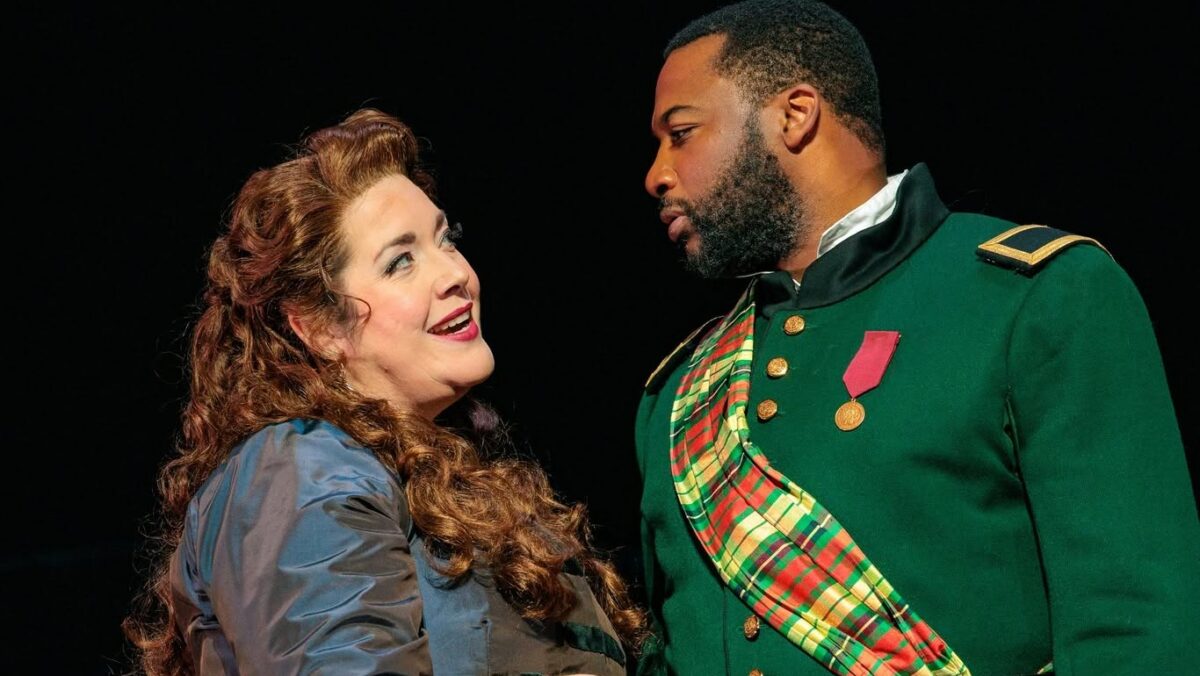
Photo: Matthew Staver
Opera Colorado, opened its 2026–27 season. the first season fully planned by General Director and CEO Barbara Lynne Jamison, with Verdi’s take on the Scottish play. It must have been considered a safe bet for Halloween season: the traffic snarl outside the Ellie Caulkins Opera House in Denver added to the opera-goers’ sense of impending doom, for ‘twas a dark (if not stormy) night outside, and the slithy toves did gyre and gimble in the wabe.
Wait, that was just the (non)regie, though. My program says that Opera Colorado set this Macbeth in 11th-century Scotland, but if you had told me it was set in 16th century Sicily or 22nd century Uzbekistan, I’d have taken your word for it. The director, Dan Wallace Miller, making his Opera Colorado debut, has supposedly framed the production around how whispers become prophecy, and how a rumor, once believed, can turn into power. One could almost hear the blue-rinsed donors reaching for their checkbooks, safely assuming there won’t be any extraterrestrials, Mars expeditions, or unexplained laundromats on stage.
As the opera opens, we’re on the blasted heath—ON IT!, to quote Anna Russell. But soft! Why are there groups of witches now, lying down for a bit of a shuteye, all dressed in their Hogwarts colors? There’s a group of white witches (not necessarily the benign kind), there’s a group of red witches, and there’s a group of black-clad witches, and they’re all made out of ticky-tacky and they all look just the same. Very Dragula, darlings.
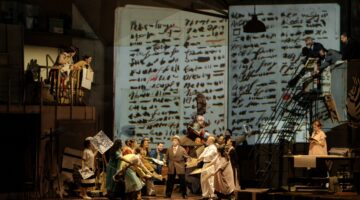
I can carry on in this vein for five more pages, but I’ll summarize by saying that this was a very generalized production with nothing more “novel” than the zombie-witch hybrids looking slightly self-conscious and out of place. The men wore bottle-green uniforms with tartan sashes. The women wore somber colors accessorized with—you guessed it—tartan sashes, except the poor Thane of Fife’s soon to be erstwhile wife, who was dressed like Olympia in a small German company’s production of Hoffmann’s Erzahlungen. Why? I dunno. There was a very comfy looking blue leather chair inexplicably placed in the middle of the stage, and the characters sat down, took a load off their feet, and sang about the evening sinking fast, or the lack of pity, love and respect, or their poor country being ravaged by a tyrant. Sounds familiar?
What else can I say about the stagecraft? The descending table in the brindisi scene was fun. A spectral Banquo did a few high jumps on and off the table, as the crossfitters in the audience nodded approvingly. Macbeth seemed slightly disoriented. Lady M. seemed to worry more about the coloratura than her hubby’s sudden descent into madness: I was reminded of Rysanek, Zampieri and Borkh’s frantic, almost frenzied efforts to prove everything was ok, or Astrid Varnay and Shirley Verrett’s magisterial, fatalistic singing, trying to use sheer willpower to cover up the cracks in Macbeth’s regal façade. Our Lady M. seemed to have very little chemistry with her hubby. This made her sporadic attempts to make out with her Lord and Master kinda cringe, especially in that one scene where they went down hot and heavy on the ground, like a Shakespearean Bonnie and Clyde. If they were angling for a sexually voracious, young Lady M a la Francesca Annis in the Roman Polanski movie, it wasn’t—shall we say—a direct recreation?
Before I move on to the big scenes, let me put down a few random impressions: the three specters in the prophecy scene were well played; Banquo’s farewell to his son was touching as he exited, pursued by a bear(y assassin); Macduff sang a touching farewell to all his pretty chickens and their dam, extinguished at one fell swoop; the pitiful little coffins shown on stage. I wish they would have kept the lid on for Lady Macduff-in-her-Olympia-getup, however. The final fight would have been more impressive if the soldiers weren’t waving what looked like plastic X-mas trees in becoming shades of yellow, ochre, orange, and other vibrant fall colours, leading to the question: had Birnam wood immigrated to Vermont recently? Macbeth’s henchmen, getting ready to kill Banquo, seemed to do a version of the leg-o’-mutton rag onstage, with the music faintly reminiscent of Gilbert and Sullivan. Given how the women were on stage for most of the time, one wonders if their sisters, cousins and aunts would have followed them to the assassination site with cat-like tread. Patrick Summers, Music Director Emeritus of Houston Grand Opera was a solid if unremarkable conductor in his Opera Colorado debut, and kept things chugging along nicely with no self-indulgent tempi.
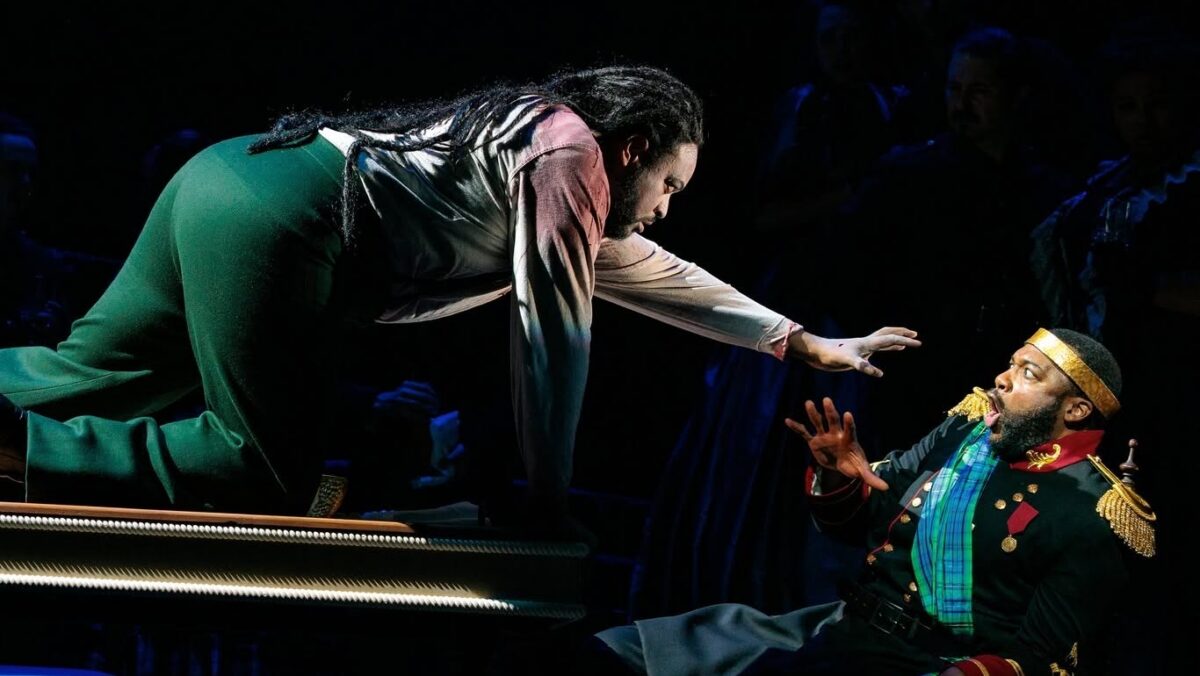
Photo: Matthew Staver
Finally, the singing. I hope I’m giving my impartial observations here, because I wasn’t familiar with the singers’ previous works. Our ill-fated and credulous Thane of Cawdor/Glamis/etc. was sung by Norman Garrett, who came to the part having already sung it with Opera Orlando; this run marked his company debut. His assumption of the role remains a work in progress, but I did find his “pieta, rispetto, amore” quite well-sung, and his initial camaraderie with Banquo made his later betrayal of his friend and comrade even more jarring and heinous. Banquo, sung by a heart-melting handsome Kenneth Kellogg, initially put on a good show, but was definitely showing signs of hoarseness toward the end of the evening. Given that Banquo isn’t a long and hard slog, I’ll attribute it to the weather, or nerves. Neither men were idiomatically Verdian; it is Edward Graves as Macduff who deserves that accolade.
The online reviews have been praising Marcy Stonikas, the Lady Macbeth, to the high heavens for her artistry. She seems to have made a specialty of the battle-axe roles in regional houses: Turandot, Elektra, etc. – a modern-day Gladys Kutcha or Lucilla Udovich. Clad in a series of funereal outfits, she sang the letter scene with a lot of voice, crumpling the letter and chucking it out (that’s evidence, woman—burn it or summat!) as a grand gesture. Her subsequent bout of bloodthirstiness was less believable. Made up in a wig that looked like it was salvaged from the Renée Fleming “Thaiiis,” she seemed to egg Macbeth on to commit bloody murder in the most humdrum of ways. Nor did she make much of an impression during the Grand Duet—one of my favourite pieces of Verdiana – where she didn’t bring Martha Modl’s hushed whisper of pure terror, Callas’ impatient ball-breaking, or Christa Ludwig’s “Mutti knows best” omniscience. Her “pass me the dagger” – a line that has been sung in the past by other artists with irritation, determination, tremulousness, or even relish, was sung as a statement of fact: “pass me the coffee, and look sharp about it.” In fact, even though Zinka Milanov had never sung Lady Macbeth (as far as I know), and I’m way too young to have seen her on stage, Stonikas’ acting reminded me of contemporary accounts of Zinka’s Aida and Leonora: one hand up, mildly agitated; both hands up, there’s some serious malarkey afoot. I also don’t have a detailed analysis of her sleep-walking scene, except to say that the right notes were sung in a business-like manner (I won’t swear to the D-flat). Despite the doctor and the serving-woman’s interjections of “oh what horrors”, I don’t think anyone in the audience found the scene spooky, horrifying or even upsetting.
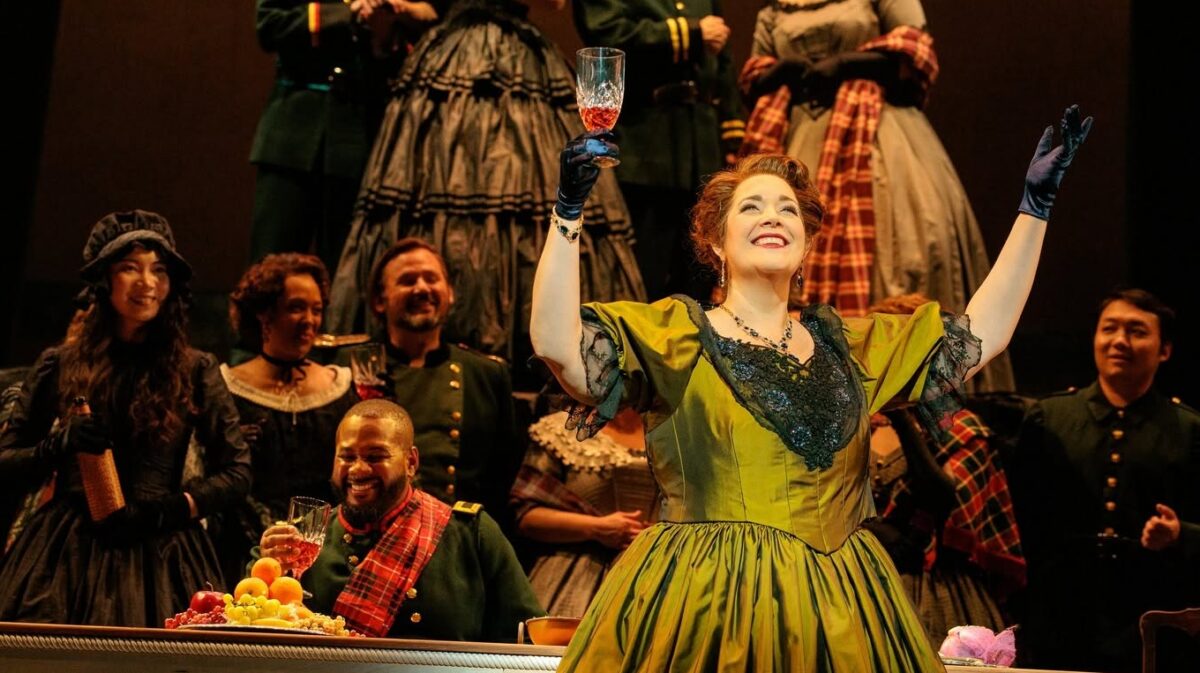
Photo: Matthew Staver
The other singers were adequate without being overwhelming: Banquo’s “Come dal ciel precipita” was well-received; Macduff’s “Ah, la paterna mano” got the show-stopper treatment, and quite justifiably so. Malcolm, the Lady-in-Waiting, the Doctor, and the Apparitions, some of these roles being sung by Opera Colorado’s resident artists, were perfectly respectable. The refugees’ chorus, “Patria oppressa,” seemed timely; overall chorus balance and diction left a positive impression.
When I had reviewed Opera Colorado’s Madama Butterfly a few months ago, I had mentioned that despite a conventional staging, the singers made the opera come alive. Other than the Macduff, and maybe Lady M. from a purely vocal standpoint, I can’t recycle that verdict for this “Macbeth”. It remains a work in progress in every sense. The concept (if there was one) didn’t come through on stage, the menace of the supernatural wasn’t creepy enough, and the quasi-traditional period setting felt tired and unoriginal. Fortunately, the fast-paced action, coupled with some of Verdi’s most exciting music, still makes this eminently watchable, and it would be interesting to see how the careers of Stonikas, Garrett, and Graves develop over time.

Ronnie Banerjee
Ronnie Banerjee is an opera-lover and a scientist. Their very first opera was a Salome at the Leipzig Staatsoper. They are a Canadian researcher with a PhD in nanobiomaterials from Saskatoon, where they worked at the Canadian Light Source (a synchrotron), and occasionally scared personnel there with bad renditions of the confrontation scene from Maria Stuarda. They are presently based in Colorado, and look forward to visiting the Met one day.
-
People: Dan Wallace Miller, Edward Graves, Kenneth Kellogg, Marcy Stonikas, Norman Garrett, Patrick Summers
-
Works: Macbeth
-
Places & Organizations: Opera Colorado

Comments