
Tricky Dick
Washington National Opera’s historically anchored production of Nixon in China highlighted the strengths of composer John Adams’s and librettist Alice Goodman’s great American opera.
 By
Andrew Lokay
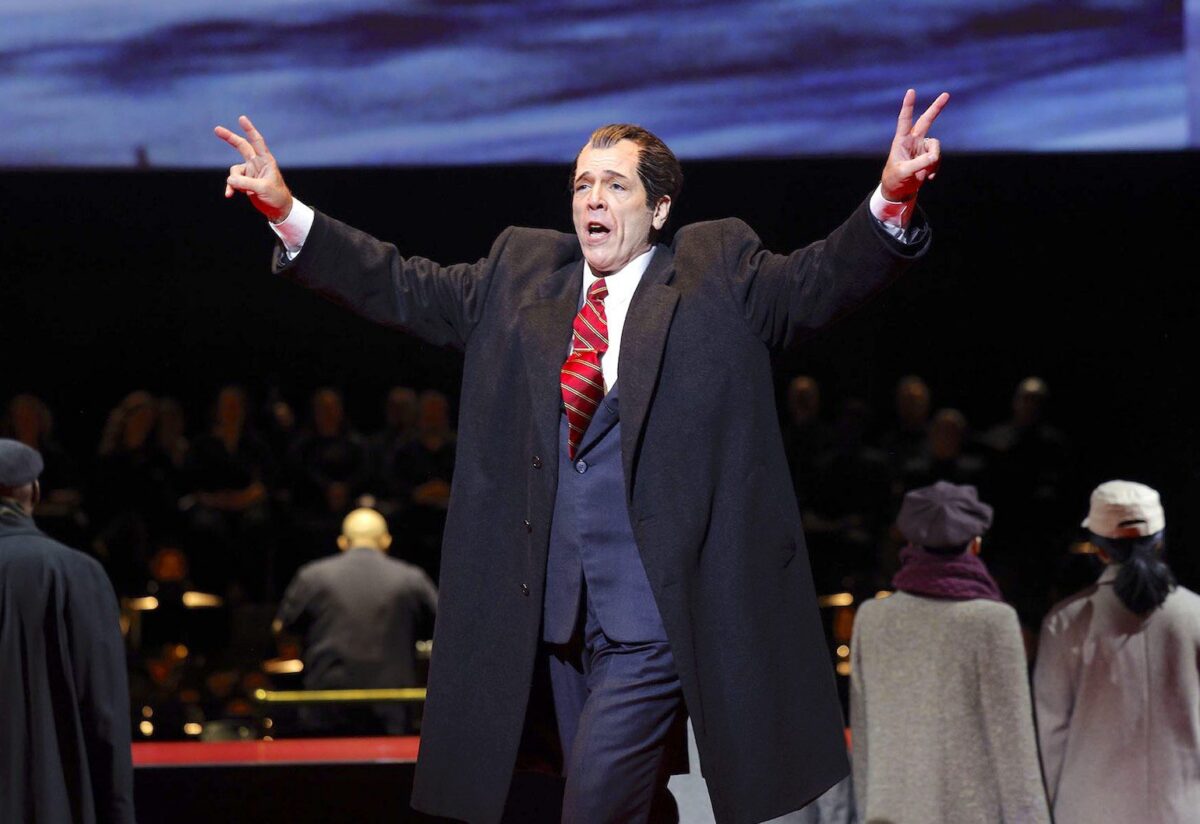
Photo: Cory Weaver
Former President Richard Nixon is having a moment. In a June speech at the Nixon Presidential Library, Vice President JD Vance compared himself to the 37th president. Last month, the Wall Street Journal reported that the Department of Justice was looking into whether the Watergate special prosecutor’s office committed misconduct. A wave of interest in Nixon, dubbed “Nixonmaxxing,” is trending among young conservatives, and the Nixon Library is leveraging social media to share the former president’s legacy.
Enter the Washington National Opera, which debuted a new production of Nixon in China this month, running in repertory with Madama Butterfly on the same newly constructed stage in the Daughters of the American Revolution’s Constitution Hall. It’s hard to think of an opera more suited to Washington, DC than this one, with its focus on geopolitics, the implications of mass communications, and the public and private lives of political leaders. Along with Houston Grand Opera, the Brooklyn Academy of Music, and the Netherlands Opera, WNO (then known as Washington Opera) co-commissioned the work, which it last performed in 1988 at the Kennedy Center.
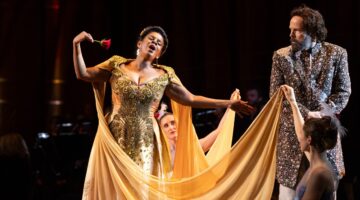
Baritone Thomas Hampson and soprano Renée Fleming brought star power to the production as Richard and Pat Nixon, respectively, reprising roles they recently performed at the Opéra de Paris and the Boston Symphony Orchestra. In fact, all the singers in the principal roles except Henry Kissinger were Nixon in China veterans. This widespread familiarity with the opera surely helped the cast sing with crisp diction, allowing the poetry of Goodman’s libretto to shine through (kudos also to diction coach Ken Weiss). I found her rhyming couplets to be a highlight of Nixon in China, lending the text a classic rhythmic cadence too often absent from contemporary opera libretti. With WNO Music Director Robert Spano at the podium, the WNO Orchestra powerfully evoked the thrilling urgency of Adams’s score with its rich repetitions and unresolved themes.
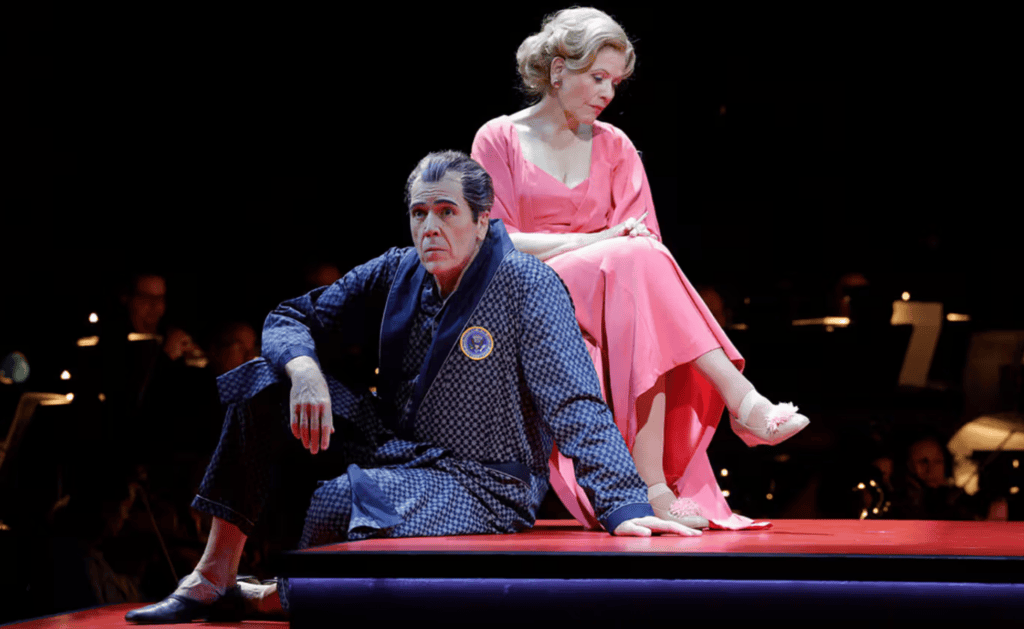
Photo: Cory Weaver
Despite some hollowness in the voice and sluggish rhythm at times, Hampson was a strong fit for the role of Richard Nixon. He brought the bombast for the character’s “News” aria but particularly shone in its second part, “The rats begin to chew the sheets,” in which his throaty intonation launched an adept portrayal of the notoriously paranoid and thin-skinned president. Hampson was a persuasively ebullient Nixon in the banquet scene; his toast revealed a thinning top but still-robust bottom to the voice. Fleming’s warm, clarion soprano made her a compelling Pat Nixon, the stalwart political spouse. Though at times her instrument may not have been quite as smooth as previously in her career, the top remains strong.
Soprano Kathleen Kim’s impressive coloratura as Chiang Ch’ing (the libretto uses Wade–Gilles romanization) proves that she owns this role, which she has previously sung at the Met and in Paris. Kim was chilling as the power-hungry impresario and engineer of the Cultural Revolution, hitting the high notes of “I am the wife of Mao Tse-Tung” with seemingly effortless poise. As Mao Tse-Tung, tenor John Matthew Myers was unflagging in navigating the role’s often punishingly high tessitura. He sang the part with a big, hard-edged voice that effectively portrayed the authoritarian leader’s stature and cult of personality. Joo Won Kang stood out as Chou En-Lai for his fine baritone, smooth like broken-in leather, and his solemn performance in the character’s final reflective aria. Bass Robert Pomakov brought gravitas to the role of Henry Kissinger. Mezzo-sopranos and Cafritz Young Artists Veronica Siebert and Anna Maria Vacca and contralto Cecelia McKinley played well-synchronized sycophants as the three secretaries to Mao.
The WNO Chorus’s precision under the leadership of Steven Gathman effectively embodied the People’s Liberation Army in the choral number that opens the opera, though a decision to stash the choristers in rows behind the orchestra rather than place them on stage left them divorced from the opera’s action. As a result, the tarmac appeared rather empty for the pivotal scene of Air Force One’s arrival in Beijing. The chorus sounded particularly strong in Act II’s Red Detachment of Women scene, in which Adams exposes the farce of authoritarian propaganda. WNO Corps Dancers and soloists Kayla Mei-Wan Thomas and Jaryd Farcon capably executed Jessica Lang’s expressive choreography. Lang’s decision to have Thomas ascend en pointe after her character’s ideological conversion to communism was a nice touch.
Directed by Elkhanah Pulitzer, who described her vision for the opera in this publication late last week, WNO’s Nixon in China draws heavily on archival footage from Nixon’s historic 1972 visit to China, which paved the way to normalizing US-China relations. This production builds on Pulitzer, projection designer Bill Morrison, and set designer Alexander V. Nichols’s previous production of the opera with the Los Angeles Philharmonic in 2017. The projections helpfully revealed the historical reality behind the libretto, such as showing the actual elephant statues that Pat Nixon refers to. The use of projected videos onto a cube of scrims surrounding Fleming’s Pat Nixon during her tours of Beijing thoughtfully melded the world of history and the staged opera. Costumes by Elisabeth Scott effectively represented the time period. The archival footage made some poignant DC connections, such as the Nixons’ departure from the White House South Lawn, just blocks from the performance venue, and a post-intermission video of pandas, which arrived at the Smithsonian National Zoo thanks to the Nixons’ trip. The creative team’s projections were most effective in the transitions between scenes but proved somewhat distracting during certain major plot points, such as the meeting between Mao and Nixon. The projections were an inexact fit for the three-quarter thrust stage configuration in Constitution Hall. Compared to a traditional proscenium stage, this layout resulted in a jumble of stimuli competing for the audience’s attention from separate angles—the singers on the stage, jumbotron-style screens directly above the stage, another screen at the back of the stage, and the supertitles—making it easy to miss some elements of the production.
Andrew Lokay
Andrew Lokay began his career as an opera fan at the San Francisco Opera, where the first performance he saw was Madama Butterfly. He graduated Phi Beta Kappa from Stanford University with a Bachelor of Arts in international relations and French with honors in international security studies. He now lives in Washington, DC and is a frequent audience member for opera and theatre in the nation’s capital.
-
Topics: Review
-
Works: Nixon in China
-
Places & Organizations: Washington National Opera
Comments