
How much of what we did was good?
Director Elkhanah Pulitzer reflects on the images and the legacy of that historic 1972 visit before her production of Nixon in China opens in Washington.
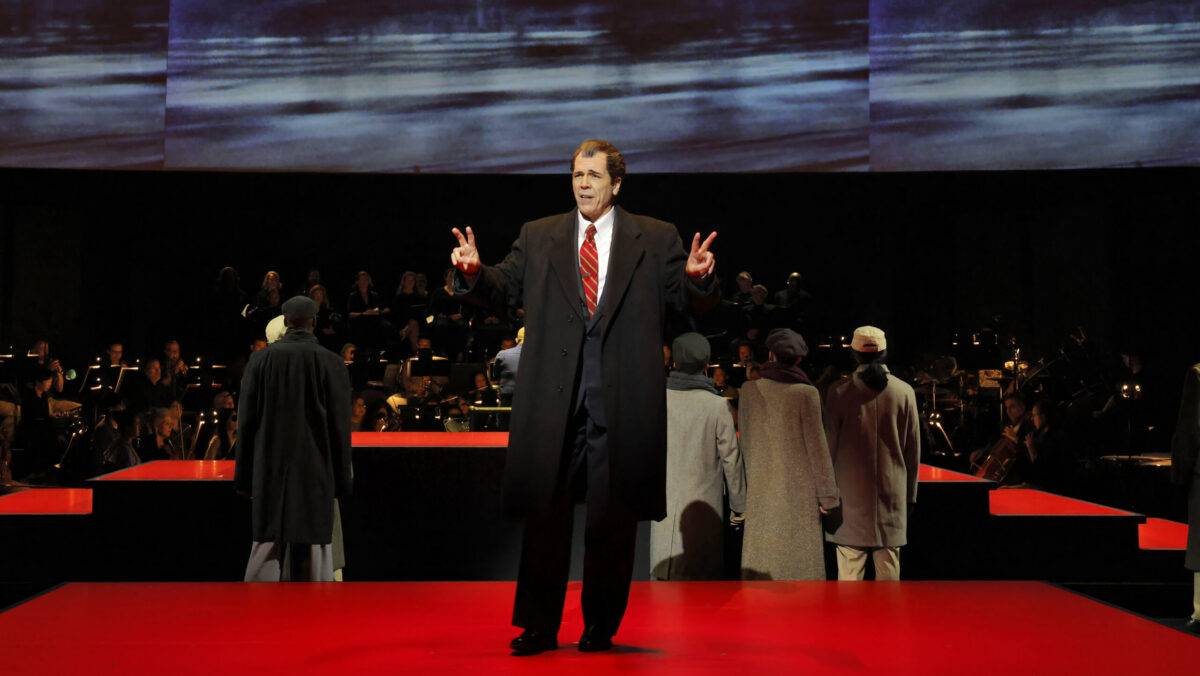
Thomas Hampson as Richard Nixon in Nixon in China at Washington National Opera / Photo: Cory Weaver
As we were doing our final rehearsal room run for Nixon in China at Washington National Opera, we were also all waiting on the midterm election results. However, I mostly was focused on reconnecting with that iconic time in history that the opera portrays, one of the successful gambits of Richard Nixon’s administration. I was also looking even further back at HUAC and the reactionary political movements within the US government that galvanized Nixon as an adamant anti-communist.
The entire US population saw these events unfold on the television. This was the portal through which the US watched China and the negotiations between these iconic leaders, Nixon and Mao Zedong. Earlier in Nixon’s career, you may recall that he went on TV and lost his debate to Kennedy in 1960; while those who had been listening to the radio thought Nixon was the clear winner, those who watched the television saw that Kennedy was more charismatic. That was the big change from radio to television.
By the time Nixon went to China in 1971, he understood the power and propaganda of the news media and television coverage. And he took advantage of it. All major networks were on the ground in China covering the events, and cabinet members were given Super 8 cameras to shoot their own films of the visit. The meeting with Mao was behind closed doors so we don’t have any content on film for that, only photographs. But we have a great deal of amazing content from the visit thanks to Bill Morrison and Alexander V. Nichols, our film and projection designers. Bill had digitally transferred all of the Super 8 content from the archives at the Nixon Library when we first did this project for John Adams’s 70th birthday with the LA Philharmonic in 2017. From there, we started in on putting together this extraordinary footage that brings such richness, veracity, and insight to the trip.
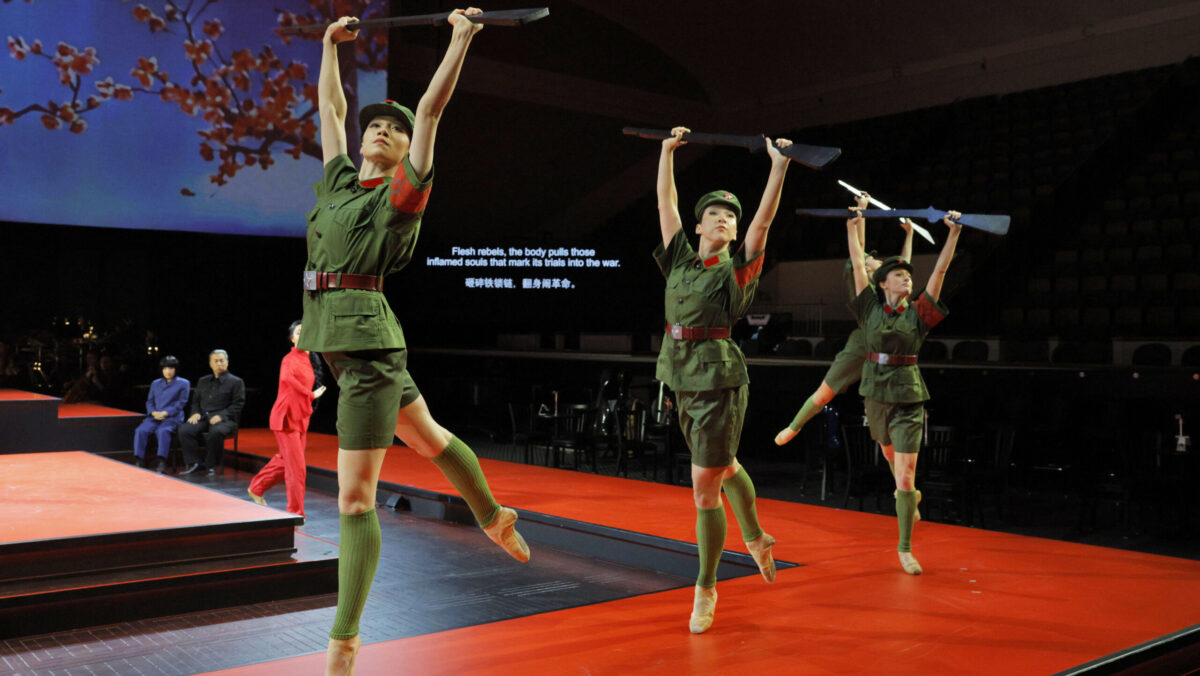
Nixon in China at Washington National Opera / Photo: Cory Weaver
One thing that has struck me in watching the archival footage again after nine years is that it is credible: truly taken at face value, completely un-doctored. There is truth in it. It recalls a time in our history when photographs and film were admissible in a court of law for their veracity, and the archival footage of Nixon’s visit to China is valuable because it documents the endlessly fascinating crafting of a public political persona.
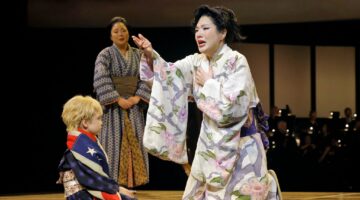
In the footage we see Nixon’s panache, Chou’s approach, and Mao, whose face was emblazoned on buildings all over Peking when the Nixons arrived despite his sickness. We see Madame Mao, who had created “Eight Great Operas,” a huge propaganda machine that included, famously, The Red Detachment of Women, which told the story of a downtrodden, starved, and abused woman who joins the Red Army to overthrow the landlords and bring communism to the people. (There’s a whole ballet in the show, one that unravels as the characters intervene in the performance, a brilliant stroke by Alice Goodman and John Adams.) These propaganda engines are still running, both here and in China, in different ways.
But when it comes to being able to trust in the images we see on our phones and televisions, we are way beyond where we left off with Nixon and the Maos.
We are into a world where anything can be deep-faked and you can play games online at The New York Times to guess whether or not the image you are looking at is real or AI-generated. What does that mean for democracy? How do we stay informed and un-siloed in our newsmaking and information gathering in order to do our part, which is to stay educated and informed as citizens? Every day the news talks about the AI race and the competition with China for battery resources. The US relationship with Taiwan continues to be a charged conversation, and the list goes on. The big difference between 1972 and now is that even if an image was used for propaganda purposes, it was generally not doctored. Or if it was, it was pretty easy to spot. We are now in a hall of mirrors when it comes to what we see and what is true. Being with footage that reads as real and archival is really powerful.
All countries and peoples and artists exist in the context of the political and creative narratives that came before them. Nixon in China does so with humor, wit, amazing text and music. It depicts a heroic moment for a problematic president alongside stunning, standout feminist moments in which Pat connects genuinely with the people of China and contemplates the impact of humanist agenda on the regular folks back home. Madame Mao also has a star turn and a famous aria so there’s lots to enjoy in her part. We never tire of seeing the man behind the mask, the person behind the crown. This story gives us both, teaching us how to move with power and reminding us that all great leaders are also just humans who will ultimately decline and die.
The piece ends with a sense of hope tinged by the reflections, memories, and musings of world leaders inventing and reconfiguring global order around the choices they executed in the name of country. Their decisions continue to impact millions of people’s lives every day, from starvation to medicine, from education to the price of tea or milk. It’s a reminder that great change is possible in this country as well as a reflection of where we have been. As the old sayings go, “history is written by the victors” and “those who don’t know history are doomed to repeat it.”
That final moment of the opera gives us a deep humanity in which we see these global leaders and political icons become real human beings concerned with how they will be remembered and what impact they had as they face their own mortality. As Horace said, “Pale Death beats equally at the poor man’s cottage and the palaces of kings.” Small acts of kindness, great acts of compassion, all matter and all provide meaning for our lives.
Chou at the end of the piece asks, “How much of what we did was good?” I want our production of Nixon in China to take the audience from the global political arena with iconic figures to the existential musings of vulnerable human beings.

Elkhanah Pulitzer
Elkhanah Pulitzer is an acclaimed American stage director whose visually arresting productions bring intellectual rigor, emotional immediacy, and a distinctly contemporary theatrical imagination to opera and live performance. She creates from the inside out, allowing the essential DNA of each work to determine the visual and dramatic language that brings it to life. She is particularly drawn to the ways class, status, and power shape identity and human behavior, often foregrounding dynamic women. Her practice encompasses newly composed operas, canonical repertoire, Baroque oratorios, collaborations with orchestras, bespoke theatrical creations for concert artists, artistic consultancy, and curatorial leadership. Her productions have been featured at the Metropolitan Opera, San Francisco Opera, Barcelona’s Gran Teatre del Liceu, West Edge Opera, The Prototype Festival, and Washington National Opera.
Pulitzer graduated Phi Beta Kappa from UC Berkeley with a degree in Theatre Arts and holds an MFA in Directing from Columbia University, where she studied with groundbreaking American director Anne Bogart. Emerging from a family tradition of art curation stretching back to the 1880s, Pulitzer also serves as vice president of the board of the Pulitzer Arts Foundation, an institution dedicated to experimentation in art curation, installation, and live programming.
-
Topics: america, nixon in china, opinion
-
People: Elkhanah Pulitzer
-
Works: Nixon in China
Comments