Aria Force One
Ahead of the world premiere of Lincoln in the Bardo next week, Carmen Paddock looks at how presidents in opera can be both symbols of an idealized past and trenchant commentaries on the present.
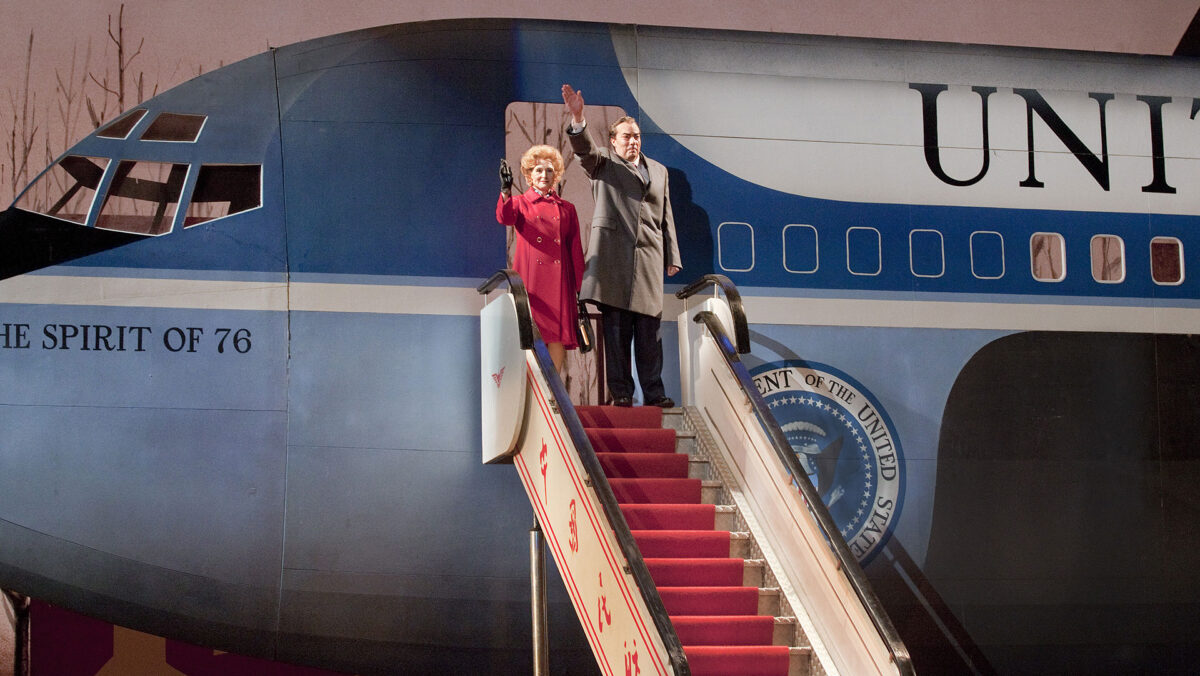
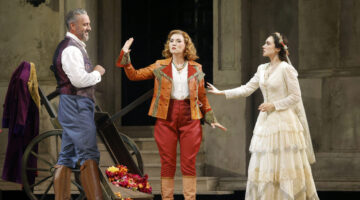
James Maddalena and Janis Kelly in a scene from John Adams’s Nixon in China at the Metropolitan Opera in 2011 / Ken Howard/Metropolitan Opera
In another high-profile literary adaptation, next week the Metropolitan Opera mounts the world premiere of Missy Mazzoli and Royce Vavrek’s Lincoln in the Bardo, based on George Saunders’s lauded novel. But it’s time to look at another way of luring audiences through familiar faces: staging U.S. presidents.
There are few things weirder than a singing president. Dramatizing current or recent leaders is a relatively new and uncanny phenomenon – especially ones we’re told are just like us. But all 45 presidents (combining Grover Cleveland and Donald Trump’s nonconsecutive terms) are anything but. The last not to graduate college was Harry S. Truman. All are men, all but one white. Their power is allegedly balanced but often enhanced by other branches of government. They stand for a country built on liberty and equality yet also on genocide and enslavement. As Manifest Destiny completed itself and there were no more lands to conquer, settling turned into meddling — Herbert Hoover was the last to not drop a bomb on foreign soil. At the end of the day, they alone have access to the nuclear codes.
A president on stage is first a symbol of their time refracted through ours, and a character second. It is a political act even if designed to be palatable across ideologies – the choice to portray a president as human first, state actor second is itself meaningful. For Broad Sound, Sarah Jane Lieber argues how staged presidents, notably in musical theater, create a national mythology in a country where little state-funded theater exists. Despite the remarkable works of U.S. composers, opera does not have the same all-American status as the musical; what it has, however, is a history of portraying the kings and emperors of yore, sometimes as symbols of an idealized past, often as subversive commentaries on the composer’s society. With this legacy, its status outside the American cultural mainstream may give opera the chance to be bold in ways that musical and other theater cannot be (especially in a world where Hillary Clinton produces Suffs).
Abraham Lincoln, soon to grace the Met’s stage through the lens of history and novelistic liberties, is perhaps the most deified in drama: self-educated, signatory of the Emancipation Proclamation, stalked by tragedy and ultimately assassinated – the mythology writes itself. Philip Glass has featured Lincoln in the “Rome” section of the CIVIL warS: a tree is best measured when it is down (1984) and Appomattox (2007, revised 2015, also featuring pre-presidential Ulysses S Grant).
Appomattox’s original version focused on the Civil War’s end with a nod to its unsettled, unfinished legacy. In the revised, more overtly political version, the action includes the 1964 Civil Rights Movement. The baritone singing Lincoln doubles Lyndon B. Johnson (more on him later). The juxtaposition shows men acting as the face of their nation in times of necessary reckoning, aware of history’s weight. If Lincoln, Grant, and Johnson become symbols in the process, those symbols represent hope that the struggle will not have been in vain.
John Adams’s Nixon in China turns the president into an everyman. Premiered in 1987, its figures are conflicted idealists, at odds through the forces of history (“our mother,” Nixon sings) rather than personal beliefs and foibles. It removes much in the way of particulars, leveling the playing field between controversial worldviews but open to a dozen reworkings as a result. Yet this quasi-apolitical, sympathetic Nixon reads on stage because the 37th president has become a sin-eater for the country’s highest office as the only president to resign, his reputation in tatters following the Watergate scandal. He still has defenders – some alarmingly enthusiastic – but the opera knows it has an uphill battle with many. As a result, his contradictions and paranoid idealism ring as perennial truths rather than concrete statements on Nixon’s time or our own
Adams told The Guardian that he would not write a Trump opera because he finds no empathy there. The current president, however, has appeared at least thrice in two years: Olga Neuwirth’s 2026 Monster’s Paradise, the 2025 Cantonese opera Trump: The Twins President, and Anthony Davis’s Pancho Rabbit and the Coyote. The last one, a 2026 children’s opera, sees an orange snapping turtle build a wall to keep Pancho Rabbit from traveling north to find his father. “It was really fun,” Davis says of writing the satirical take and seeing the enthusiastic response when Pancho Rabbit was performed in Tijuana. “Sometimes I think comedy masks how evil the guy is, but in a children’s opera, it was better to do the Saturday Night Live version.”
Davis previously staged Trump in 2019’s Central Park Five. The original libretto did not include Trump, but, Davis says, “this was the beginning of his political career. He exploited these boys and the racial divide. That was important to represent.” His Trump has three building blocks: “first, he’s a tenor; second, he repeats himself; and third, he never completes a sentence.” Then, musically, the “violence of words” can come out.
“I became very aware of the savage directness of his words,” Davis says. “With Trump, you don’t get metaphors.” The result captures “the way he preys on people’s sympathies but doesn’t care about anything.” Davis keenly notes the case’s mass hysteria, when white people held placards referencing Spike Lee’s Do The Right Thing (released in 1989) as a call to bring back the death penalty and the media reported “wilding” in the park, mis-hearing Tone Loc’s “Wild Thing” to whip up a moral panic. Central Park was a “battleground,” Davis says, where urban development, youth culture, and gentrification met and exploded. “The links between culture and politics and the anxiety towards hip-hop becoming mainstream is part of the whole thing,” Davis says. Decades after the case, Trump’s tactics of distraction have not changed.
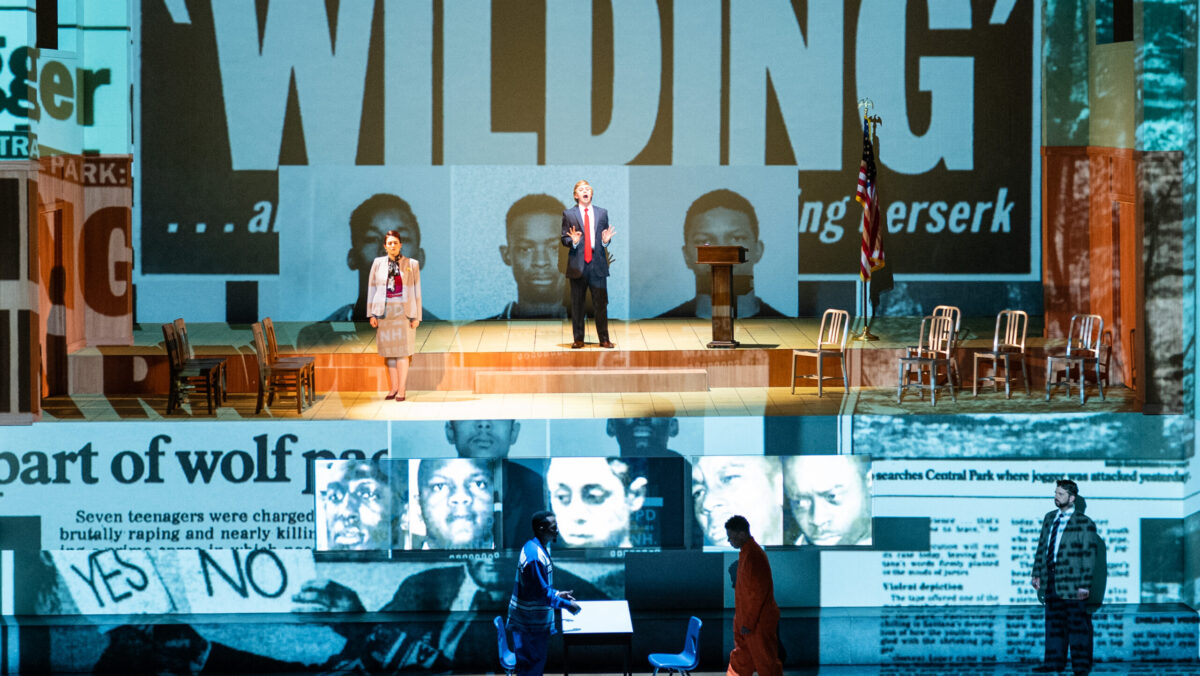
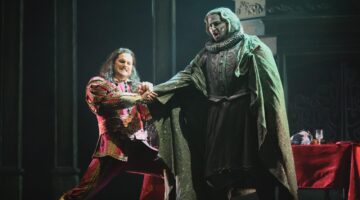
A scene from Anthony Davis’s The Central Park Five at the Detroit Opera in 2025 / Photo: Austin T. Richey/Detroit Opera
Davis is no stranger to staging presidents; his 2009 work Amistad, about the 1839 revolt on an illegal slave ship where kidnapped Africans commandeered the boat and then faced murder charges when seized in US waters, features two presidents: John Quincy Adams and Martin Van Buren. Adams, post-presidency in the House of Representatives, defended the Africans in court; Van Buren, the sitting president, quietly tried to negotiate with Spain and Southern senators like John C. Calhoun to ship the Africans to Cuba and slavery.
“I was thinking about where America was – on the precipice of a civil war that did not, of course, resolve those issues,” Davis says. “In the opera, Adams reflects on the Missouri Compromise, dividing the country into states that are free and states that have slaves; in a way, America was compromised from the beginning. Adams knows it’s not going to resolve itself.” The former president is heroic, but not as in the 1997 film. It was important for Davis to center the kidnapped Africans’ point of view. “I didn’t want to do an opera that was ‘a few good white men.’ That’s Spielberg’s thing,” he says.
Adams’ Act I aria draws on Davis’s dream of the Statue of Liberty as a Balinese dancer, looking back and forth as ropes pull her arms in different directions. Gamelan and Americana elements fill the score. “ “The idea was to use this dissonance between the B-flat and F-sharp as a way of summing up conflicts, inner struggles, and American ethical problems that are not at all resolved.” Davis considers opera ideal for exploring such tensions because it “intrinsically has abstraction,” allowing us to examine the world and find metaphorical truths within.
Van Buren, on the other hand, appears “in conspiratorial mode,” Davis says. To evoke the smoking rooms were where men of the early 19th century retired to talk privately about (sometimes unsavory) dealings, Davis used serial music for the first (and only) time to date. “The scene is about what happens in the background, the intrigue of trying to make problems go away rather than resolve them, and having a president involved in these machinations,” Davis says. “He’s interested in re-election – in not losing to William Henry Harrison” (which he did).
Amistad is not John Quincy Adams’s only operatic outing. Virgil Thomas’ The Mother of Us All (1947) is dreamlike historical soup where three presidents appear: Andrew Johnson, Grant (also of Appomattox), and one identified as John Adams but likely Quincy. These “great” men become abstract symbols of bluster, idealism, and frustrated petty masculinity in the hands of Thomas and his librettist Gertrude Stein.
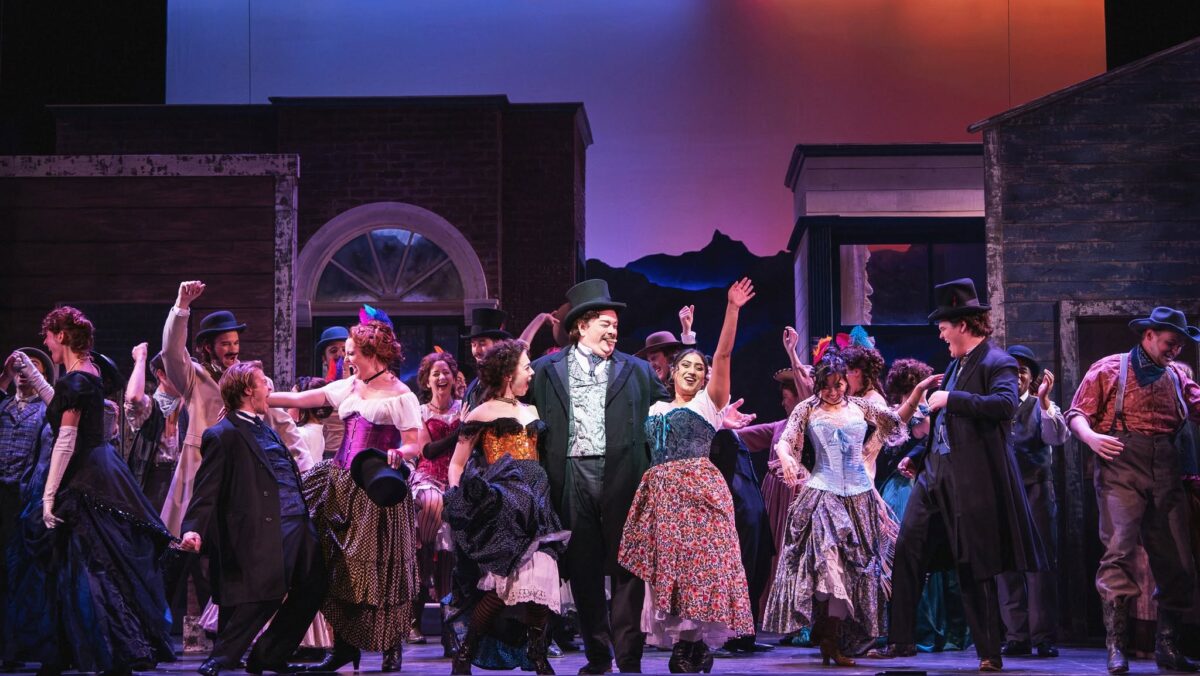
A photo from The Ballad of Baby Doe at Central city Opera, July 2026 / Photo: Amanda Tipton Photography
If The Mother of Us All plays fast and loose, Douglas Moore’s The Ballad of Baby Doe (1956) is specific. Chester A. Arthur appears at the end of Act I to toast Horace Tabor and Elizabeth “Baby” Doe on their 1883 wedding day, smoothing over the scandal of their divorces. His appearance echoes Tchaikovsky’s Catherine the Great in The Queen of Spades: pinning the action in a time and place, blessing the proceedings, and inspiring joy. In the second Act of Baby Doe, Tabor loses his fortune supporting William Jennings Bryan’s presidential hopes: Bryan lost to William McKinley in 1896 and 1900 and William Howard Taft in 1908. (Bryan appears onstage; McKinley and Taft do not.) With the success of HBO’s The Gilded Age, this ultimate Americana romance feels due another outing.
The Queen of Spades is also cited by Michael Daugherty, composer of Jackie O (1997). This opera is more interested in the former First Lady’s tumultuous romance with Aristotle Onassis than it is with her as the wife of John F. Kennedy. The 35th president appears as a ghost, asking Jackie’s forgiveness for his infidelities and giving her a fresh start. “It was more interesting to present JFK as a ghost when Jackie reconciles with him on Lesbos,” Daugherty says. “There is a tradition of dead (often murdered) characters appearing as ghosts in classic operas as Don Giovanni, Macbeth, The Turn of the Screw, and The Queen of Spades.” He wouldn’t change anything about this cameo today: “JFK is treated with reverence but also as a man who has regrets.”
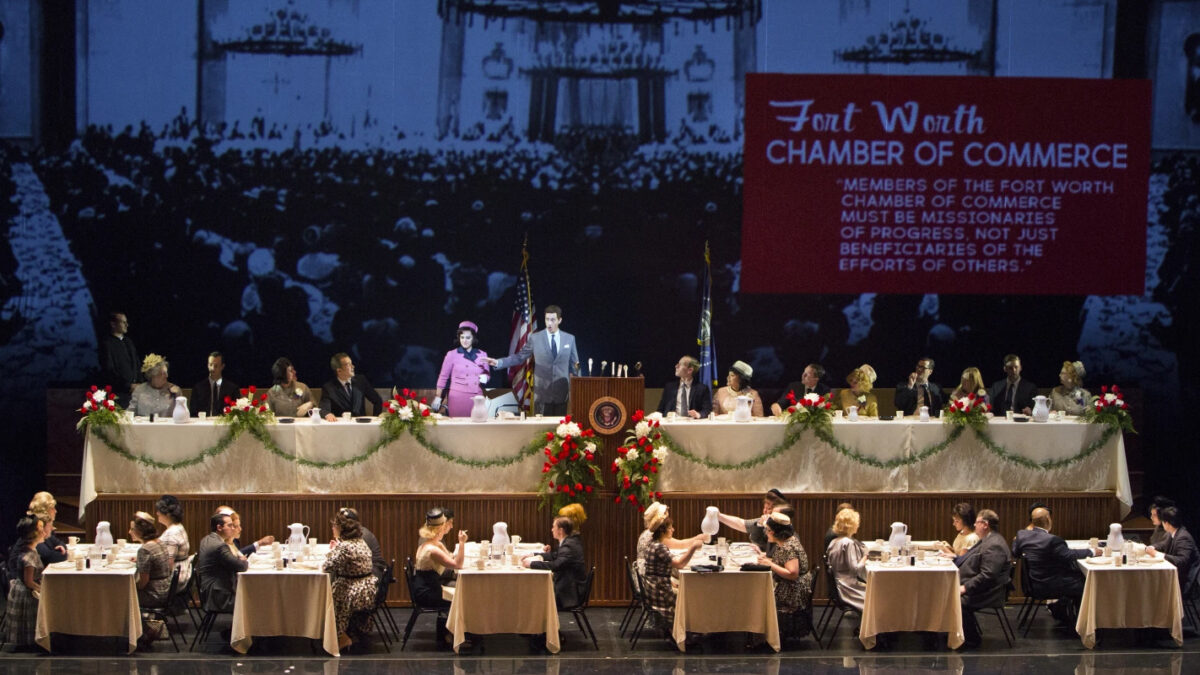
A scene from the opera JFK by composer David T. Little and librettist Royce Vavrek from May 2017 / Photo: Marty Sohl/Fort Worth Opera
Kennedy got his own opera in 2016 with David T. Little’s JFK, which will appear in Boston in March 2027. The opera follows the president’s stay at Fort Worth’s Hotel Texas before his assassination. The first Act unfolds just before midnight on 21 November 1963; the second, which opens with an extended LBJ sequence, carries through dawn; and the third spans the morning of 22 November until noon, ahead of their departure to Dallas. Little and librettist Royce Vavrek (of Lincoln in the Bardo) decided not to create “a straight-ahead biopic” during their research process. “When we dug into JFK’s life and the days before the assassination, something otherworldly, poetic, and mythic began to emerge,” he says. “We started to see elements of grand opera — the inevitability of fate, the possibility and wonder of love, humanity’s constant wrestling with mortality and loss. Much of the opera takes place between worlds, in dream states where time is loose and memories are vivid and strange, and in the waking world where, as the final lyric says, ‘time forces forward.’ I was immediately drawn to the idea of exploring them through the rich lore of Kennedy’s last days.”
While this approach stirred some controversy, the result is mesmeric, putting the human ahead of the political. “JFK ruffled some feathers,” Little says. “We portray a beloved president as imperfect: we wanted to take Kennedy down off of his pedestal; show his insecurities; and show the physical and emotional pain he lived with on a daily basis, which has still been rarely discussed.” (His back brace is obvious in the premiere production’s trailer.) LBJ and Khrushchev are almost cartoonish, but the dichotomy of realism and exaggeration heightens a pathos. “I think this sense of humanity — and the losses he experiences: his sister, his father, his brother all leave him in some way — makes both his life and death resonate so strongly,” Little says. “Like a mirror, his losses portend our own. Strip away the presidential pomp and circumstance, and he becomes just another person. I think the piece works in part because we made him so much like us.”
Some reviews critiqued JFK’s portrayal of his successor. LBJ is a loud-mouthed cowboy type, happy to show off “Jumbo.” (Appomattox’s treatment of LBJ received similar notices.) Bachtrack lamented, “Was he so vulgar? Cheap laughs at any rate.” Cheap, but not without truth. Johnson and his direct predecessor and successor – Kennedy and Nixon – bugged their offices and tapped their phones, capturing everything from “Jumbo” to meetings conducted from the toilet. Add in a few other juicy facts, and are Glass’s and Little’s portrayals so outlandish?
Johnson’s licentious predecessor and corrupt successor add new considerations to the popular image opera has capitalized on. His sins are more crudely amusing – the comic interlude between two noble tragedies. There may also be an element of subconscious politicized classism in popular receptions of Johnson: physically large, vocally imposing, unrepentantly Texan against Kennedy and Nixon’s coastal backgrounds. But affectionately clownish treatments are far more relatable than a canonization, and Johnson seems squarely established as opera’s buffo president.
The audience laughs when a sombrero’d Johnson bursts onstage in Evan Hause’s 2002 Nightingale: The Last Days of James Forrestal. The second in Hause’s Defenestration Trilogy, where conspiracies lead someone towards a death by open window, his presidential musical characterizations are “dictated by dramatic needs.” LBJ provides levity in a “‘cocktail hour’ interlude”: “LBJ is only present for a minute, and the libretto was clear on satirizing the fact that he had spent World War II in Malibu, that Forrestal plays a part in that, and that Forrestal wasn’t really friendly with him,” he says.
Harry Truman plays a key role in Nightingale, visiting Forrestal, his former Secretary of the Navy, in a scene that shifts between concern and something more sinister: a recorder is turned off, allegations of espionage are made, both insist the other is the dupe of big banks and class traitors. The music evokes “a twisted Shostakovich waltz,” fitting discussions of the Eastern Bloc. “I set Truman as a high tenor against Forrest’s baritone, because the contrast between two males was going to be needed when it explodes into a dense argument,” Hause says; “neumatic inflection” and vocal floridity further sets the President above the plainspoken former cabinet member. Should Hause ever write a Truman opera without Forrestal, the “musical portrait” would be different. “I would likely set him as more plain-spoken and square. But this is how the overall musical conception drives the detail.”
Relationships to historical heroes – presidents included – change over time. Native Arkansan Bonnie Montgomery evokes Bill Clinton’s youth in her 2016 opera Billy Blythe, set in 1959 Hot Springs and based on memoirs by the former President and his mother. “Since childhood, I have seen Bill Clinton as a mythological character who came from a rural, Southern, beautiful, and unlikely place which also happens to be my home,” she says. “Clinton had a tumultuous childhood, full of the dramas that comprise operatic material, and we wanted to capture the mysticism and character of Arkansas. The piece turned out to be a snapshot of a day-in-the-life of a 14-year-old Clinton. Britt [Barber, librettist] and I loved painting a portrait of life during that time, focusing only on his childhood, with none of the politics. We loved writing a story of hope and the ability to dream big, even in the most unlikely circumstances.”
Montgomery is not sure her “starry-eyed portrait” has aged perfectly. “I’m not as enamored with Clinton as I was 15 years ago because of my advocacy for women,” she says, “That said, I am still very proud of the piece and it holds integrity as a portrait of a young man from a unique and fascinating time and place. The overall theme is still about the ability to dream and have resilience in the face of suffering.”
Montgomery has even thought about renaming the work Virginia, after Clinton’s mother: “She plays as big a role in the opera as Bill does,” she explains. “By changing the title, the focus could change from the portrait of a man from Arkansas to a woman from Arkansas, and to me, that’s more interesting.”
Each operatic refraction tells a new story about presidents, about us, and about the world they gave us to make what we can of. If we are lucky, the next 250 years will provide many more reckonings with the legacies of the United States’s complicated, compromised leaders. Perhaps through them, we can cherish the country’s ideals without forgetting the unsung wrongs along the way.

Carmen Paddock
Carmen Paddock has been opera-obsessed since the age of twelve; hailing from a rock and country music family, the name is a coincidence. An American in Scotland, she writes about film, opera, and adaptations.