
Correcting the record
The Head & the Load, William Kentridge‘s multimedia World War I epic, receives a stirring West Coast premiere.
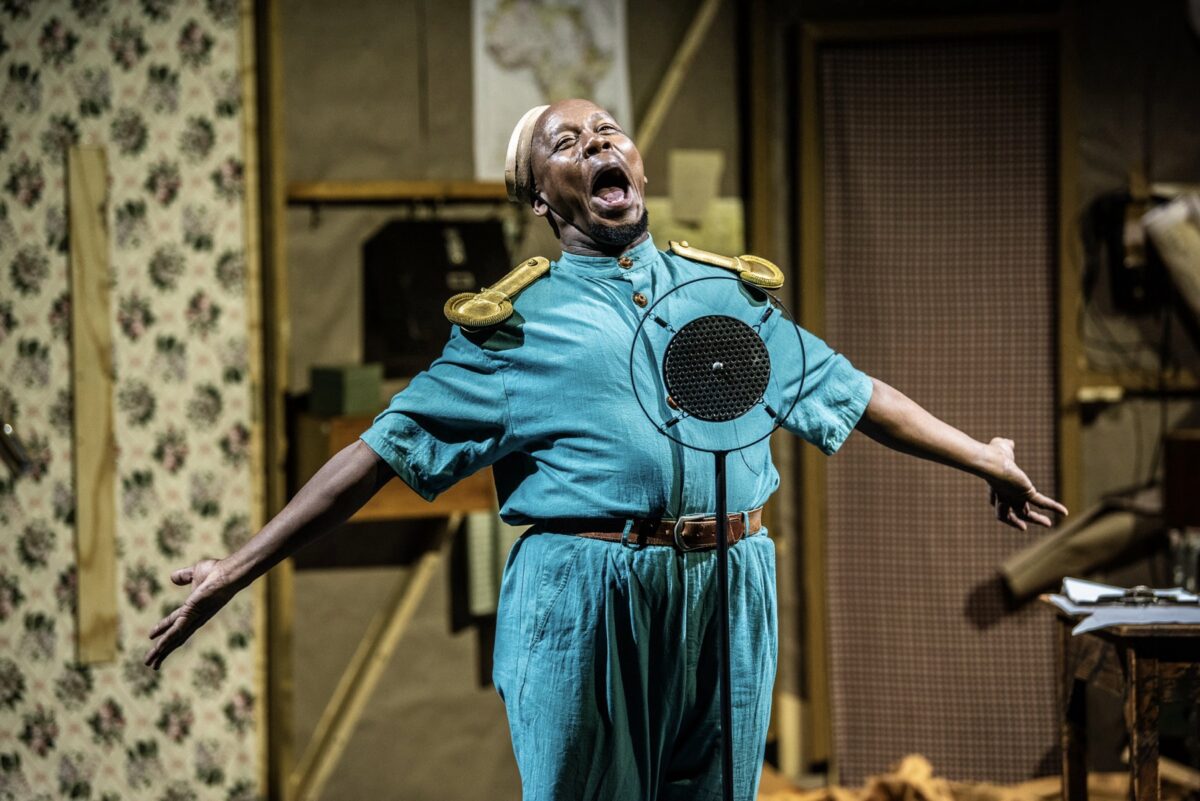
Photo: Stella Olivier
In peacetime, everything belongs to Europeans. But in war, Africans were suddenly invited to shed our blood in equality.
That protest against the recruitment of Africans in World War I, written by the African Baptist minister John Chilembwe in Nyasaland (now Malawi), became the blueprint for William Kentridge’s monumental interdisciplinary work The Head & the Load, which received its West Coast premiere in a spectacular fashion earlier this month at the Henry J. Kaiser Center for the Arts arena in Oakland as part of Cal Performances’ this year’s Illuminations theme: “Innocence & Experience.” Kentridge’s seminal work also launched a new five-year initiative that will feature a multidisciplinary Kentridge work each season, following the successes of 2023’s Sybil and Cal Performances’ 2025 co-commission The Great Yes, The Great No.
The Head & the Load received its 2018 world premiere at London’s Tate Modern’s Turbine Hall, followed by its US premiere at New York City’s Park Avenue Armory the same year. The piece’s colossal physical demands have limited its travel to Duisburg, Amsterdam, Miami, and Johannesburg over the past eight years. The title comes from a Ghanaian proverb: “The head and the load are the troubles of the neck,” linking “thought to weight, memory to labor, and historical knowledge to the bodies asked to carry it.” More than two million Africans labored, fought, and died in World War I, and over 1.5 million served as porters and carriers for the British, French, and German forces. As Kentridge said, “The colonial logic towards the Black participants could be summed up: ‘Lest their actions merit recognition, their deeds must not be recorded.’ The Head & the Load aims to recognize and record.”
To say that The Head & the Load was a big production truly understated its grand scale. Sabine Theunissen’s set was 180 feet long, full of wonders (most notably, boxes that opened to reveal a band or group of dancers) that excited and confused the audience all at once. No matter where the audience sat, they were bound to see some parts of the stage and not the rest, an intentional move to signify that during the war, no one would ever get the whole story. Coupled with Kentridge’s brand of artistic collage through dance, projection, speech, song, shadow play, costuming, and music, the whole show was designed to overwhelm all senses, to create some kind of “organized chaos,” mirroring the chaotic and senseless nature of war.
For Kentridge, “[c]ollage is not a decorative layer pasted over a historical subject but a way of thinking historically, assembling fragments, weighing them differently, allowing contradiction to remain visible.” The libretto for The Head & the Load offered the clearest indication of how the collage spirit shaped the development process. Cast in three delineated acts (namely “Manifestos”, “Paradox”, and simply “War”), the libretto was nevertheless constructed from various sources that were then cut up, interpolated, translated, and even expanded. The Berlin Conference (which divided up Africa), for example, was rendered as sections of Kurt Schwitters’ Dadaist poem Ursonate. Even Aimé Césaire, whose character appeared in 2025’s The Great Yes, The Great No, had some lines here. “Can one think about history as collage, rather than as narrative?” asked Kentridge.
Similarly, Philip Miller and Thuthuka Sibisi’s music juxtaposed African traditional songs in various languages with European classical music’s move toward atonality and serialism, as exemplified by Arnold Schoenberg, Paul Hindemith, and Maurice Ravel. Nevertheless, African rhythms and percussion gave the show its beating heart, particularly in the last act, signifying resistance to the ever-changing colonial soundscape. The coda, especially when coupled with Catherine Meyburgh’s projections of the great African leaders who led each nation to independence, gave the piece a hopeful ending while also serving as a cautionary tale that history tends to repeat itself.
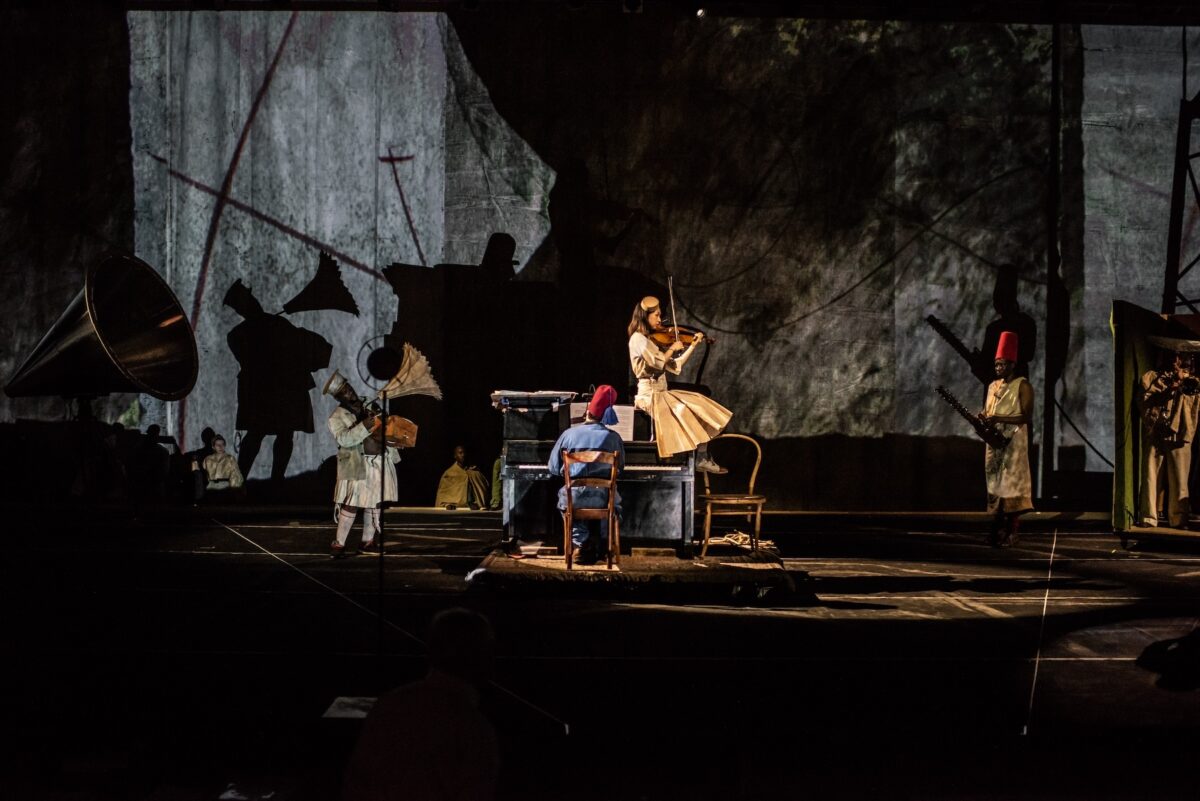
Photo: Stella Olivier
Each act was anchored by a scene that grew increasingly tragic and chaotic. “Manifestos” ended with “Procession to War,” in which the cast walked onstage from left to right, wearing headgear depicting loads, weapons, people’s faces, and even planes, for an extended period. The cast’s shadow play, coupled with Meyburgh, Janus Fouché, and Žana Marović’s composite videos and projections, created a suffocating feeling among the audience, as if we were witnessing the actual march to death. “Paradox” showcased “God Save the King,” in which Ann Masina sang the British anthem beautifully at first, before the rest of the vocal crew joined in with distorted fragments that eventually derailed the song into silence. In the heartbreaking “Wounded Man” from the final act, two men tried to cross the stage while one kept falling and the other kept trying to stand him up and force him into a salute. Gregory Maqoma’s choreography proved indispensable in this act, creating a grand tableau of the perils of war.
Kentridge assembled a great cast to bring out the spectacle, and they performed with amazing intensity and energy. Luc De Wit and Joanna Dudley particularly stood out, embodying the opposing French and German forces with outlandish, over-the-top flair (Dudley even wore a German Reichsadler as her headdress), while Hamilton Dlamini assumed the role of Chilembwe with wit and grace. Each member of the cast had multiple roles, and their tight connection with one another, especially on such a huge stage, was a sight to behold and cherish.
The Head & the Load was a mind-blowing, profound experience that lingered long after the show ended. On the way out, a lady asked me what I thought of the show, and we both couldn’t find words to describe it. A long standing ovation showered everyone on stage, and they definitely deserved it. If art is meant to teach the audience how to think, I can think of no better example than The Head & the Load.
-
Topics: art, does this count as an opera?, Review
-
People: Ann Masina, Catherine Meyburgh, Gregory Maqoma, Hamilton Dlamini, Janus Fouché, Joanna Dudley, Luc de Wit, Philip Miller, Sabine Theunissen, Thuthuka Sibisi, William Kentridge, Žana Marovi?
-
Works: The Head & the Load
-
Places & Organizations: Cal Performances



Comments