
Commedia all’italiana
Juilliard Opera presents a double bill of seldom-seen buffi .
 By
Dawn Fatale
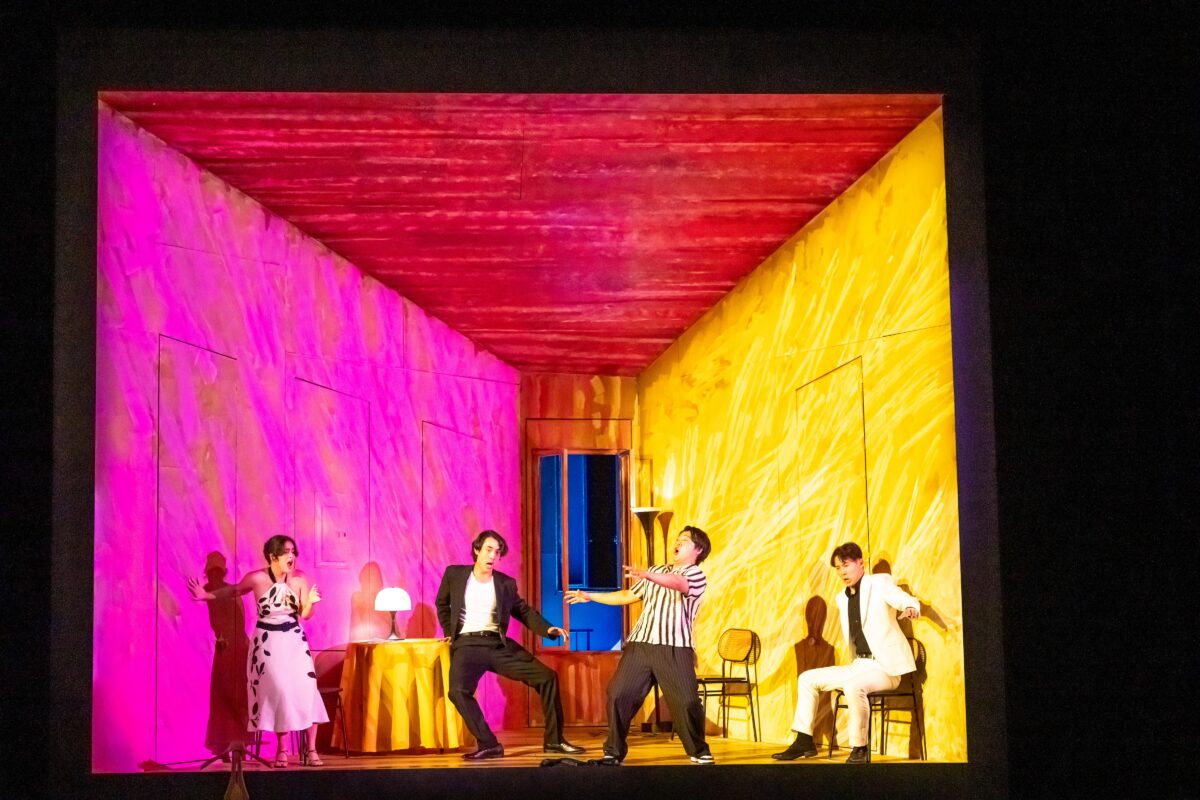
Photo: Richard Termine
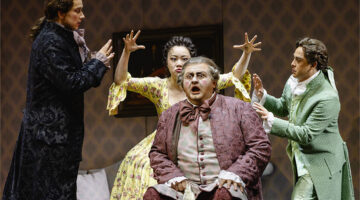
On Saturday, Juilliard Opera began a brief run of a double bill of two rarely heard Italian comedies: Gioachino Rossini’s La Scala di Seta (The Silken Ladder) and Nino Rota’s I Due Timidi (The Two Timid Ones). It made for a captivating afternoon, even with some directorial overthinking and the occasional vocal hiccup.
La Scala di Seta is Rossini’s sixth opera and the third of a series of one-act comedies that he wrote for the Teatro San Moisè in Venice. The libretto, by Giuseppe Maria Foppa, involves a standard farcical situation: Giulia is secretly married to Dorvil, who sneaks into her bedroom every night using a silken ladder. Her tutor, Dormont, wants her to marry Dorvil’s friend, Blansac. After many complications and misunderstood conversations relayed by the servant Germano, everything gets sorted out. Blansac even ends up betrothed to Giulia’s cousin, Lucilla.
The performance featured students who all sang with charm and commendable focus on diction and style. They were helped by the attentive and well-paced conducting by Patrick Furrer. There were some technical mishaps along the way, as notes missed their intended mark or some singers’ vocal tones thinned out or lost their centers. All of this is to be expected in performances by artists at this stage of their careers. Nothing soured the performance overall. The singers were: Adriana Stepien (Giulia), Nathan Romporti (Dorvil), Woosik Nam (Germano), Minghang Wang (Blansac), Samone (Lucilla), and Tong Zhang (Dormont).
Director John Matsumoto Giampietro had an itinerant peddler wander on during the overture and go through an elaborate dumb show of playing with a shiny orb (which was apparently the moon) and strapping on his rack of wares. Then, the peddler was not seen again until the Rota opera, where he turned out to be the Narrator. The director also insisted in his synopsis that “Giulia is a celebrity whose life is dominated by her manager, Dormont.” I’m not against directorial interventions updates—but his assertions in the program were not reflected in the actual staging, where the actual relationships between the characters were poorly defined and nothing about Giulia suggested that she was a star in our era. Having an unexplained prologue did not clarify matters. Ultimately, the charm of the work still came through.
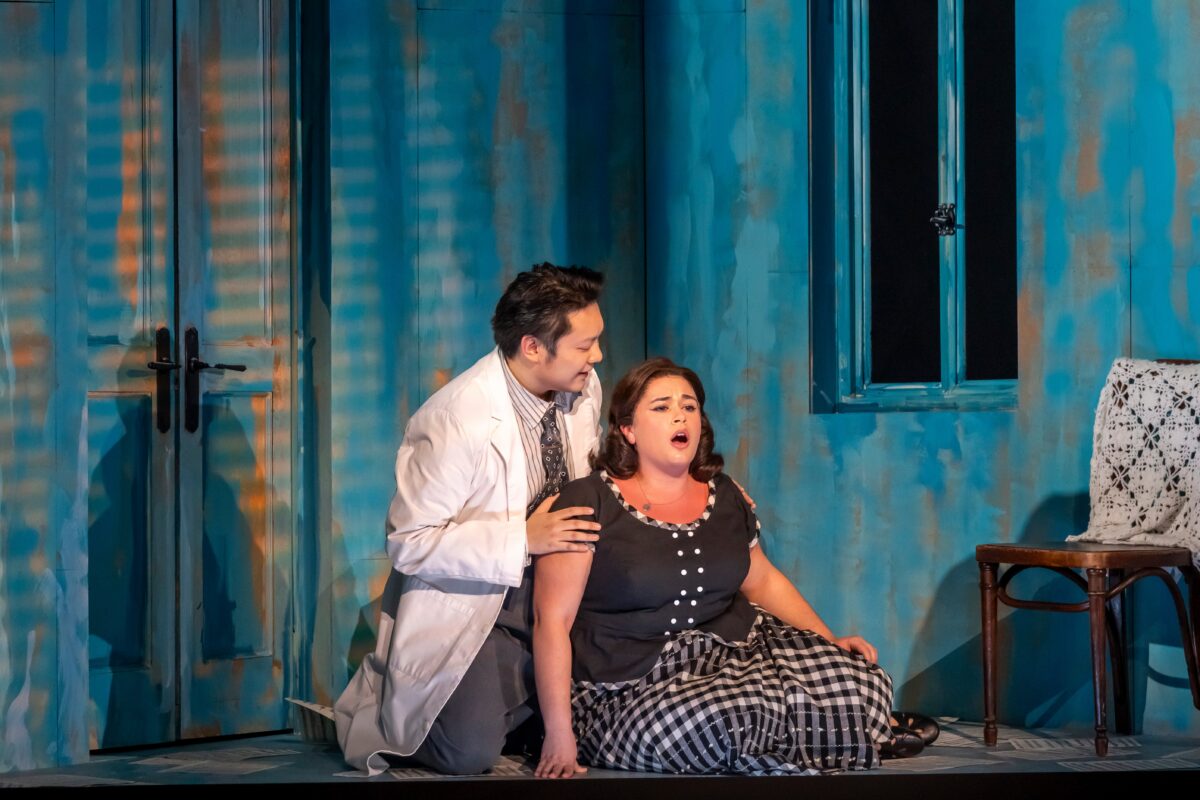
Photo: Richard Termine
Thankfully, his directorial hand was much surer in I Due Timidi. The Rota work was written for the radio and premiered in 1950. The libretto by Suso Cecchi d’Amico deals with two individuals who are too timid to act on their mutual attraction. Fate, in the form of a loose window frame, intervenes, and they each end up married, unhappily, to the wrong person. The music is colorful and characterful, with memorable, quite passionate vocal writing. I’m surprised that it gets so little attention and definitely recommend seeking it out. A recording of the radio premiere is on YouTube along with some other video performances.
Giampetro managed the locational and focus shifts deftly. He effectively maintained the tension as to whether the characters would find their happy ending. His approach brought out the kinship to other Italian films of the same time period, particularly Visconti’s Le notti bianche (White Nights), which d’Amico co-authored with Visconti.
This work makes heavier demands of its singers, but the singers here displayed considerable security and vocal confidence, even in the most strenuous passages. All the parts were well cast with three fine singers in the biggest roles: .Alison Kessler and Chester Seungyup Han as the two timid souls( Mariuccia and Raimondo), and Sophia Pelekasis as La Signora Guidotti, the hotel proprietress who ends up marrying Raimondo. Other singers included Wil (June Young) Kim as the Narrator, Tong Zhang as the Doctor, and Eloise Fox as Mariuccia’s mother. Conductor Patrick Furrer and the Julliard Orchestra handled the many shifts in color and style with ease and verve—easily matching if not surpassing the performances I’ve listened to.
Dawn Fatale
Richard Lynn is a New York City based opera lover who writes at parterre box under the name Dawn Fatale. His love of opera started at a very young age when he used to listen to the Met broadcasts and obsessively read back issues of Opera News in lieu of socializing at family gatherings. In college, he majored in Chemistry while taking as many music and theater courses as possible. He worked at the Music Library to get access to the opera recordings that were off limits to undergraduates. Since the early 1990s he has been writing about opera at parterre box and other publications and is particularly interested the evolution of staging and performance practices.
-
Topics: Review
-
People: Adriana Stepien, Alison Kessler, Chester Seungyup Han, Eloise Fox, John Matsumoto Giampietro, Minghang Wang, Nathan Romporti, Patrick Furrer, Samone, Sophia Pelekasis, Tong Zhang, Wil (June Young) Kim, Woosik Nam
-
Works: I due timidi, La scala di seta
-
Places & Organizations: Juilliard

Comments