
Eastern promises
Two Giordano jaunts to Eastern Europe, including an unearthed early work, receive starry recordings.
 By
Dawn Fatale
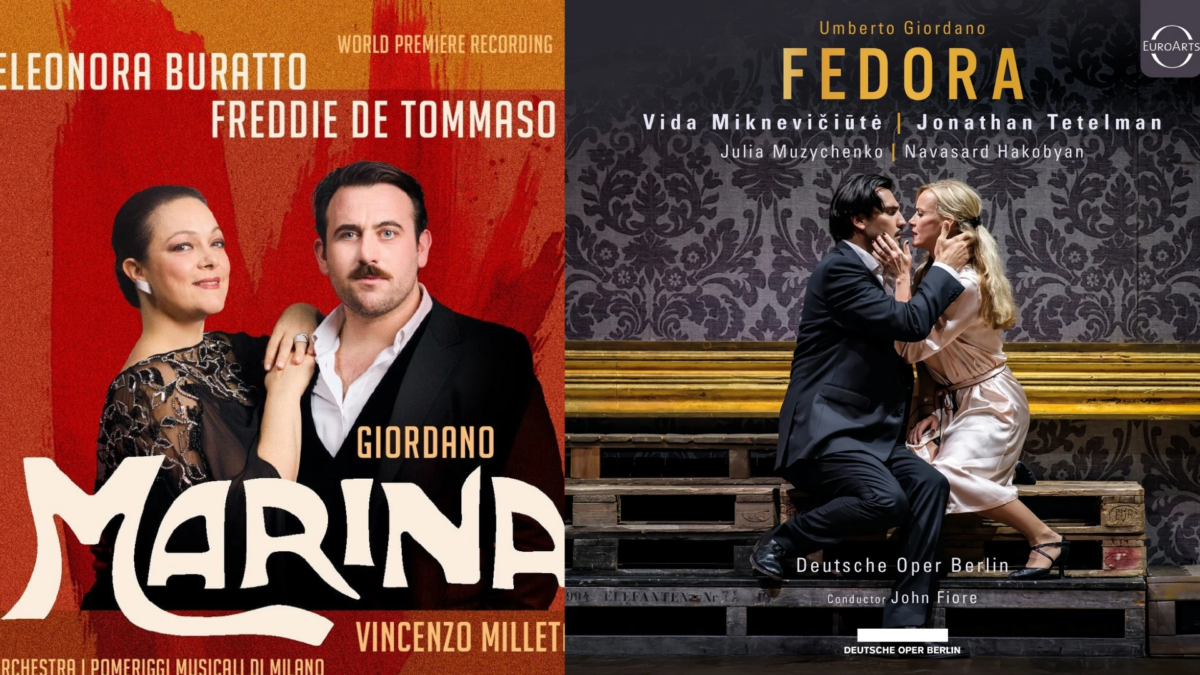
The recent recording of the opera Marina by Umberto Giordano captures the opera’s first-ever public performance. Giordano wrote this opera for the 1888 opera competition sponsored by the publisher Casa Sonzogno, the very contest that Cavalleria Rusticana won. Marina received an honorable mention. Sonzogno saw enough potential to commission a new opera. Giordano then wrote La Mala Vita, his first success. Since it reused materials from Marina, Giordano never tried to have Marina performed and the manuscript was thought lost.
Then, musicologist Andreas Gies found it in the Beinecke Library at Yale. His performing edition debuted at a concert performance in February 2026 at the Teatro dal Verme in Milan, which was recorded for this release. The first staged performances followed at the Teatro Umberto Giordano in Foggia in June.
It takes place during a conflict between Serbia and Montenegro, which may have been the creation of the librettist, Enrico Goliscani. Marina, a Montenegrin, offers shelter to a wounded Serbian soldier, Giorgio. Of course, Giorgio is the son of the man who killed Marina’s father. Marina’s brother, Daniele, and his friend Lambro return from just having killed Giorgio’s father. Lambro asks for Marina’s hand in marriage, but then Giorgio is discovered. Giorgio is condemned to death and Marina is denounced even though she was just following the Montenegrin hospitality practices. After an orchestral interlude, Marina visits Giorgio in his makeshift prison. They sing a love duet before she frees him and gives him a cloak so he can flee. Within seconds, he is shot by Lambro, who then finds Marina and kills her. Daniele laments while Lambro insists only heaven can judge him.
As a first work by a 21-year-old composer, it’s impressive for its intensity and idiomatic vocal writing. However, the opera feels rushed and frantic, and the big numbers are not particularly memorable. Of course, there are glimmers of the Giordano to come in the work, such as in the lovely interlude. While its discovery is notable, this release feels like something of a honeypot designed to lure obsessive classical music collectors. I would be more excited if they recorded La Mala Vita instead or if this marked the start of an initiative to record verismo works that now languish in obscurity. (Madame Sans-Gêne, anyone?) Once upon a time, Decca had the remarkable Entartete Musik series devoted to music suppressed by the Third Reich. Alas, a similar initiative for verismo does not seem possible from the less ambitious Decca Classics of today.
The performers make the best possible case for this work. As Marina, Eleonora Buratto gives us plenty of passionate intensity, chest voice, and massive, if slightly wild, high notes. Freddie De Tommaso is mostly on his best behavior, singing with tenderness, pathos, and an impressive final diminuendo in his aria. Baritone Mihai Damian makes a strong impression as the murderous Lambro. He won the Operalia competition in 2025 and holds promise in dramatic baritone roles. Baritone Nicholas Mogg, as Daniele, typically sings lighter roles and seems stressed at the climax. Conductor Vincenzo Milletarì leads the Orchestra I Pomeriggi Musicali and the Coro del Teatro Petruzzelli di Bari. He delivers a compelling performance, but probably should have allowed the work more breathing room.
This recording of Marina was quickly followed by a new recording of Giordano’s Fedora, derived from live performances at the Deutsche Oper Berlin at the end of 2025. The later work has the color and dramatic sweep that Marina lacks. This performance is helped enormously by the conducting of John Fiore, who conducts with real verismo style. The work is carefully shaped with deeply emotional climaxes that don’t cross into schmalz.
The doomed lovers, Fedora and Loris, are portrayed by Vida Miknevičiūtė and Jonathan Tetelman. Miknevičiūtė will be making her Met debut in the new Fanciulla and I am excited based on her work here. While I was concerned at first that her voice was too light, her singing quickly took on a weightier, more dramatic character. There are many thoughtful details in her interpretation along with considerable emotional range. Tetelman sings very well, but he occasionally seems cautious and aloof in comparison to Miknevičiūtė. Still, it’s a worthy, exciting rendition of the part.
Rounding out the cast are Julia Muzychenko and Navasard Hakobyan as Olga and De Siriex. Neither has a particularly glamorous voice, but they perform their parts vividly without resorting to the hamminess that can harm these roles.
This performance is also available on video in a production by Christof Loy that can be found on medici.tv or Stage+. The production does not strike me as amongst Loy’s better efforts, but I heartily recommend giving this performance a listen or a watch if you’re curious.
Dawn Fatale
Richard Lynn is a New York City based opera lover who writes at parterre box under the name Dawn Fatale. His love of opera started at a very young age when he used to listen to the Met broadcasts and obsessively read back issues of Opera News in lieu of socializing at family gatherings. In college, he majored in Chemistry while taking as many music and theater courses as possible. He worked at the Music Library to get access to the opera recordings that were off limits to undergraduates. Since the early 1990s he has been writing about opera at parterre box and other publications and is particularly interested the evolution of staging and performance practices.


Comments