
Serious people
A.J. Goldmann takes on the succession drama at the Salzburg Festival and how its new intendant Peter de Caluwe might bring it into a new era.
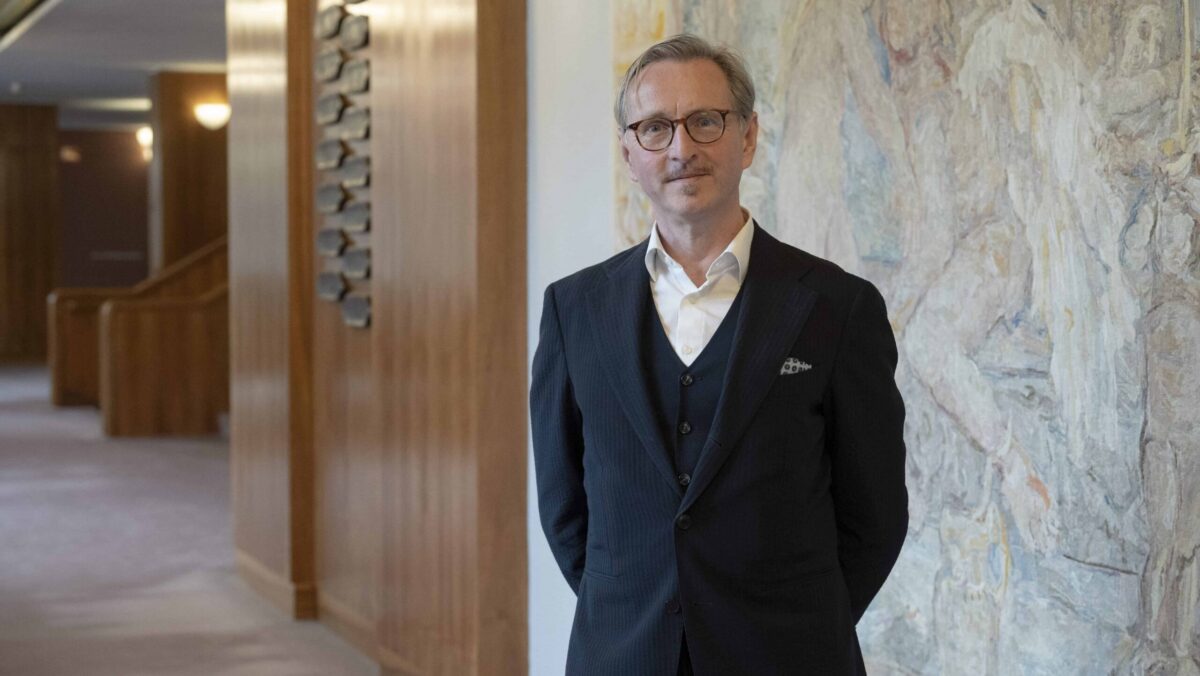
Designated Artistic Director Peter de Caluwe / Photo:
© SF/Jan Friese
For an institution seeking a fresh start, the Salzburg Festival displays a remarkable attachment to Gérard Mortier. A quarter-century after the Flemish impresario’s departure, another of his protégés is taking over. In mid-September, the Festival named the 63-year-old Peter de Caluwe, also Belgian, its next artistic director, ending months of rumors and heated speculation. De Caluwe will succeed Markus Hinterhäuser, who was unceremoniously let go this spring after a decade-long intendanz that was largely seen as an artistic success. Hinterhäuser helped define Mortier’s Salzburg with the Zeitfluss contemporary music series before eventually running the whole Festival – six weeks of nonstop opera, classical music, and theater scattered around Mozart’s native city — between 2017 and 2026. 25 years after Mortier left Salzburg (after his contract wasn’t renewed, he went on to establish the Ruhrtriennale, a vital performing arts festival in Germany’s rust belt that is, tonally speaking, the polar opposite of Salzburg) and a dozen years after his death, it’s remarkable that his shadow still hangs over what is arguably the world’s premier classical music event.
Throughout the 1990s, Mortier challenged an institution identified with Herbert von Karajan’s superstar glamour, insisting that its lavish resources should support adventurous theater and difficult music. His former colleagues now occupy some of European opera’s biggest jobs: Serge Dorny, head of Munich’s Bavarian State Opera, was his dramaturg in Brussels; Alexander Neef, director of the Paris Opera, worked with him in Salzburg and at the Ruhrtriennale before becoming his casting director in Paris; Stuttgart’s intendant, Viktor Schoner, was once his personal assistant. Mortier’s once-provocative ideas, in the service of disrupting the model of predictable excellence by opening elite cultural institutions up to new works and radical reinterpretations, have become par for the course for much of the classical music and opera establishment throughout Europe.
De Caluwe began his career at La Monnaie in 1986. He was just 23 and still a student when Mortier, who led La Monnaie from 1981 to 1991, hired him to work in dramaturgy and communications. From Brussels, de Caluwe moved to Amsterdam, where Pierre Audi became another formative influence. He returned home to lead La Monnaie from 2007 to 2025 and had already been running it for six years when he joined the Salzburg shortlist in 2013, losing out to Hinterhäuser. You might say this appointment has been a long time coming.
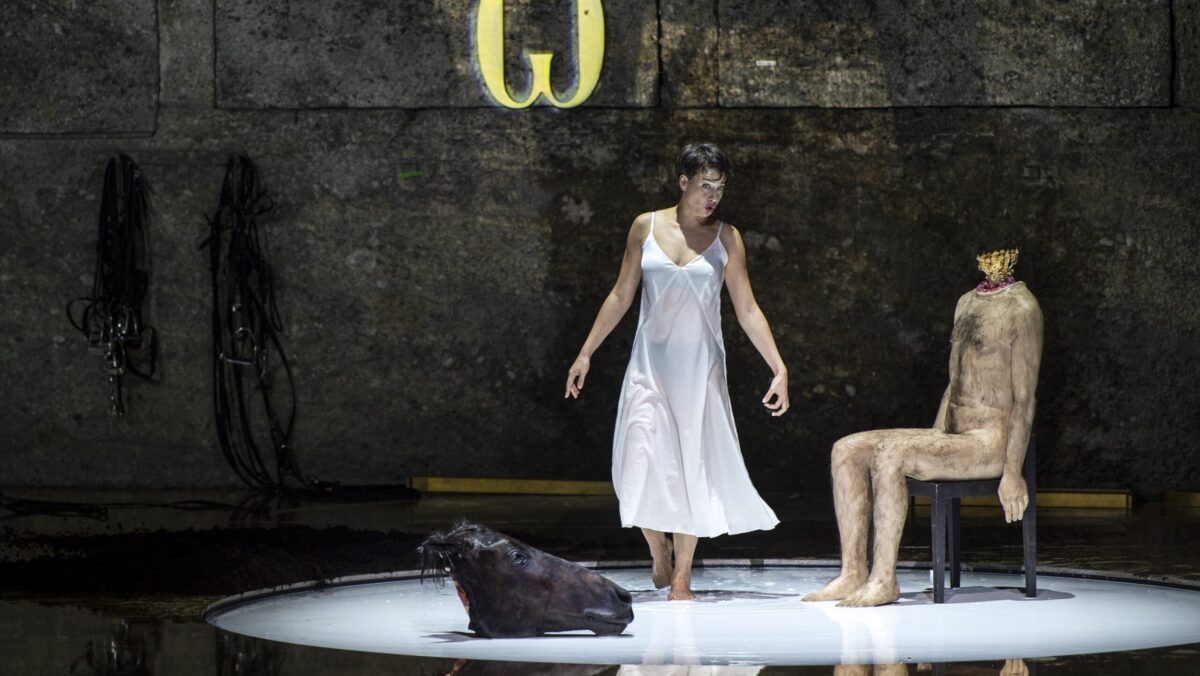
Asmik Grigorian in Salome at the Salzburg Festival in 2018 / Photo: © Salzburger Festspiele / Ruth Walz
Hinterhäuser’s removal in March ended a period of unusual continuity at Salzburg. Between Mortier’s final Festival in 2001 and Hinterhäuser’s first permanent season in 2017 came Peter Ruzicka, Jürgen Flimm, Hinterhäuser himself for an interim year, Alexander Pereira and Sven-Eric Bechtolf. Behind the imposing façade, the artistic leadership had been remarkably unsettled. Flimm and Pereira left early for other jobs. Hinterhäuser stuck around and gave Salzburg a sustained identity.
That identity could be exhilarating and exasperating. His wide-ranging concert programs, devised with Floran Wiegand and Axel Hiller, accommodated music that other festivals would struggle to present; his loyalty to a small circle of directors sometimes produced repetition and oppressive solemnity. Romeo Castellucci’s 2018 Salome with Asmik Grigorian was a defining triumph during his second season, while this summer’s Saint François d’Assise, also staged by Castellucci and conducted by Maxime Pascal, revisited a work central to Mortier’s Salzburg and became an unintended farewell to Hinterhäuser’s own. All the while, audiences had scarcely deserted him: the Festival reported a staggering ticket sales above 99 percent for the 172 performances it presented over 45 days during the summer of 2026, an enviable figure for any music or opera festival, but especially one that highlighted works by Messiaen, Henze, Kurtág and Dusapin.
For his early seasons, Hinterhäuser also had a formidable political partner. Helga Rabl-Stadler, president from 1995 to 2021, was a former Austrian People’s Party (ÖVP) MP who knew whom to call. During the pandemic, she pressed Chancellor Sebastian Kurz for a way to hold Salzburg’s centenary festival. While Bayreuth, Bregenz, Aix and others cancelled their festivals, Hinterhäuser devised a reduced program, commercial director Lukas Crepaz developed the safety arrangements, and Rabl-Stadler helped secure the political backing. Salzburg miraculously staged 110 performances in August 2020, including Christof Loy’s Così fan tutte and Krzysztof Warlikowski’s Elektra.
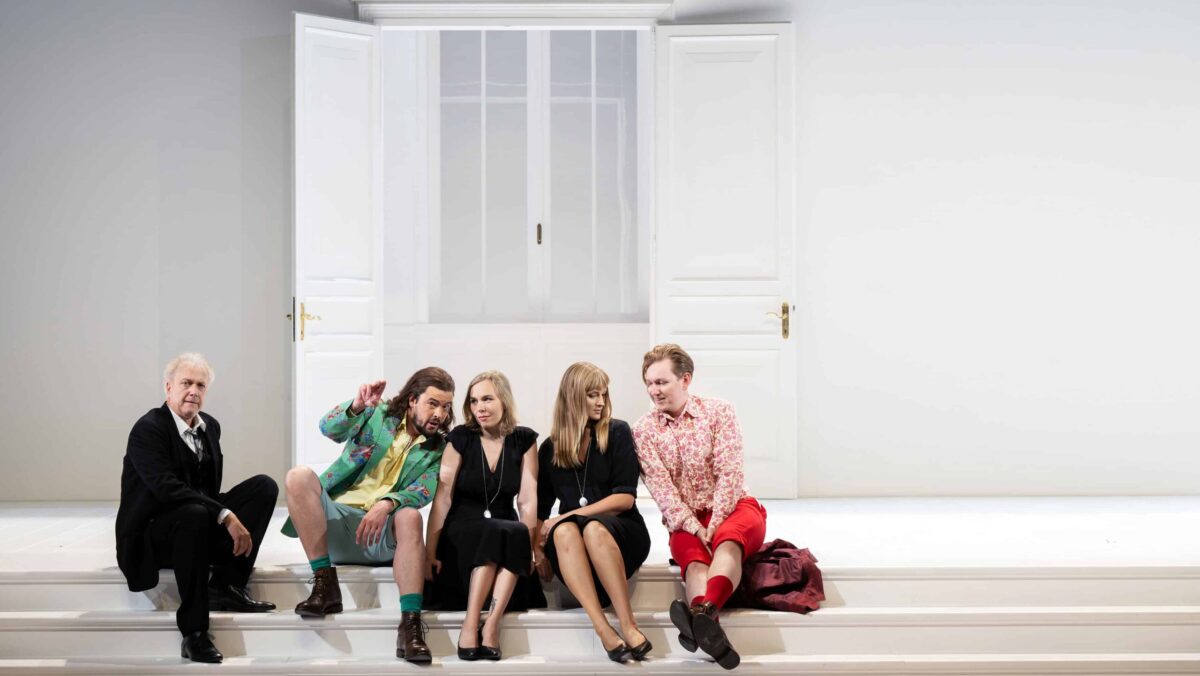
Così fan tutte at the 2026 Salzburg Festival with Johannes Martin Kränzle (Don Alfonso), Andrè Schuen (Guglielmo), Elsa Dreisig (Fiordiligi), Victoria Karkacheva (Dorabella), Bogdan Volkov (Ferrando) / Photo: © SF/Monika Rittershaus
Rabl-Stadler’s successor, Kristina Hammer, arrived from a rather different background: marketing in the automobile industry. She took office on January 1, 2022, with responsibilities including fundraising and representing the Festival publicly. Reports of friction with Hinterhäuser appeared the following year. In 2024, when Hinterhäuser’s contract was up for renewal, he initially left open whether he would reapply. Meanwhile, the names of other contenders circulated, including Dorny and Schoner. When Hinterhäuser was quietly renewed through 2031, the announcement left some of the other candidates mildly embarrassed. (Salzburg’s prestige gives its recruitment process an unusual capacity to shame people who apply for and don’t get the job.) In light of this, Hinterhäuser’s coyness had served him well.
Later that year, however, a fresh controversy erupted. Marina Davydova, a dissident Russian theater critic, writer, director, and curator, had been appointed to lead the Festival’s drama division in October 2023. On November 28, 2024, shortly after her first summer at Salzburg, she was abruptly removed for organizing a theater festival in Berlin that Salzburg claimed violated the terms of her contract. (Davydova has denied any wrongdoing.) Hammer, Hinterhäuser and Crepaz approved the dismissal, with the supervisory board’s backing, although the program that she put together for 2025 went ahead as planned.
By early 2026, the fight over filling that vacancy had helped make Hinterhäuser’s own position untenable. Karoline Edtstadler, the conservative ÖVP politician who became Salzburg’s governor in July 2025, led the supervisory board’s confrontation with him. Hinterhäuser wanted Karin Bergmann, a former artistic director of Vienna’s Burgtheater, to run the Festival’s drama division. The board challenged his handling of the appointment and declared that it no longer had confidence in him.
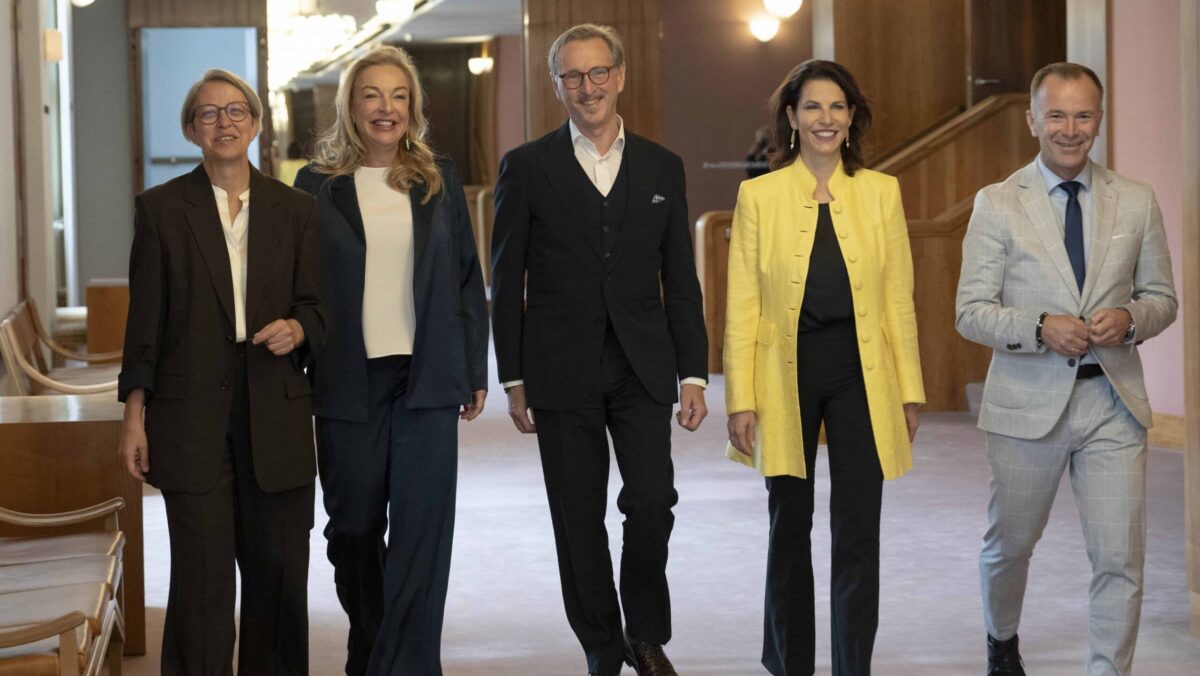
Theresia Niedermüller, Kristina Hammer, Peter de Caluwe, Karoline Edtstadler, Bernhard Auinger at the Press Conference that announced de Caluwe’s appointment / Photo: © SF/Jan Friese
Although appointing the drama director normally fell within the intendant’s remit, the board had insisted on an advertised selection process after Davydova’s departure. (Hinterhäuser has claimed that a board member he consulted assured him that Bergmann could be considered without a formal application or hearing.) By this point, the intendant, who by his own admission could be “an emotional, sometimes impulsive character,” seemed to be running out of people who were willing to put up with his moods and volatility.
On March 26, 2026 the festival announced that it was severing ties with Hinterhäuser due to “irreconcilable differences.” The public record still leaves plenty unexplained, including whether artistic disagreements, rather than dissatisfaction with his leadership style, contributed to his departure. Then, on April 7, the board appointed Bergmann to run the entire festival temporarily; ironically, the woman whose proposed appointment to a departmental post had become so contentious was suddenly entrusted with everything.
Not only did Hinterhäuser retain his popularity among festivalgoers this summer, he also had their newfound sympathy, and the consensus seemed to be that he was done dirty by Edtstadler. Although no longer running the show, Hinterhäuser was a ubiquitous presence around the city. During my weeklong sojourn there in August, I ran into him on a daily basis: inside the Felsenreitschule, where he sat through multiple performances of Saint François (as did I), at cafes on both sides of the Salzach, roaming the narrow Gassls of the Altstadt and smoking in the shadow of the Mönchsberg.
While finding a replacement for the Festival’s most transformative leader in a quarter century was certainly a tall order, Salzburg did not lack a list of plausible and worthy successors. Over the summer, Elisabeth Sobotka, the Austrian head of Berlin’s Staatsoper, was suggested to me as someone who would make a good choice. Matthias Schulz, who previously led Salzburg’s Mozarteum Foundation and took over Zurich Opera House in August 2025, also figured in public speculation. Dorny, whose contract in Munich runs until 2031, was also in the running (again). Yet the name I heard tossed around the most was Barrie Kosky. Many people seemed confident that the job was his for the asking and German and Austrian media reports from over the summer seemed to agree. It certainly wasn’t hard to understand the appeal of a Salzburg takeover by Kosky.
Kosky is one of today’s most acclaimed and influential opera directors. Hinterhäuser invited him to Salzburg in 2019 Orphée aux enfers, a delicious romp that he followed up, in true Koskian fashion, with an austere and desolate Káťa Kabanová in 2022. Since then, he has been a staple of Cecilia Bartoli’s Whitsun Festival, the summer event’s younger springtime sibling. With and for La Bartoli, Kosky has directed the Vivaldi pasticcio Hotel Metamorphosis (2025) and a deliriously over-the-top Il Viaggio a Reims this summer.
Kosky’s decade running Berlin’s Komische Oper showed what could happen when an institution gave his theatrical imagination room and the financial resources to roam freely, and I would have liked to see him let loose on Salzburg. By September, that prospect was no longer theoretical: there were reports of a joint proposal by Kosky and Sophie de Lint, who succeeded Audi at Dutch National Opera in 2018 and who has worked closely with the Australian director ever since.
On 16 September, the Austrian Press Agency, citing unnamed insiders, reported that negotiations with the pair had broken down over contracts and the division of responsibilities, and two days later, the Salzburg Festival officially announced de Caluwe’s appointment. Precisely what sank the Kosky–de Lint Doppelspitze remains undisclosed. For the foreseeable future, a Salzburg Festival remade in Kosky’s image will be left to our imaginations.
Kosky, at any rate, isn’t and wasn’t waiting for Salzburg. His monumental Lear, staged in a hangar at Tempelhof airport, opened the Komische Oper’s season in September; he’s currently preparing Ariande auf Naxos which premieres in Vienna on Sunday; his Covent Garden Ring reaches completion early next year; and a new musical version of Yentl that premieres over the summer at Bard, in upstate New York, is the first of several shows that Kosky is set to direct in the US. De Lint’s next move is less clear. For now, she remains in Amsterdam. Whether she stays there for the long term or pursues another appointment is an open question.
At de Caluwe’s presentation on 18 September, Hammer also received another five-year term, to the surprise of many, including the Austrian daily Der Standard. Edtstadler, who ostensibly led the campaign against Hinterhäuser from the advisory committee that appointed de Caluwe and renewed Hammer, clearly expects them to play nice with each other.
Anyone hoping for a corresponding outbreak of artistic good behavior would do well to examine de Caluwe’s record in Brussels. Castellucci and Warlikowski, mainstays of Hinterhäuser’s Salzburg tenure, were recurring presences there. De Caluwe told the Associated Press that only about five productions during his tenure had caused a stir. “That’s too little,” he said. He hardly sounds like someone hired to rid Salzburg of provocative directors.
What he may offer is support for new work, including opera commissions. (The last world premiere opera at Salzburg was Thomas Adès’s astounding The Exterminating Angel in 2016!) Caluwe presented 23 world premieres at La Monnaie, including Pascal Dusapin’s Macbeth Underworld and Mikael Karlsson’s Fanny and Alexander. Hinterhäuser championed demanding modern music, but new operas for Salzburg’s main stages were a conspicuous blindspot. De Caluwe could give living composers a larger share of the money and attention lavished on reinterpreting established works. Salzburg knows how to make stars of performers. Its international audience and exceptional resources could also help new operas establish a life beyond their premieres.
For now, we will have to wait. De Caluwe officially takes office in October 2027. Bergmann is responsible for next summer’s program and is already helping prepare 2028. Whether any of Hinterhäuser’s longer-term projects will survive remains unclear.
The first summer program fully assembled by De Caluwe will be in 2029. That coincides with the renovation of the Großes Festspielhaus. The 2,179-seat opera house will close from autumn 2028 until spring 2031, displacing performances in the festival’s largest indoor venue for two summers.
On October 16, the board chose Salzburg’s exhibition grounds as the replacement location. De Caluwe wants opera concentrated in the remaining old-town theaters, with concerts and special projects at the temporary premises. Persuading audiences to follow the Festival beyond its familiar setting will require more than shuttle buses, comfortable seats and – god willing – air conditioning. The productions will have to justify the schlep.
But that need could also encourage something extraordinary. Consider Stockhausen’s seven-opera Licht cycle. Maxime Pascal and Le Balcon recently completed their multi-director series of productions with a bonkers production of Mittwoch at Deutsche Oper Berlin; Pascal has publicly discussed presenting the complete cycle someday. (The composer’s centenary is in 2028.) Thirty-odd hours of Stockhausen would be a splendidly excessive use of a Festival that is supposed to attempt what ordinary institutions cannot. A construction project need not condemn its artistic director to several summers of making do. Of course, no such plans have been announced for Salzburg. But hey, a girl can dream…
Or, to indulge an even more mischievous fantasy, de Caluwe might invite Castellucci to finish the mesmerizing Ring cycle that the Italian director was forced to abandon halfway through in Brussels, officially due to financial constraints. (The idea of La Monnaie running out of cash is quite rich.) Salzburg’s separate Easter Festival already has its own new Ring underway, directed by Kirill Serebrennikov and conducted by Kirill Petrenko. Rival cycles would give the city something vastly more entertaining to argue about than employment contracts. De Caluwe may have been hired to restore harmony, but his programming need not be harmonious.
A.J. Goldmann
A.J. Goldmann is an American writer and critic based in Munich and Berlin. He is a longtime contributor to The Wall Street Journal, The New York Times and The Forward. He has also written for The Atlantic, The New Republic, The Guardian, The Spectator and Gramophone Magazine. Between 2007 and 2023, when it folded, he was the Berlin, Vienna and
Salzburg correspondent for Opera News Magazine.
-
Topics: salzburg festival, succession
-
People: Barrie Kosky, Peter de Caluwe
-
Places & Organizations: Salzburg Festival
Comments