
Un bel DAR
Washington National Opera kicked off its first season as a fully independent company with a thoughtful production of Giacomo Puccini’s Madama Butterfly.
 By
Andrew Lokay
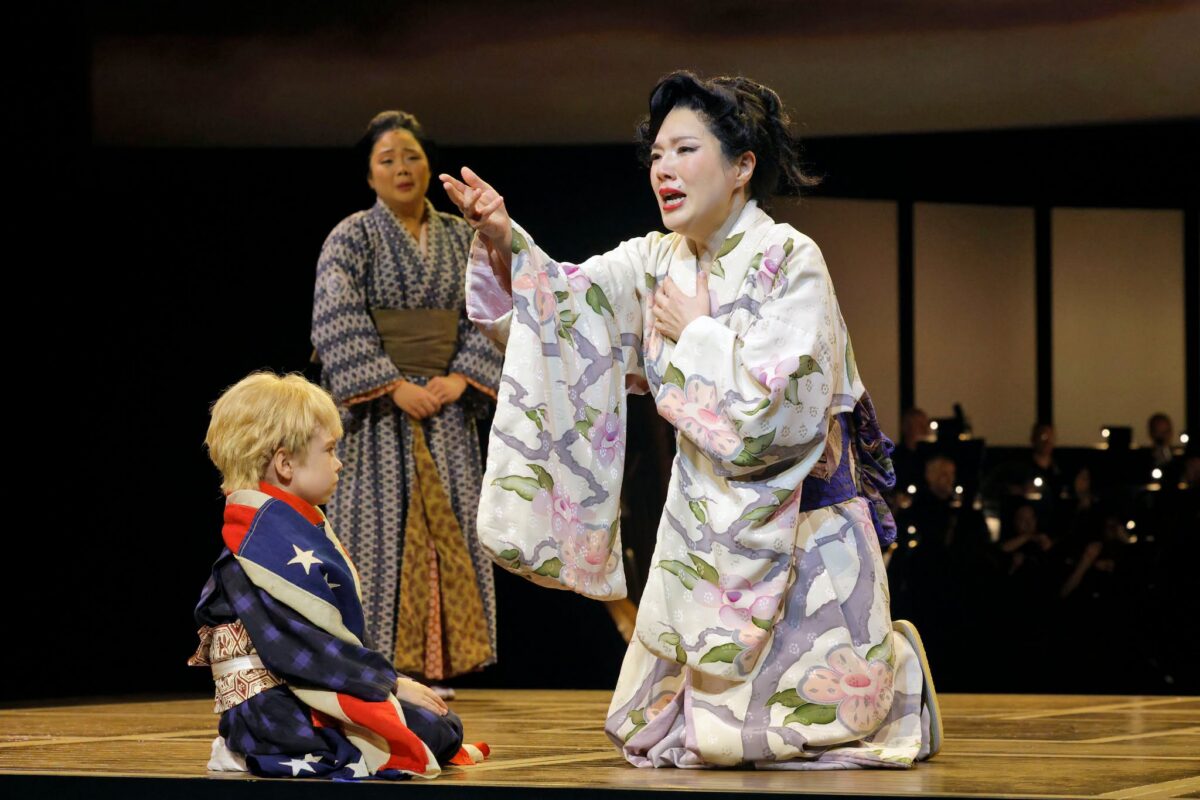
Photo: Cory Weaver
After departing the Kennedy Center early this year, Washington National Opera has relocated to a constellation of venues across the Washington, DC region for its 2026-27 season. The first half of the season takes place at the Daughters of the American Revolution’s Constitution Hall. Later productions will be held at Arena Stage, Shakespeare Theatre Company’s Harman Hall, and the Music Center at Strathmore.
With strong performances by tenor Matthew White as Pinkerton and soprano Karah Son as Cio-Cio-San in their WNO debuts, WNO’s Butterfly demonstrated how even at a time of upheaval and uncertainty for the company, the show will go on. For Butterfly, upcoming performances of Nixon in China, and a concert titled We the People, WNO constructed a three-quarter thrust stage in the center of Constitution Hall. This configuration helped make the vast space feel like a more intimate venue for the audience. The DAR’s Constitution Hall is a challenging space for opera; the WNO Orchestra sounded excellent under the delicate touch of conductor Erina Yashima but the cavernous space proved unkind to smaller voices and ensembles, particularly when singers faced a section of the house opposite to where you were sitting. The WNO Chorus delivered an ethereal Humming Chorus but Act I’s wedding scene sounded muddled. Constitution Hall may not be a perfect venue, but WNO’s creative team maximized its full potential.
A harmonious production by director E. Loren Meeker placed the human tragedy of Puccini and librettists Luigi Illica and Giuseppe Giacosa’s work at the forefront. Simple but highly effective use of scenery, props, and choreography allowed the opera to speak for itself. Beautiful sets by Walt Spangler replaced a traditional house with inset rectangles divided by a flower-bedecked moat, all underneath a massive cherry blossom branch. The layout thoughtfully emphasized the entrances and exits of the characters over the horizon line watched incessantly by Cio-Cio-San. Their silhouettes first visible behind lighted screens, characters emerged from sliding doors placed behind the orchestra, then walked on a path around the orchestra to reach the stage.
Excellent lighting and projections by Duane Schuler and Alexander V. Nichols, respectively, shaped the emotional resonance of the production. The fiery red aftermath of the disclosure of Cio-Cio-San’s religious conversion and the moonlit love duet were particularly impactful. Detailed costumes transported the audience to early 20th-century Japan (the program credited Florence Klotz as the original costume designer and Timm Burrow as the new costumes designer). The production made thoughtful use of props in building character, giving audiences a wealth of details to observe. A photographer captured a shot of Pinkerton and Cio-Cio-San’s wedding, which later appeared framed on the table in their home and ultimately wound up trashed by Pinkerton. Goro eagerly brandished a cascading roll of wallet-sized photos of marriage prospects. Elegant choreography by Kanji Segawa, executed by the WNO Corps Dancers, accentuated the major beats of the plot without distracting from it. The stunning finale, in which dancers enveloped the dying Cio-Cio-San in a giant cherry blossom, left audiences with an indelible image.
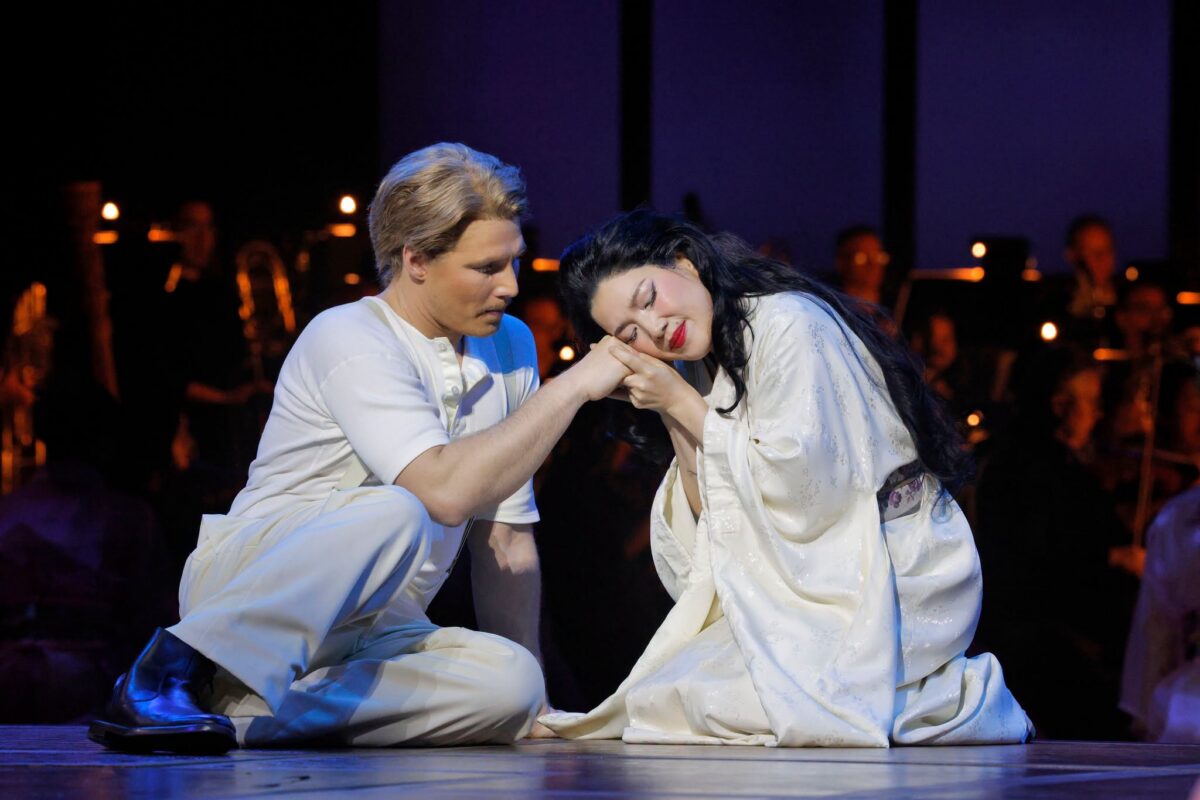
Photo: Cory Weaver
Armed with a golden tenor, smooth passaggio, and easy charm, White portrayed a dreamy beau for Cio-Cio-San in Act I, making it no mystery why she would fall in love in love with this American visitor. White’s volume flagged at times, and his vocal line was occasionally lost during ensembles as the unforgiving acoustics of the venue didn’t do him any favors. Son recovered well from a vocally rocky Act I to give an excellent performance of a signature role. The character of Cio-Cio-San comes into her own in Acts II and III, and this half of the opera revealed Son in top form. Son effectively darkened her bright, expressive soprano in conveying Cio-Cio-San’s anguish and projected well in the house with good pianissimi and a plush lower register. Nice legato in “Un bel dì, vedremo” highlighted a strong sense of longing.
Will Liverman lent a rich, oaky baritone to the role of the American consul Sharpless, betraying a tenderhearted nature in his moving exchange with Son’s Cio-Cio-San. Mezzo-soprano Michelle Mariposa, an alumna of WNO’s Cafritz Young Artists Program, stood out as Suzuki thanks to her clear, smooth mezzo and empathetic stage presence (with an impressive performance of heartbreak in Act III). Mariposa’s voice soared in the acoustically challenging space to a degree not common for a young artist. Making much of a smaller role, tenor Rodell Rosel was a grandiloquently scheming Goro with excellent musical phrasing and diction. Current Cafritz Young Artist Chandler Benn’s warm baritone left an impression as Cio-Cio-San’s pining suitor Yamadori.
Andrew Lokay
Andrew Lokay began his career as an opera fan at the San Francisco Opera, where the first performance he saw was Madama Butterfly. He graduated Phi Beta Kappa from Stanford University with a Bachelor of Arts in international relations and French with honors in international security studies. He now lives in Washington, DC and is a frequent audience member for opera and theatre in the nation’s capital.
-
Topics: Review
-
People: Alexander V. Nichols, Chandler Benn, Duane Schuler, E. Loren Meeker, Erina Yashima, Florence Klotz, Kanji Segawa, Karah Son, Matthew White, Michelle Mariposa, Rodell Rosel, Timm Burrow, Walt Spangler, Will Liverman
-
Places & Organizations: Washington National Opera

Comments