The virtue of being Verdi
At the Festival Verdi, the “mondi lontani” of Nabucco and Aida lead back to universal, Verdian virtues.
 By
Larry Wolff
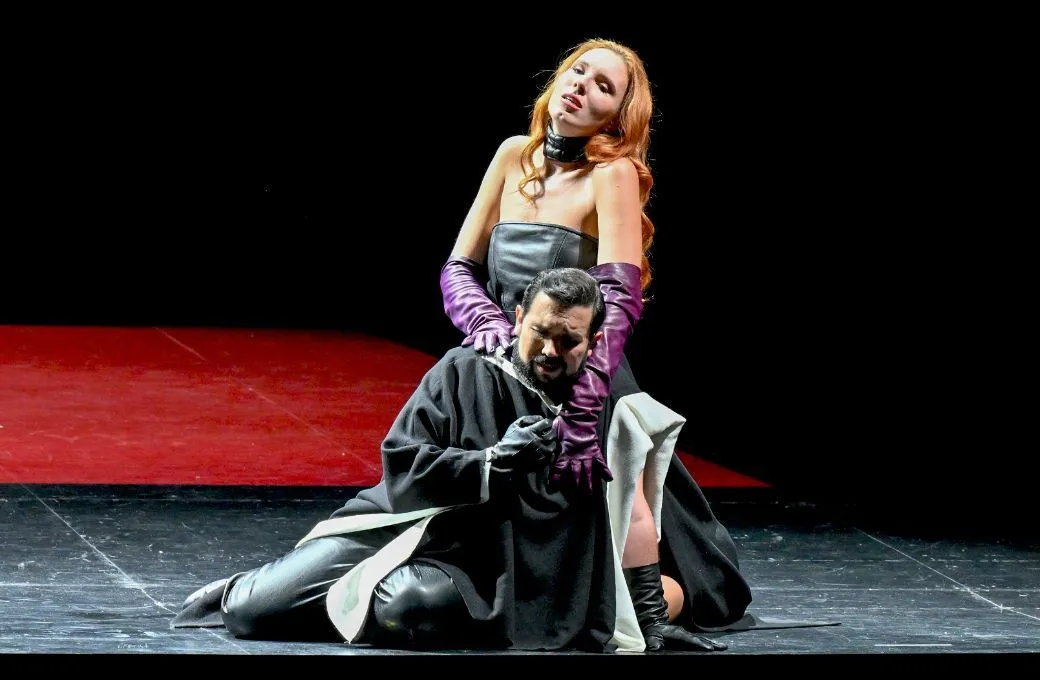
Photo: Roberto Ricci
In Parma, Verdi’s birthday on October 10 always begins with a gathering at the Verdi monument in the center of town. The monument itself was once part of a much larger commemorative arch, completed just after World War I and severely damaged during World War II; what survives is a huge bronze relief that depicts Verdi among allegorical representations of his genius. The mayor of Parma, Michele Guerra, a professor of cinema, spoke briefly about the importance of Verdi’s values for defining Parma’s community identity, and the president of the broader province of Parma spoke about “Verdi” as a global brand name for Italian culture, recognized everywhere that opera is performed. The high point of the birthday gathering, however, is always the singing of “Va pensiero,” the chorus of the exiled Hebrews from Nabucco.
Biblical Hebrews singing from Babylonian exile with longing for their homeland have been accepted by Italians, ever since the nineteenth-century, as disguised Italians singing their sentimental attachment to Italy, and spontaneous crowd performances of “Va pensiero” have taken place inside and outside the opera house—most famously at Verdi’s funeral procession in the streets of Milan in 1901. Its lyrics by Temistocle Solera are not easy to learn, as the versification fits the music somewhat awkwardly. Even the heart-stopping line “O mia patria sì bella e perduta!” extends the “du” of “perduta” to three triplet syllables. Though sometimes the event at the Verdi monument is a sing-along, this year the crowd seemed to be mostly listening to members of the chorus of the Teatro Regio and the municipal chorus “Corale Verdi”— who were, of course, musically perfect and had no trouble fitting the words to the triplets.
If Alzira was the great rarity of the 2026 festival, a new production of Nabucco was perhaps the most anticipated event, because the director Pier Luigi Pizzi, at 96, is the most venerable and beloved opera director in Italy. There was a time when the full opera was rarely performed, with the chorus as the only familiar excerpt, but today, Nabucco has become a reasonably recurring item of the Verdi repertory. The last production in Parma, in 2019, was controversially set on a ship at sea, imagining the Hebrew captives as exploited contemporary refugees at the mercy of the cruel commanders. By contrast, Pizzi’s elegantly minimalist production took place on an almost bare stage with a low flight of steps leading up to a large screen that changed color through the opera and allowed for the possibility of stark silhouette.
The color scheme began in black and white with the chorus of Hebrews dressed in black, accented with white headscarves for the women and white skullcaps for the men, as if they could be displaced Jewish victims of any era from biblical to modern times. Pitti’s austerity here as director permitted conductor Francesco Lanzilotta and choral director Martino Faggiani, to emphasize the liturgical quality of Verdi’s chorus of Hebrews, led by their high priest Zaccaria, basso Michele Pertusi, who wore a traditional Jewish prayer shawl. Pertusi, a native of Parma, has always been a local favorite and, having turned 60 last year, has now become, with the semi-retirement of Ferruccio Furlanetto, the grand old man among contemporary Italian bassos. He is still singing with firm command, idiomatic phrasing, and the age and experience that gives meaning to such Verdian basso roles as Zaccaria, the Padre Guardiano in Forza , and King Philip in Don Carlos.
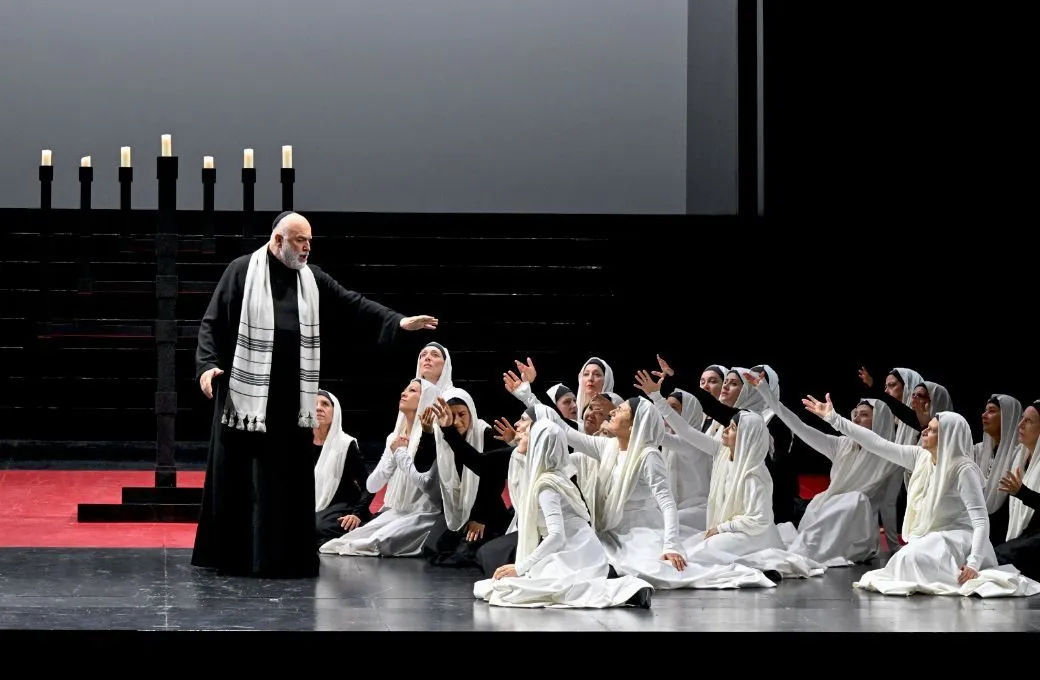
Photo: Roberto Ricci
Abigaille’s entrance in the first act was visually striking: She was dressed, like her male Praetorian guard, in a tight black leather tunic, black helmet, long black boots and gloves, showing a lot of leg. She could have been an evil Valkyrie, a Dark Jedi, or a demonic dominatrix. Not every soprano could carry off this costume but thirty-year-old Russian wonder Lidia Fridman seems capable of anything. An Italian bel canto specialist, she has already sung in I Lombardi (in a Pizzi production) and as Lady Macbeth (in the French version) at past Parma festivals. Recently, she has sung both Norma and Salome with great success in Vienna (I heard her Salome in May; yes, she was sensational), and her return to Parma as Abigaille was a triumph. She began with her knee on the prostrate body of the Hebrew tenor Ismaele, singing in a spirit of both cruelty and wounded pride, with a sinuous line, mezza voce, and plenty of appoggiatura over pulsing strings: “Io t’amava”: I loved you, I would have given my kingdom and my heart for your heart. She sings with the intensity, and some of the Bellinian style, of Norma confronting Pollione: “In mia man, alfin tu sei.” The black and white stage picture begins to add color as Abigaille removes her black helmet, and Fridman lets down her long, silky red hair. Ismaele, however, remains unmoved, for he is in love with her sister Fenena, whose conversion to Judaism will eventually help drive the drama to the brink of catastrophe.
A great Abigaille must be matched by a great Nabucco on stage, for the real musical and dramatic contest in the opera lies between them, father and daughter, with the Hebrews appearing almost as pawns in their Babylonian dynastic struggle. In fact, Parma had a star Nabucco who fiercely held his own in the opera named for him—though Parma billed the work with its full original title: Nabucodonosor, a moniker that is virtually unsingable. This was a name that spoke of “mondi lontani,” and the role was sung in 2026 by a baritone who came from afar with another challenging name, Ariunbaatar Ganbaatar. Parma is a small town and last year, the opera-loving chef of the restaurant La Filoma told me that there was a great Mongolian baritone in rehearsal for Giovanna d’Arco. “Enkhbat?” I asked, and he replied, “No, another Mongolian.” Amartuvshin Enkhbat, who sang as Nabucco in the 2019 production as commander of the outlaw ship and has returned several times to Parma, is now recognized as one of the world’s leading Verdi baritones. That there should be a second Mongolian baritone coming out of Ulan Bator with gorgeous tone, immense power, flawless Verdian phrasing, and perhaps even greater dramatic presence than Enkhbat, at first seemed improbable.
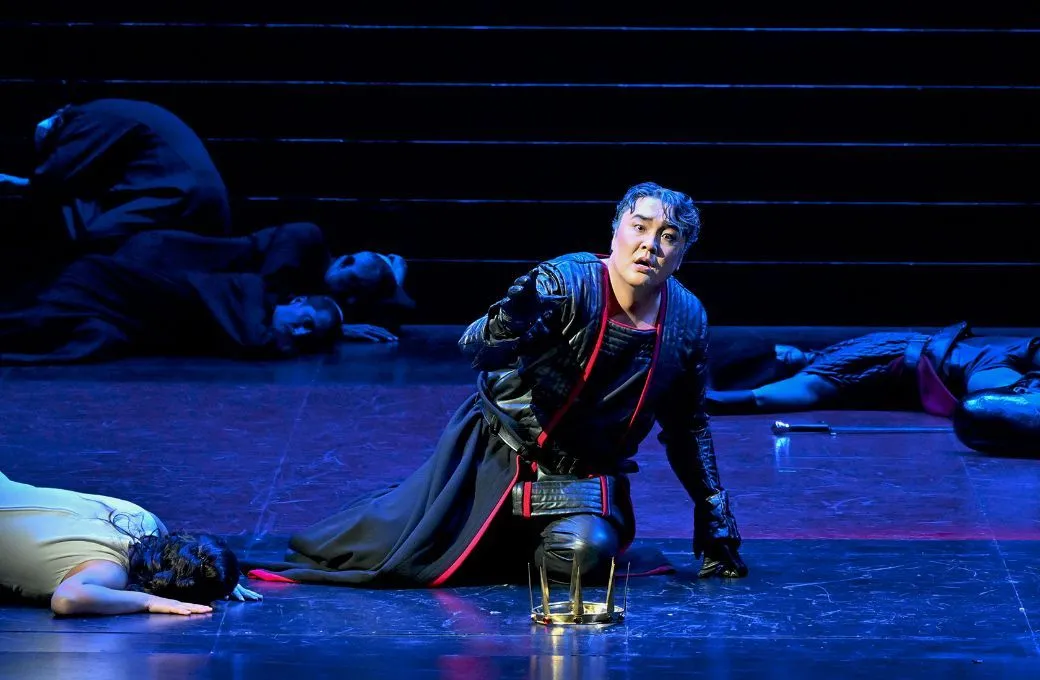
Photo: Roberto Ricci
In Nabucco, Ganbaatar was the last of the principals to appear in Act I, just in time to lead the presto ensemble finale: “Mio furor non più costretto” (My fury is no longer constrained), with Ganbaatar raging in ¾ time, expressing “ferocious joy,” as marked in the score. He was even more compelling in the second-act finale when Nabucco declares himself to be the only god. The Hebrews are scandalized, and Zaccaria declares him “insano”—at which point, a divine thunderbolt intervenes, maddening Nabucco. Again, he raged, but this time as a madman, with Fridman launching triumphant high notes over the full ensemble, as Abigaille prepared to seize power herself from her devastated father. In the second act she received big ovations for her aria and cabaletta, the latter on ascending the throne (“Già salgo al trono”), with spectacular runs and glittering ornamentations, as she resolved to avenge herself against her sister and destroy the Hebrews. Throughout the opera, the gleaming metallic intensity of her top notes easily cut through the full chorus and orchestra in the big Verdian ensembles.
Fridman and Ganbaatar played out the third act with special brilliance, she gowned in red, he robed in purple— fauve figures in Pizzi’s carefully controlled palette—she intoxicated with the power that now allowed her to triumph over her father, he abjectly performing a unique Verdian mad scene for baritone, uncertain even of his own identity. Fridman exulted in a frenzy of brilliant coloratura display, while Ganbaatar sought to rediscover himself in richly colored Verdian cantabile singing.
“Stolto” (fool), she mocks him contemptuously, and Ganbaatar, closely directed by Lanzilotta from the orchestra pit, played the scene as if it were the King Lear opera that Verdi contemplated composing throughout his career but never actually composed. Nabucco has favored the wrong daughter, and she now humiliates him with relish, as his mind remains pitifully unmoored.
Pizzi worked closely with legendary director Giorgio Strehler in the 1950s, learning something about psychological focus from Strehler’s revolutionary approach. Franco Zeffirelli, by contrast, was working with equally legendary director Luchino Visconti in the 1950s, and the widely beloved excesses of Zeffirellian style owe something to that apprenticeship. The contrast between Pizzi and Zeffirelli was perhaps most evident in 1972 when La Scala staged a stripped-down Aida production by Pizzi to replace the lavishly cinematic Zeffirelli production of 1963. Zeffirelli, seven years older than Pizzi, was 88 when he staged Aida at Busseto in 2001, marking the centenary of Verdi’s death, and daring to devise an uncharacteristically compact production.
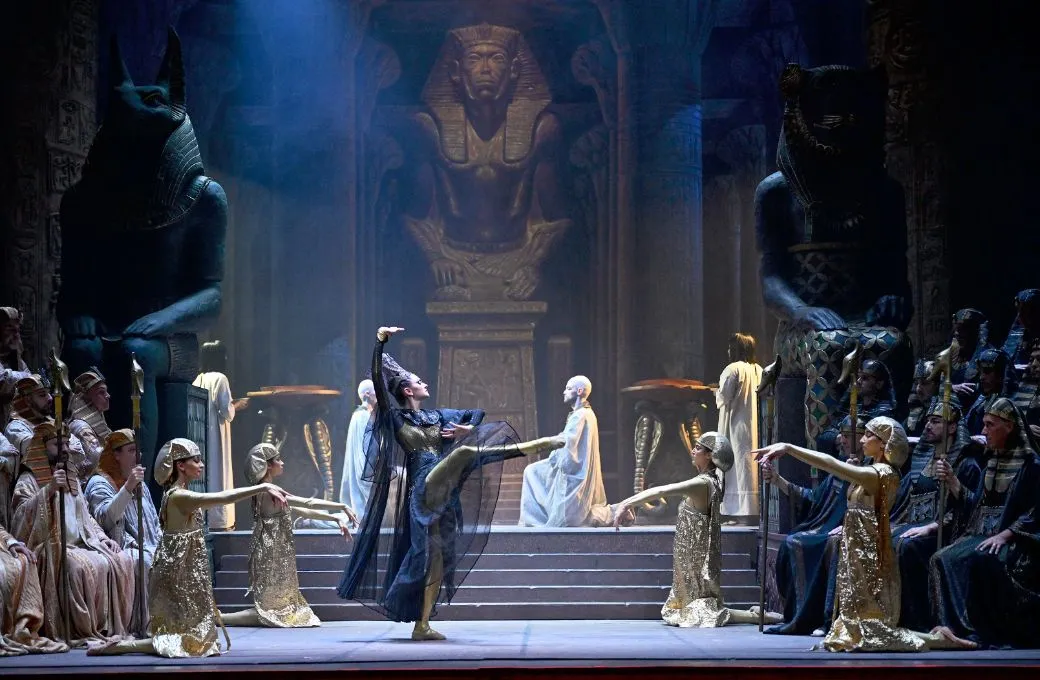
Photo: Roberto Ricci
Aida on a small scale (“Aidina”) is a small masterpiece. The central features of the staging are two giant seated statues of jackal-headed Anubis and lion-headed Sekhmet, almost too large to be fully viewed in the tiny stage space. They mark the entrance to an Egyptian temple, and they change position on the stage to mark the changing scenes, depending on whether we, the audience, are supposed to be outside, inside, or alongside the temple. There is also space for a backdrop that can display the pharaonic face of the Sphinx or even the Great Pyramid. Egyptian antiquities thus crowd the little stage, while leaving just enough room for an unexpectedly intimate drama of Aida. In an ingenious Zeffirellian coup, the triumphal procession of the second act never appears onstage; rather, we see the small chorus watching and waving to a procession that is implicitly present offstage but not actually seen. It is musically fascinating to hear Aida with a reduced orchestra and chorus, allowing attention to Verdi’s contrapuntal writing, starting in the prelude, and also to the individual instruments, especially the woodwinds, that here do supply some of the exotic coloring of “mondi lontani.”
The Egyptian court is costumed in the golden Zeffirellian excess of Tutmania, and there are four ballerinas so glitteringly golden that they look like alchemically transmuted Bond girls. Teresa Iervolino was a glamorous Amneris, singing with rich voice and dramatic force. Soprano Federica Vitali, performing in colorful sarongs, was lovely in Aida’s most lyrical moments, including “O patria mia,” while Amonasro, thrillingly sung by Korean baritone Hae Kang, was styled in an abundance of dreadlocks. The racial face painting that used to characterize this Zeffirelli production (I last saw it at Busseto in 2019, when not only were the Ethiopians painted black, but the Egyptians were painted brown) has been toned down in deference to current conventions, though Aida still has an appearance that Italians would call “well tanned.” It was Zeffirelli, after all, who directed Elizabeth Taylor in blackface through the lip-synching of Aida in The Young Toscanini in 1988.
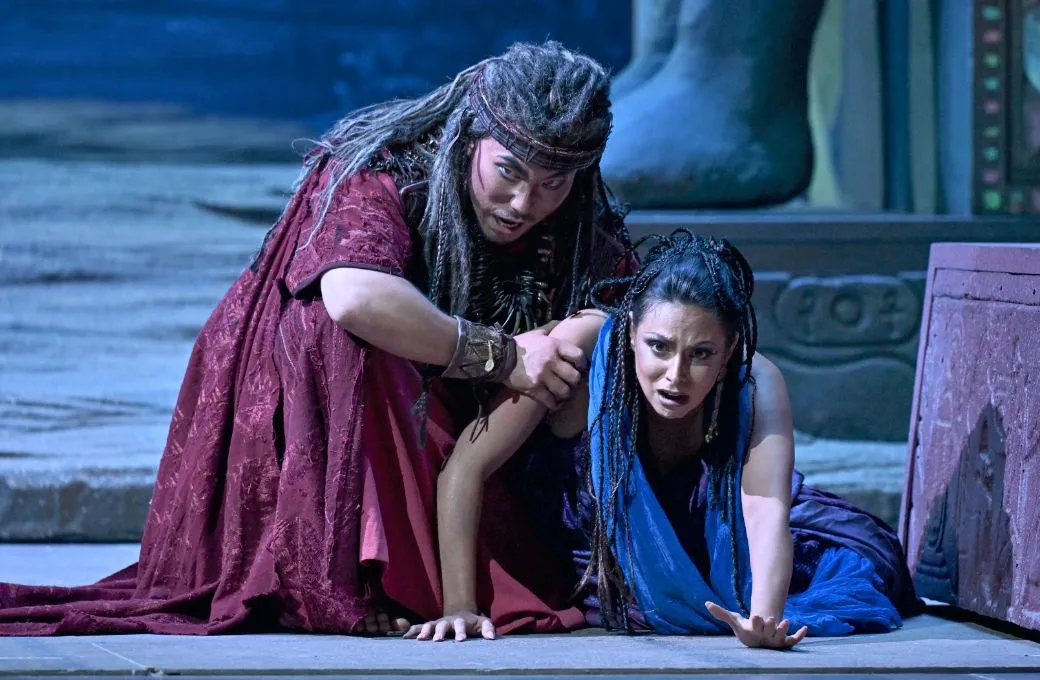
Photo: Roberto Ricci
Pizzi at 96 remains marvelously active as a director, but most artists have retired in their nineties. Verdi, who lived to 87, bequeathed the royalties from his operas to endow a retirement home for aging musicians in Milan, the Casa di Riposo, which has now been open and active for more than a century. One non-operatic event of the festival this year was the European premiere of the moving 2025 American documentary “Viva Verdi!”, directed by Yvonne Russo, who interviewed residents of Casa. One aging soprano, still vocalizing impressively as Violetta in her 80s, remarks that singing takes away all the bitterness. Verdi himself, when asked which was his favorite among his own works, replied, “la Casa di Riposo.” The mayor of Parma was there for the screening and again emphasized the importance of Verdian values for the whole community.
The operas of this festival’s “mondi lontani”— from Alzira and Nabucco to Jérusalem and Aida—are all of them operas of war and struggle that achieve at best a tentative resolution of tragic reconciliation. As a Verdian value, however, that reconciliation usually comes after lives have been lost, as in Amneris’s plea for peace at the very end of Aida or when the dying Gusmano pardons his murderer Zamoro at the conclusion of Alzira. In Nabucco the chorus “Va pensiero” creates an interlude of lyrical meditation in an opera of madness and violence, as the Hebrews nostalgically remember their lost homeland in the transcendent key of F-sharp major. Pitti had the chorus gently swaying as they sang, as if moved by the “aure dolci,” the gentle winds, of the text, but also in motion together as a devastated community in prayer, their nostalgia sentimentally intertwined with liturgy.
The chorus of the Teatro Regio included some of the same singers, costumed in black as Pitti’s Hebrews, who also appeared in their Italian street clothes to sing the same hymn at the Parma monument on Verdi’s birthday. In the concluding verse they invoked the harmony (concento) that infuses suffering with virtue, repeating the final words, al patire virtù (in suffering virtue), with the accented final syllable of virtù coming to rest each time on the tonic F-sharp. The chorus, by convention, outlasts the orchestra to intone that final sustained syllable “ooh” (ù) as the a cappella, pianissimo conjuring of an otherworldly moment of Verdian peace in a universe of violence. The audience demanded (and was granted) an encore.
Larry Wolff
Larry Wolff is Julius Silver Professor of History at New York University. His most recent book, about Die Frau ohne Schatten, is The Shadow of the Empress: Fairy-Tale Opera and the End of the Habsburg Monarchy (2023). His books also include The Singing Turk: Ottoman Power and Operatic Emotions on the European Stage from the Siege of Vienna to the Age of Napoleon (2016), Paolina's Innocence: Child Abuse in Casanova's Venice (2012), The Idea of Galicia: History and Fantasy in Habsburg Political Culture (2010), and Inventing Eastern Europe: The Map of Civilization on the Mind of the Enlightenment (1994). He writes frequently about opera, publishing essays and reviews in the Times Literary Supplement, the New York Review of Books, the New York Times, the New Yorker, the Los Angeles Review of Books, and the Hudson Review. He is a member of the American Academy of Arts and Sciences. When he was six years old his father took him to the opera to see Aida, the beginning of a lifelong passion.
-
People: Ariunbaatar Ganbaatar, Federica Vitali, Francesco Lanzilotta, Hae Kang, Lidia Fridman, Martino Faggiani, Pier Luigi Pizzi, Teresa Iervolino
-
Places & Organizations: Teatro Regio di Parma