Mother courage
Maxim Kolomiiets‘s urgent The Mothers of Kherson premieres in Warsaw ahead of its Metropolitan Opera run.
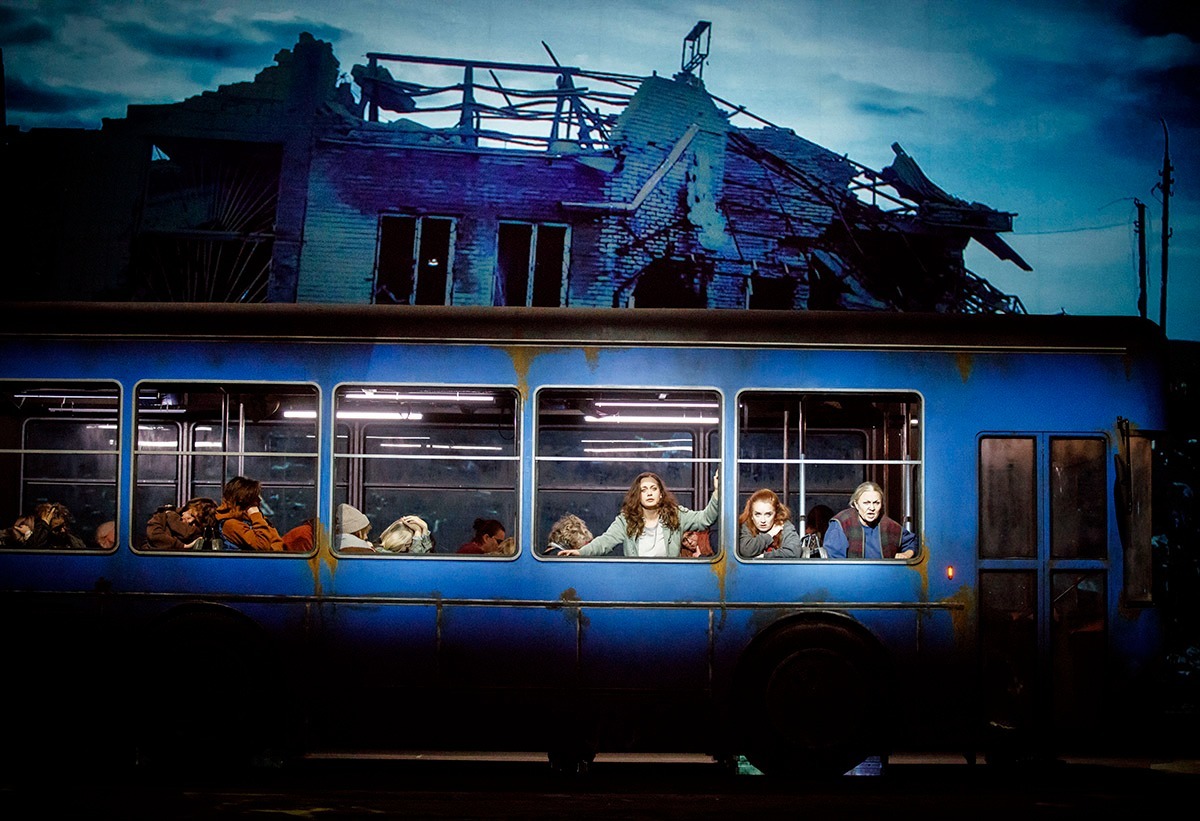
Photo: Krzysztof Bieliński/Teatr Wielki
When Russia invaded Ukraine in February 2022, Europe’s largest war since World War II shook the world. The war has displaced between 6 and 8 million Ukrainians. Casualties are also in the millions. Tens of thousands of children have been forcibly removed from Ukraine to Russia.
Nearly five years later, the war may feel distant for many Americans, especially with so many other events dominating the news cycles. Yet the Metropolitan Opera and the Polish National Opera have commendably upheld their advocacy, the former spearheaded by duo Keri-Lynn Wilson and Peter Gelb. More recently, before a performance of Macbeth on October 14, general manager Gelb reaffirmed the Met’s commitment to this cause, and the orchestra performed the Ukrainian national anthem.
Just weeks after the 2022 invasion, Wilson founded the Ukrainian Freedom Orchestra, since then touring across Europe and the US. Later that year, Gelb commissioned a Ukrainian opera, bringing librettist George Brant and composer Maxim Kolomiiets on board. The Mothers of Kherson developed remarkably quickly. Wilson and the Ukrainian Freedom Orchestra recorded a suite from the opera in 2025. In June 2026, scenes from the opera were performed for the first time in Kyiv, presented in Ukrainian. In attendance were several mothers and rescued children.
This month, Kolomiiets’s opera premiered at the Teatr Wielki in Warsaw ahead of its planned spring 2028 US premiere. A video of the premiere is available on demand on arte.tv until November 6 (with an accompanying 30-minute documentary worth watching).
Brant had initially thought of developing a libretto around the 2014 EuroMaidan protests in Kyiv. But after reading about the harrowing journeys of Ukrainian mothers in search of their children, Brant pivoted to Kherson, a city near Crimea besieged in the early months of the 2022 invasion. Many mothers, sold on false promises of safety, had signed off to send their children to summer camp in Russian-occupied Crimea. Weeks stretched into months. Some mothers, with the help of NGO Save Ukraine, took a 3,000-mile journey through Poland, Belarus, and Russia to rescue their children.
The Mothers of Kherson centers on three fictional mothers who undertake the harrowing trip. Kateryna has a fractious relationship with her alcoholic husband, Dasha relies on her faith for resolve, and Olha seeks her grandchild even as she is dying of cancer. On the road, they meet a large cast of characters: border patrol agents, a cheeky bus driver, and the menacing officials of the Crimean “Camp Friendship.”
Izabela Matuła and Kamila Dutkowska starred as Kateryna and Dasha, respectively. While Matuła began somewhat restrained, her intonation and stage presence gained vitality.
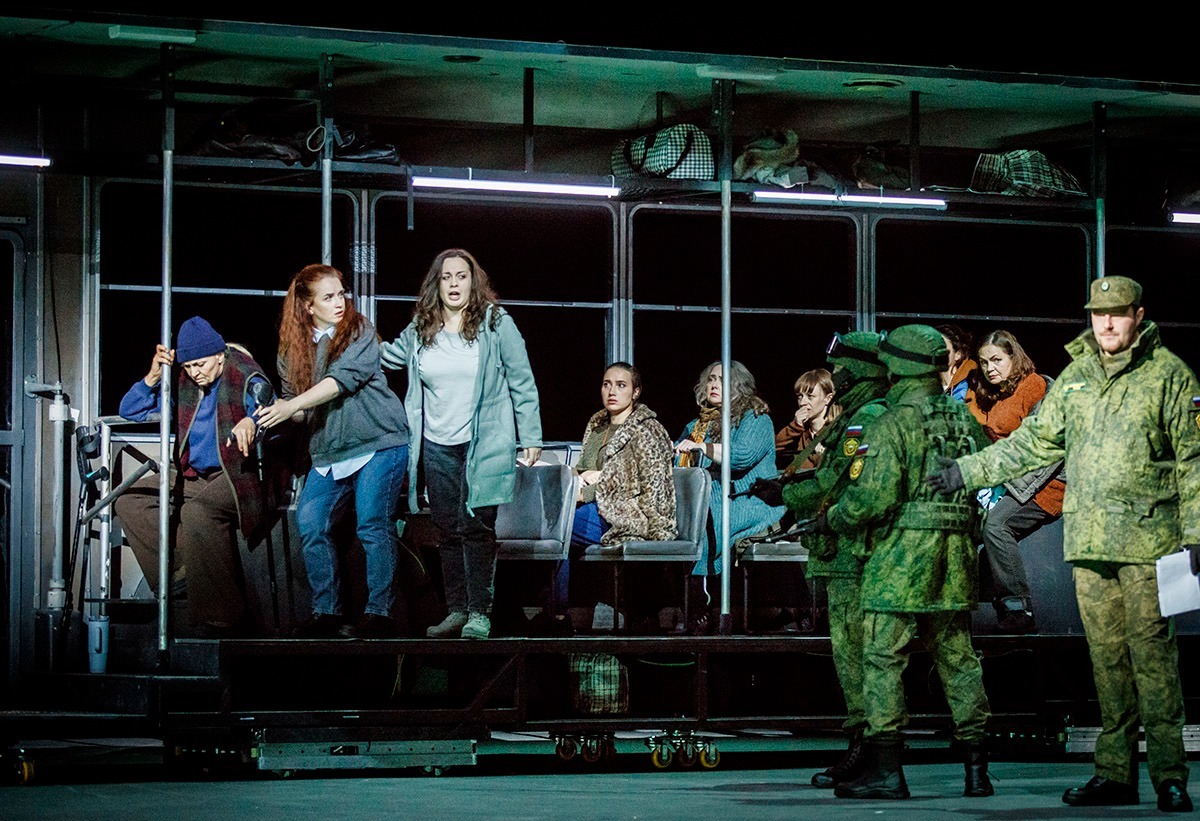
Photo: Krzysztof Bieliński/Teatr Wielki
Dutkowska gave a captivating performance with her mellow, almost resigned soprano. Weronika Wojtkowska’s Olena was somewhat harder to grasp, as her timbre ranged from sweetness when reminiscing about a nightingale to a coarse lower register when recounting her antipathy towards the occupation, emphasizing her perseverance despite sickness. Moving from social media-fueled naiveté to stoic resoluteness, Hanna Sosnowska-Bill and Kamila Dutkowska portrayed daughters Lilia and Dasha with gleaming, youthful tones.
In an all-too-short role (the reality of his military service) as Kateryna’s husband Vitaly, Andrei Bondarenko had a somewhat monotone sprechstimme but aptly conveyed his dismay at Lilia’s trip to Crimea. A veteran Peter Grimes, Dutchman, and other similar brooding roles, Ólafur Sigurdarson was a standout. Sigurdarson’s baritone as Oleksii the bus driver was full of pathos for a dying Olena.
Although Brant distills real events into a new story, the one nonfictional character is Maria Lvova-Belova, the Russian Children’s Rights Commissioner. Along with Putin, she was charged by the International Criminal Court for the unlawful deportation and transfer of Ukrainian children, an act deemed genocidal by the Council of Europe. Katarzyna Wietrzny portrayed the commissioner as both charming and cruel. Russian henchmen, including Marcel Orłowski’s deputy and the menacing, searing tenor of Tadeusz Szlenkier as the Camp Principal, were a grim bunch.
There are also characters in moral gray zone. Adrian Domarecki played Kostya, a brainwashed teenager, appropriately snotty. Perhaps the most complex character, schoolteacher Tetiana Borysowa (a guilt-ridden Elissa Pfaender) convinces the parents to send the kids to camp, only to hurry off in a Russia-bound train as the Ukrainian troops close in on the city.
The score was only finished in its current performance version in August, but it is thoughtfully composed, neither too sentimental nor voyeuristic towards the ongoing violence. In an interview, Kolomiiets admitted the struggle to pull this off: “It was an incredible challenge: I’m writing a Ukrainian opera for New Yorkers, in English, about a Ukrainian tragedy, with the world premiere taking place in Poland. I had to make all of that work.” Prompted by suggestions from Wilson and Gelb, Kolomiiets incorporated Ukrainian folk melodies, from the opening lullaby to a rousing theme reminiscent of the iconic overture to Mykola Lysenko’s opera Taras Bulba (which Lysenko insisted be sung in Ukrainian).
Olena’s perseverance is matched by a rousing trumpet, which returns funereally as Oleksii mourns for her in a pseudo-Purcell dirge alongside a solo piano. Throughout the score, the Ukrainian zither-like bandura adds textural detail with its placid ostinati. Soviet-style pastiches of Prokofiev and Kabalevsky’s marches and waltzes accompany the Russian indoctrination scenes. In one particularly blunt moment, timpani, bass drum, and tuba accompany booming sound effects as cruise missiles land near the traveling group’s bus.
Although Kolomiiets drew on Ukraine’s rich cultural and musical heritage, Brant’s libretto is entirely in English. Peter Gelb explained to The Guardian that “we want this opera to have the broadest popular international appeal … we felt that the English was more accessible language.” I’m not entirely convinced by this linguistic restriction. Especially as the first Ukrainian opera performed in Poland, one can imagine it would still have “international appeal” if performed in its Kyiv version — it might even sound more idiomatic in Ukrainian. For example, the powerful Polish National Opera chorus and the Artos Children’s Choir (prepared by Łukasz Hermanowicz and Danuta Chmurska) poignantly delivered pleas for help, including the children’s haunting wordless version of the lullaby towards the end. Yet their Polish-influenced diction in English sometimes overemphasized syllables, rendering Brant’s text in an overly drawn-out manner. Then again, the Met will have Aleksandra Kurzak, Erin Morley, and Alice Coote (and presumably native English speakers will fill the smaller roles), so these issues may look different in New York.
Brant’s libretto balances contemporary themes with perennial moral questions. Religious language permeates the story: from Dasha’s “faith is hard work” to the bereaved bus driver’s “I should say a prayer.” Social media is also a major plot device, from spotting soldiers to Russian indoctrination of historical myths (though thankfully no AI-generated war songs are in the score) to the mothers pressuring for the children’s release.
The text and pace could benefit from some tightening, however. The scenes which conveniently use Telegram and livestreamed phones grated with the more philosophical musings on solidarity and resistance. The English phrases did not always sound idiomatic. Lines like “vicious Belarus” and praise for the Poles — “bless their generous hearts and their hatred of the Muscovite” — came across somewhat on the nose, especially in Warsaw, even if they expressed oft-felt sentiments in the upheaval of the war.
Keri-Lynn Wilson conducted the somber score with poise, never veering into lush Romanticism in its more lyrical passages. While the Verdi and Mussorgsky-style moments of intrigue and choral declarations could have landed with a greater punch, the orchestra and singers nevertheless cohered throughout the evening. More importantly, Wilson’s involvement with the entire project should be lauded.
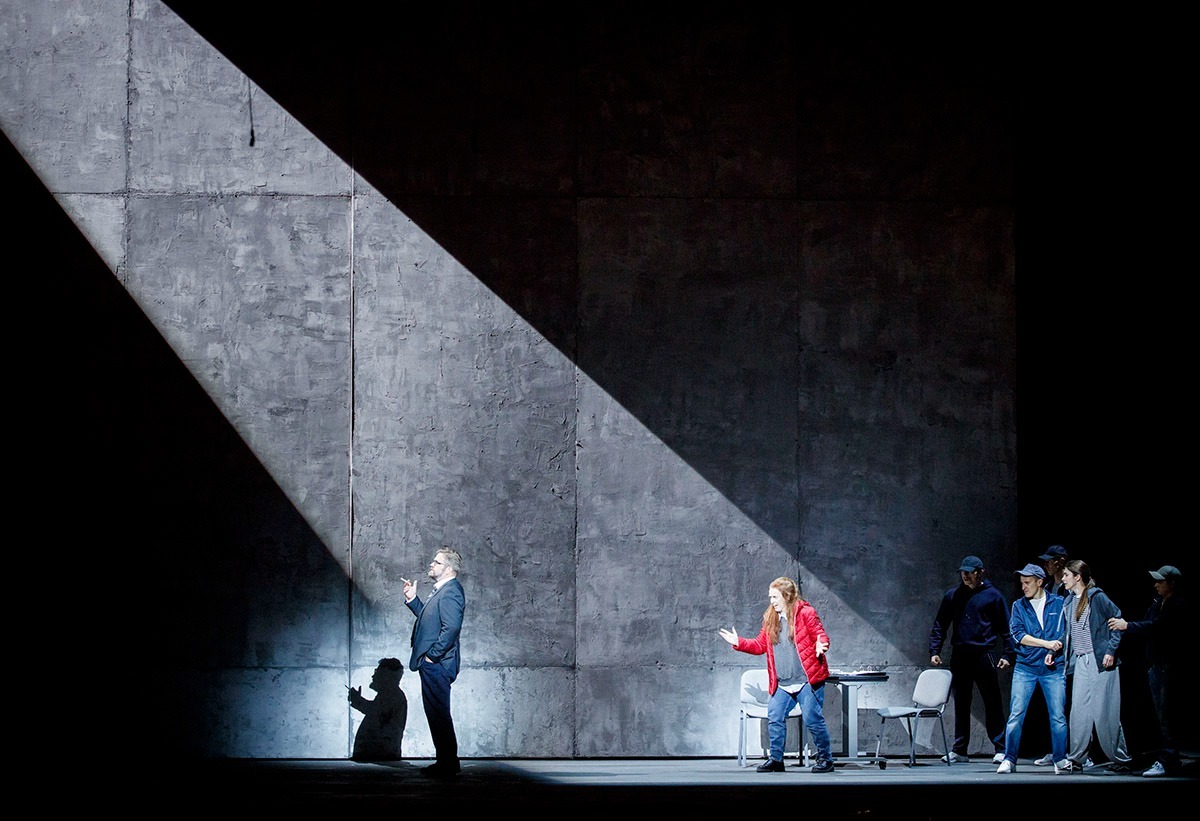
Photo: Krzysztof Bieliński/Teatr Wielki
Barbara Wysocka’s production also balanced historical realism with theatrical abstraction.
Wysocka and Artur Sienicki’s projections allowed the narrative to move quickly between locations using real footage of bombed-out Ukrainian buildings and roads. Much of Act I is set in a cavernous bunker, while modular walls in Act II, designed by Barbara Hanicka, move between the bus journey and the Crimean camp. Costumes by Julia Kornacka are as realistic as possible, from the Russian officials in military attire to the journeying mothers in jeans and winter puffer jackets. Marc Heinz’s grey and blue infused lighting complemented the costumes, somber videos, and concrete sets for an overall drab look punctuated by individual moments of color like Kateryna’s defiant red jacket and Maria Lvova-Belova’s obnoxiously spotless white dress.
A screen at the end a dedication “to the over 20,000 Ukrainian children who have not yet returned.” One can only hope that number will soon decrease. Unfortunately, audiences in New York may encounter the work in a very different geopolitical environment. Recent setbacks for Ukraine’s war effort have been linked to the same person which Peter Gelb infamously reached out to for a financial lifeline.
The Mothers of Kherson is an urgent voice not only in calling out ongoing injustice, but also as a witness to everyday acts of resilience and courage. It should not be interpreted as simply a “CNN Opera.” This worthy project and its harrowing stories will remain urgent. Its musical commemoration is one step in the right direction, a necessary effort to promote a more peaceful culture — not just for Ukraine, but a lesson for all of us.
Montagu James
Montagu James is a PhD student at Brown University studying modern European political and cultural history. He also enjoys composing and conducting.
-
People: ?ukasz Hermanowicz, Adrian Domarecki, Andrei Bondarenko, Artur Sienicki, Barbara Hanicka, Barbara Wysocka, Danuta Chmurska, Elissa Pfaender, George Brant, Hanna Sosnowska-Bill, Izabela Matu?a, Julia Kornacka, Kamila Dutkowska, Katarzyna Wietrzny, Keri-Lynn Wilson, Marc Heinz, Marcel Or?owski, Olafur Sigurdarson, Peter Gelb, Tadeusz Szlenkier, Weronika Wojtkowska
-
Works: The Mothers of Kherson
-
Places & Organizations: Polish National Opera