All about Donbas
Keri-Lynn Wilson and the Ukrainian Freedom Orchestra channeled a want for justice into fine music-making in two appearances at David Geffen Hall.
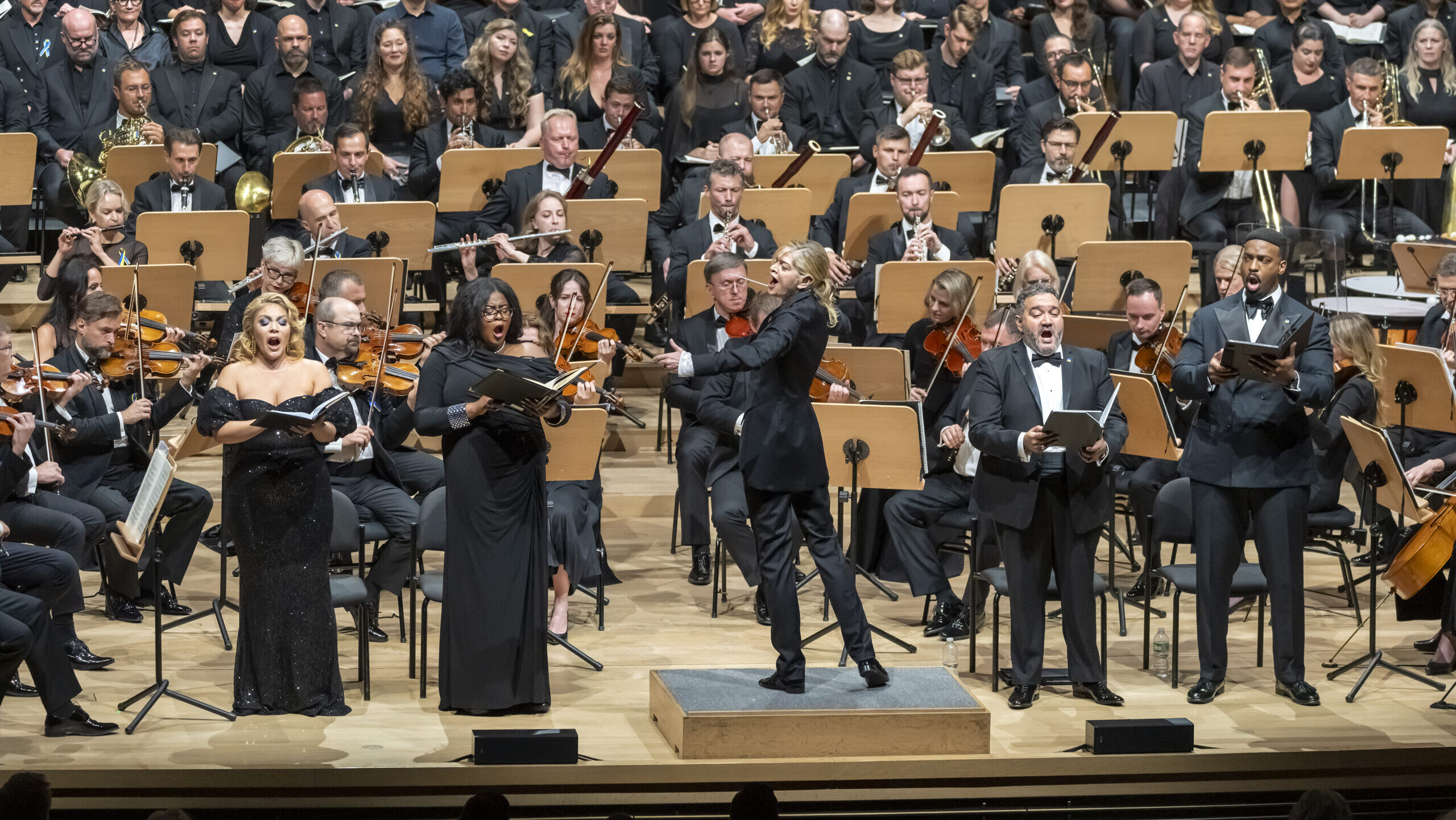
Maestro Keri-Lynn Wilson leads soprano Ailyn Pérez, mezzo-soprano Natalie Lewis, tenor René Barbera, bass Soloman Howard, and the Ukrainian Freedom Orchestra in Verdi’s Requiem at David Geffen Hall on August 26, 2026, in New York City. Photo: Richard Termine / Met Opera
Critics must always fight their prejudices in the pursuit of accuracy and truth. You can’t let personal attitudes about artists or public events cloud or color your judgment. But — it’s hard and many critics don’t even try.
In the case of the Ukrainian Freedom Orchestra, I am so moved and distressed at the plight of Ukraine fighting against evil at the hands of Russia that my critical judgment is biased. In the case of the orchestra’s founder, Music Director, and Principal Conductor, Keri-Lynn Wilson, I must deal with different prejudices that rightly concern both nepotism and the history of sexism female conductors have experienced. (I don’t know what happened in the case of the gifted Nathalie Stutzmann, but I am pretty sure if she was male, maybe it would not have ended as it did with the Met.) I am happy to report that both the Ukrainian musicians and their leader acquitted themselves superbly over two evenings last week at David Geffen Hall.
I have been favorably impressed with Maestro Wilson’s work at the Metropolitan Opera in Russian operatic repertoire leading Lady Macbeth of Mtsensk and The Queen of Spades. Her La bohème last Fall was capable but rather unidiomatic. Despite arriving with several previous career achievements, at the Met struggled to move past her role as Mrs. Peter Gelb and establish herself as an informed and capable conductor.
The Ukrainian Freedom Orchestra has embarked on its 2026 “Invincible Tour” and after six stops in Europe they wound up in New York City’s Lincoln Center on August 25 and 26. Two programs presented a wide repertory with the first consisting of Strauss’s Vier Letzte Lieder with dramatic soprano phenom Lise Davidsen, Beethoven’s Seventh Symphony, and a modern premiere: Ukrainian composer Maxim Kolomiiets’s Suite from The Mothers of Kherson. The second program centered on Verdi’s epic Messa di Requiem prefaced by a Gloria by acclaimed Ukrainian composer Bohdana Frolyak. (Some of the European dates swapped out the Four Last Songs for Mahler’s Rückert Lieder featuring German soprano Julia Kleiter.)
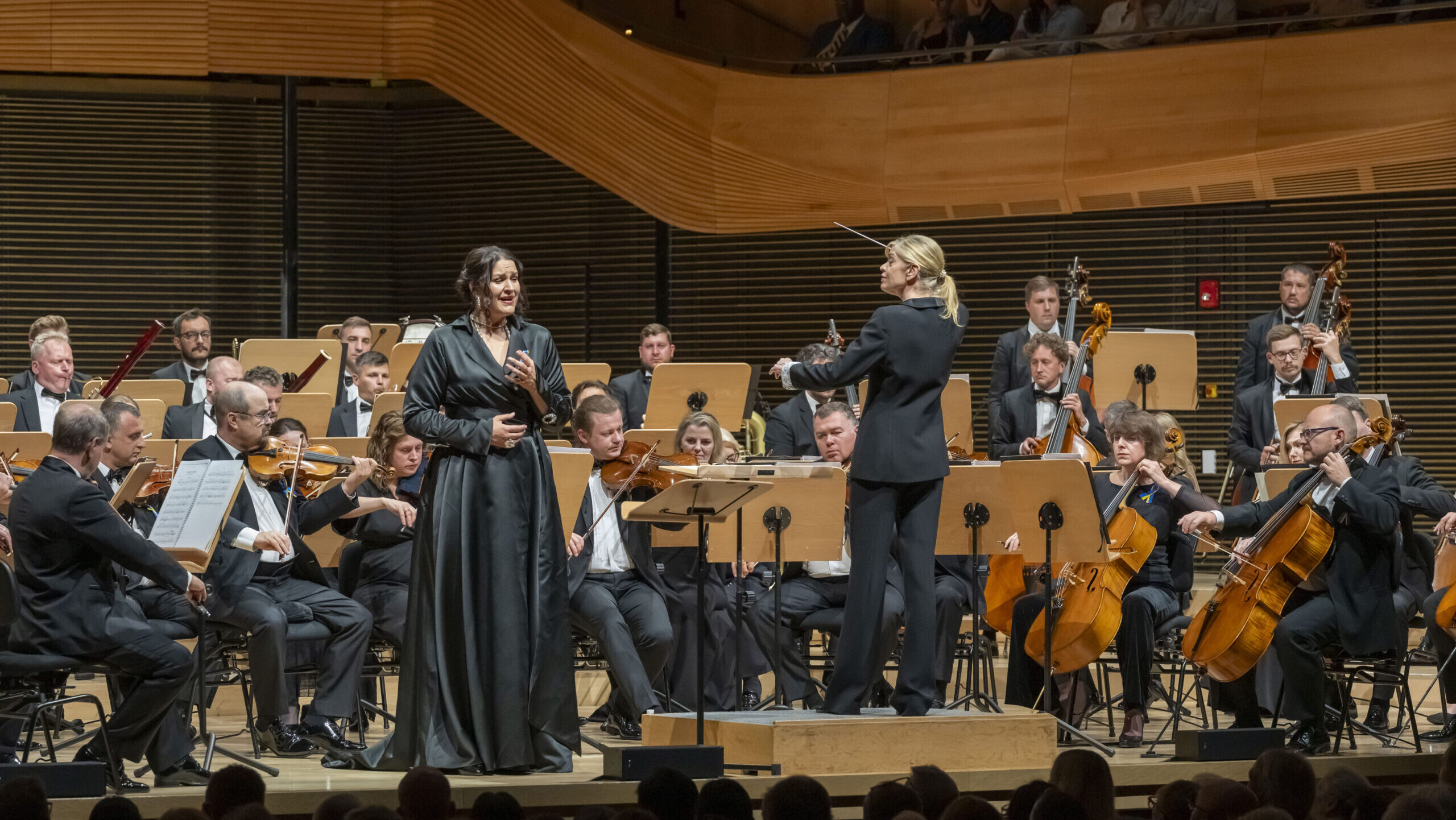
Soprano Lise Davidsen with conductor Keri-Lynn Wilson and the Ukrainian Freedom Orchestra on August 25, 2026, at David Geffen Hall in New York City. Photo: Richard Termine / Met Opera
First of all, the two Ukrainian premieres were tonal, highly listenable, well-crafted, and reminiscent of Soviet movie scores from the twentieth century – in a word: Retro. (By the way, that isn’t a knee-jerk bad thing.) They featured what a friend of mine has dubbed “tonality in crisis,” meaning dissonance and dark chordal masses in the strings. Then both pieces resolved into lyrical reflection. Kolomiiets’s Suite started out with low, dark chords that sounded like the opening of Wagner’s Das Rheingold and concluded with an ethereal message of peace. The Suite is from an opera (which will eventually make its way to the Metropolitan Opera in 2029 — if humanity, art, and democracy survive that long…) concerned with two Ukrainian mothers who travel across battle lines into enemy Russia to rescue their two sons from a summer camp-turned-prison camp. Frolyak’s Gloria also seemed a journey from doubt and despair to shimmering hope with pulsing string figures wafting towards the heavens to prepare us for the Requiem to come.
On the Tuesday program, Davidsen was intermittently lovely but seemed uneasy with the Four Last Songs. Her post-Isolde voice, unlike other sopranos known for their performances of this cycle, isn’t a naturally floaty instrument and she seemed to be gingerly navigating her way through the high tessitura of “Frühling” and “September.” “Beim Schafengehen” engaged more of her expansive, dark middle voice and in “In Abendrot” she found a more ideal balance between rich broad lyricism and floating silvery radiance. Davidsen has a complex and still-developing voice. This was not a vapid, clueless interpretation. (Reportedly she hadn’t dug below the surface of the material when she first presented it in New York with the Met Orchestra a few years ago.) My companion described her performance as a text-free vocalise, but that wasn’t my perception. She was communicating the text but her vocal production was a bit backward and focused over and up rather than forward – so words were overshadowed by tone.
I am obsessed with the Four Last Songs and collect recordings – but live performances over the decades have almost always disappointed me. (The late Margaret Price, an underpowered Felicity Lott, a shiny but empty Karita Mattila, and vocally hollowed-out Deborah Voigt). This performance had more vocal command and some memorable moments and rated a bit higher. Meanwhile, I want to hear what Davidsen does with the “Wesendonck Lieder.”
Keri-Lynn Wilson’s reading of Beethoven’s Seventh had strong forward movement with little time for reflection or lyrical expansion. It had dash, vigor and was very well played by the Ukrainian musicians. The string section was particularly clean and precise and I heard no horn bloopers at any time. It was quite invigorating.
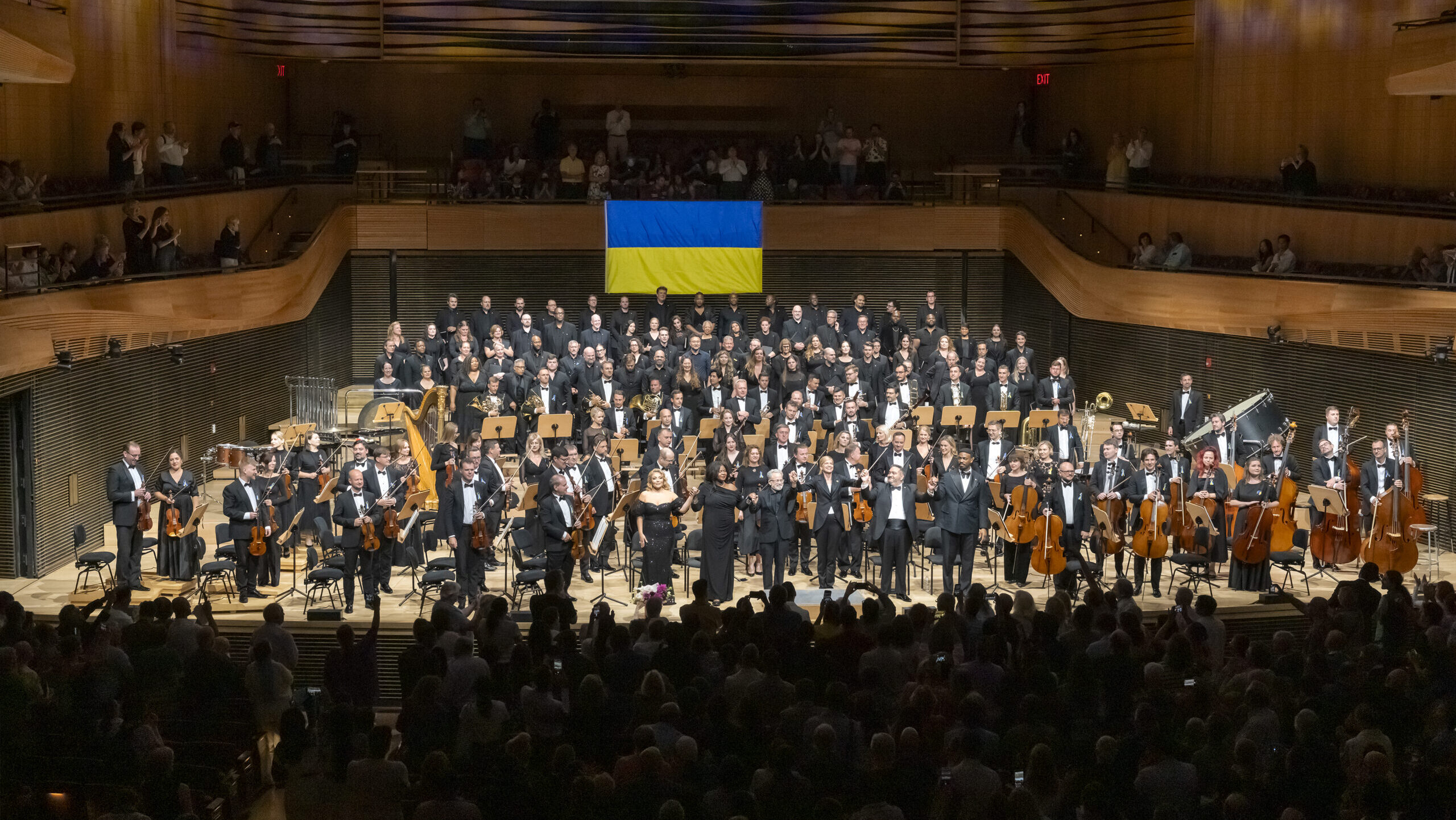
Maestro Keri-Lynn Wilson leads soprano Ailyn Pérez, mezzo-soprano Natalie Lewis, tenor René Barbera, bass Soloman Howard, and the Ukrainian Freedom Orchestra in Verdi’s Requiem at David Geffen Hall on August 26, 2026, in New York City. Photo: Richard Termine / Met Opera
The Verdi Requiem was a vast improvement over the Met’s rendition in September 2023 under their music director Yannick Nézet-Séguin which sounded like the Canadian maestro was sight-reading a score he had just received. This had much better shaping, contrast, and overall structural understanding. It was also moving and exciting with Verdian dramatic attack and drive. There was also a much more consistent and vocally authoritative quartet of soloists.
A newly blonde Ailyn Pérez, in a low-cut, tight-fitting black lace gown, sang with creamy smoothness with easy access to floated or full-throated high notes. American mezzo-soprano Natalie Lewis has a richly centered, lush tone that ranged from contralto depths to firm (if occasionally opaque) forte top notes. Ms. Lewis is based at the Bavarian State Opera but I hope she finds her way back home often. René Barbera is another American singer who sings more in Europe and should be frequently featured at the Met – he has Leicester in Maria Stuarda this upcoming season, thankfully. But he could enliven the Met’s often lackluster and repetitive tenor casting in La bohème and La traviata. Barbera’s background in bel canto repertoire proved useful here as he had elegance and agility in abundance. But it is now a mature voice with a darkening timbre which handled the more tortured, dramatic passages with aplomb. Basso Soloman Howard has a dense, focused tone that filled out the sepulchral annunciations of his deep-voiced assignment beautifully – “Confutatis Maledictis” had a few musically unfocused moments but otherwise he was a pillar of vocal strength.
The excellent quartet was backed up by a well-drilled group of Metropolitan Opera regular and extra choristers billed as the “Met Choral Artists” who were under the direction of Tilman Michael, the Met’s chorus director. Everyone held up their end beautifully and I was impressed with the control, cohesion, and musical focus of Mo. Wilson’s direction.
The audience was quite large on Tuesday night, filling up the house to the rear and upper levels, and several were dressed in Ukrainian national dress. It was an enthusiastic and festive crowd with cries of “Slava Ukrainy!” The Requiem program was less sold which was unfortunate as it was very worth hearing. An orchestral setting of the Ukrainian National Anthem (folk-like and tuneful) provided a moving encore (both nights). I found that the Freedom Orchestra’s message of solidarity, idealism, and bravery was backed up by the high level of artistry of all involved.
-
Topics: Review, ukrainian freedom orchestra
-
People: Ailyn Pérez, Keri-Lynn Wilson, Lise Davidsen, Natalie Lewis, Nathalie Stutzmann, René Barbera, Soloman Howard, Tilman Michael
-
Works: Four Last Songs, Requiem (Verdi)
-
Places & Organizations: Ukrainian Freedom Orchestra