Would you say I have a plethora of piñatas?
Domingo Hindoyan makes an auspicious debut as LA Opera’s Music Director against a distractingly busy production of Carmen.
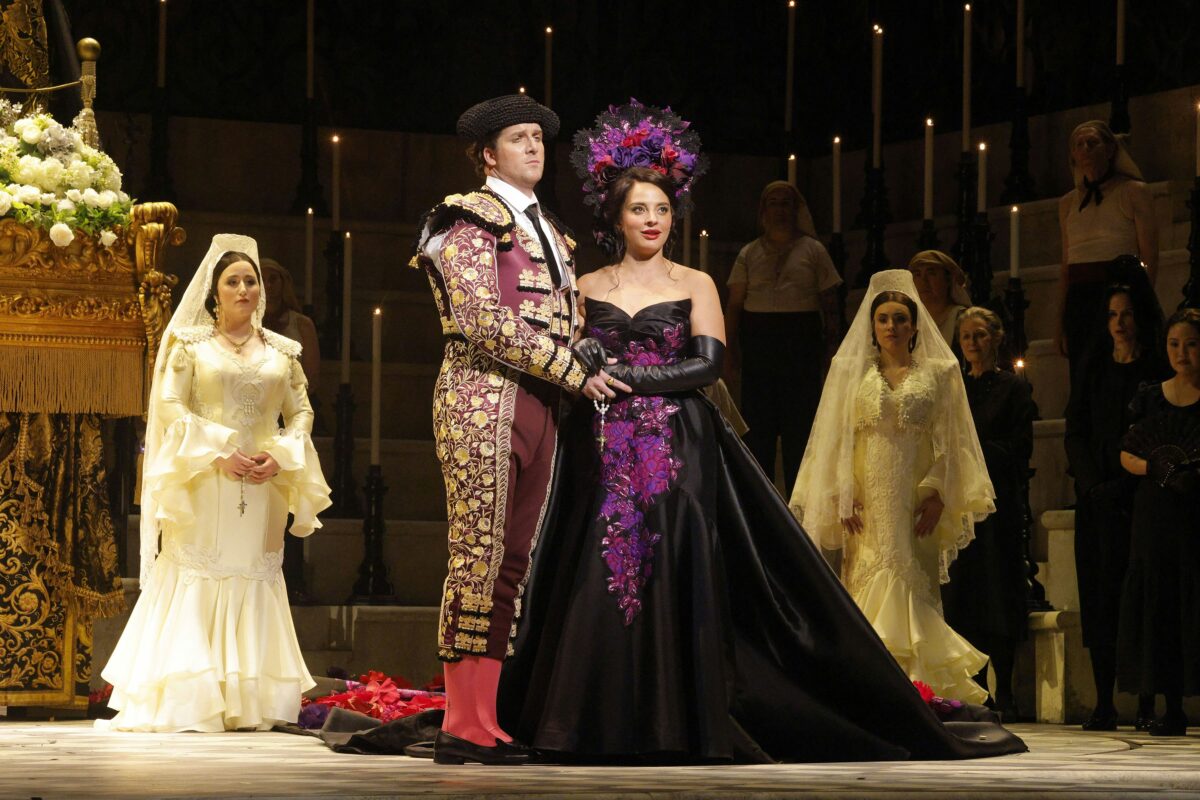
Liam James Karai as Escamillo and Rihab Chaieb as Carmen (with Katie Trigg, left, as Mercédès and Gabrielle Turgeon, right, as Frasquita) in LA Opera’s 2026 production of Carmen. Photo: Cory Weaver
They say change is what is needed to promote growth. Judging from the audience’s reactions last Saturday, Los Angeles Opera’s season opener of Georges Bizet’s perennial Carmen proved that the arrival of Venezuelan conductor Domingo Hindoyan as the third Music Director in its 40-year history seemed to revitalize the operatic scene in Los Angeles. Like other opera companies in the US, it has been struggling with dwindling sales and rising costs, forcing inevitable cuts to the number of performances (down to six staged operas this season). The sold-out event, along with a glamorous Opera Ball featuring flamenco dancing and well-heeled luminaries, brought palpable excitement back to the Dorothy Chandler Pavilion, a hopeful sign for LAO’s future.
A lot has been written in the press about Hindoyan. The 46-year-old conductor was named the new Music Director in May 2025, following his triumphant debut in Gounod’s Roméo et Juliette two years ago. The son of an accomplished violinist, he graduated from the renowned Venezuelan music program El Sistema, as did another charismatic Venezuelan (and a close friend) who left the city last season, Gustavo Dudamel. Like Dudamel, Hindoyan aims to commission new works and emphasize community outreach, including adding an opera component to Youth Orchestra Los Angeles (YOLA), which Dudamel started.
On Saturday, Hindoyan clearly demonstrated why he was the perfect man for the job, leading the LAO Orchestra in a fiery, passionate reading. Bizet’s score came fully alive in his hands; the strings sounded bright and sonorous, and the percussion — particularly the castanets — worked extra hard to enliven the many dance rhythms. The preludes were especially thrilling, as if preparing the audience for the chapters to unfold. As the late Patrick Mack noted in his review of Roméo (linked above), his greatest strength was his keen sensitivity to the singers; despite all the vigorous music-making in the pit, he kept all the singers clearly audible to the audience and sustained the energy throughout. Little wonder that he received the loudest cheers during the final bows!
In the title role, Rihab Chaieb was simply marvelous. With a dark timbre and as a native French speaker, she embodied the femme fatale to a terrifying degree, conveying equal measures of seductiveness and danger in both her voice and, particularly, her acting. She clearly saw herself in the role, and emphasized Carmen’s freedom through her body language. In a role that has to tread the line between sexiness and nastiness, she managed to find a balance that presented a fully developed character. She moved very well on stage, even joining Antonio Najarro’s choreography while playing castanets — a triple threat!
Even more stunning was her rival, Micaëla, who was sung by Kathleen O’Mara with jaw-dropping intensity that threatened to steal the show whenever she appeared. While Chaieb brought a dangerous persona, O’Mara’s clear, bright voice embodied purity and innocence, creating a striking vocal contrast between the two. She was particularly mesmerizing in “Je dis que rien ne m’épouvante” in Act III, where she demonstrated her steely determination to save Don José at all costs. That aria was one of the highlights of the night, beautifully supported by Hindoyan.
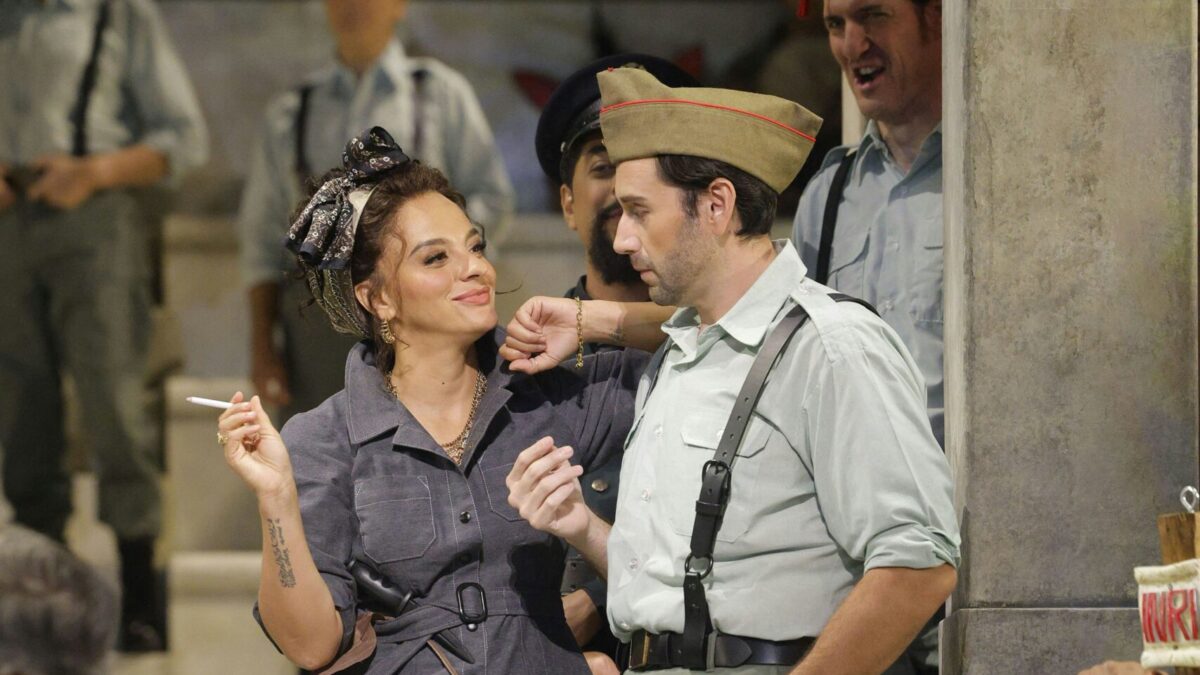
Rihab Chaieb as Carmen and Joshua Guerrero as Don José in LA Opera’s 2026 production of Carmen. Photo: Cory Weaver
Former Domingo-Colburn-Stein artist Joshua Guerrero completed the love triangle as Don José, the naïve soldier who undergoes the opera’s most extreme transformation. Guerrero sang earnestly, with top notes that rang out at the climaxes, though in the acting department, he sometimes disappeared into the crowd onstage. It was unfortunate that his final scene was bogged down by unnecessary stage action (more on this later), which made it less impactful. Debuting Liam James Karai turned in a suave, pompous Escamillo, though on Saturday he took a long time to warm up, making the famous “Votre toast” sound choppy and breathless. He was much better in the reprise at the end of Act III.
Current Domingo-Colburn-Stein young artist members filled the small roles and excelled collectively, elevating the night’s musical aspects. Soprano Gabrielle Turgeon and mezzo Katie Trigg beautifully complemented Chaieb’s Carmen as Frasquita and Mercédès, lending the card-game trio in Act III a harmonious significance. Similarly, tenor Samuel Wallace and baritone Mario Manzo provided a brief comic respite (and an act of violence in Act III) as Le Remendado and Le Dancaïre, while Vinícius Costa turned in a sinister Zuniga. Lastly, Ryan Wolfe assumed the role of Moralès, Don José’s colleague. The Opera Chorus and Los Angeles Children’s Chorus also delivered a strong showing under Jeremy Frank’s direction.
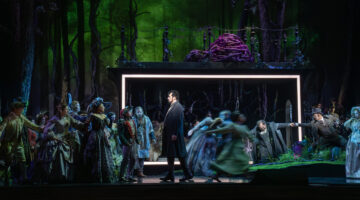
LAO entrusted the production of Carmen to Thaddeus Strassberger, who had staged three other shows for LAO before (including this season’s revival of Nabucco). This Carmen is a co-production with Houston Grand Opera and Detroit Opera. In his Director’s Note, he outlined his lofty vision, drawing heavily on Cristina García Rodero’s landmark España Oculta (and, to a lesser extent, Pedro Almodóvar) for visuals to present Carmen as “a procession of the sacred and the profane.” He worked closely with choreographer Najarro, costume designer Mattie Ullrich, lighting designer Pablo Santiago, and projectionist Greg Emetaz. Strassberger also designed the sets.
While I tried hard to love this behemoth (and massively expensive) show, many factors worked against it, in my opinion. Carmen is notoriously difficult to stage, particularly because of its subject matter. It is the story of ordinary people, set in an exotic location, with an exquisite (and very danceable) score. If one aims for realism, the show can be drab; at the opposite extreme, it threatens to become a circus.
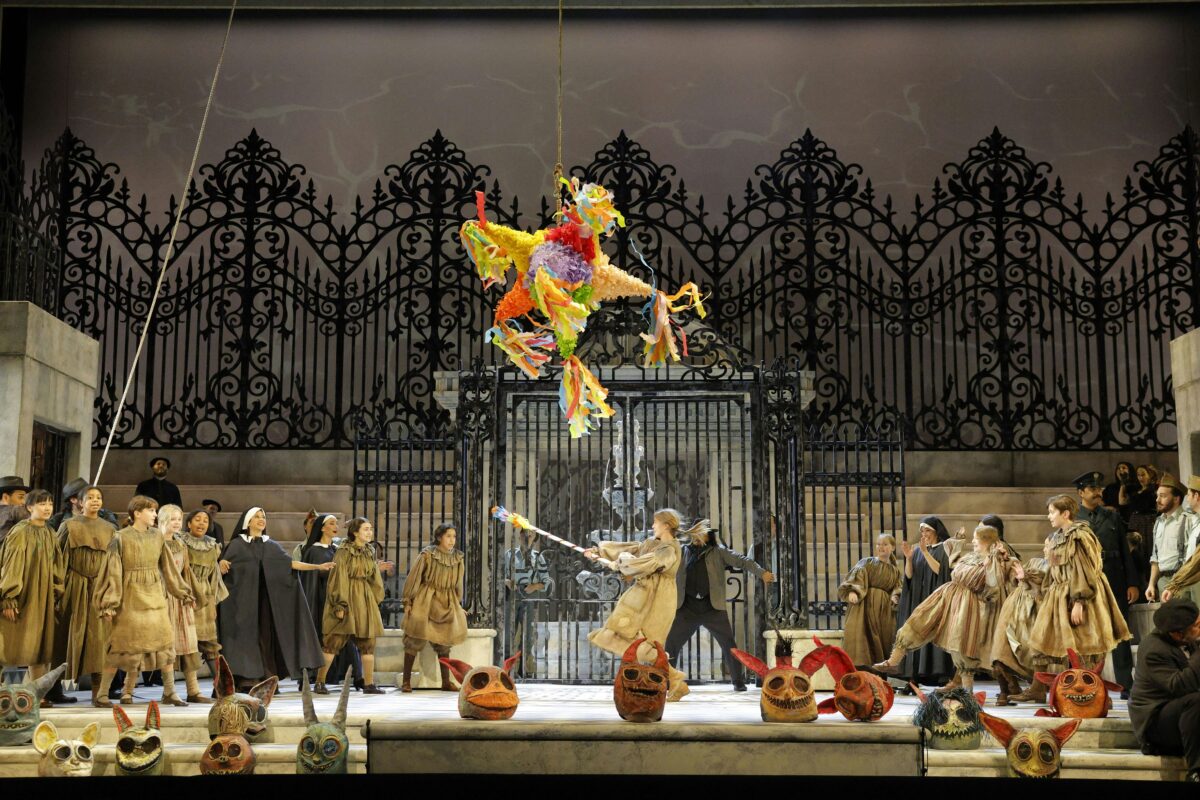
Members of the Los Angeles Children’s Chorus in LA Opera’s 2026 production of Carmen. Photo: Cory Weaver
On paper, his ideas sounded grand, but the execution became problematic as he adopted maximalism as his modus operandi, literally throwing everything but the kitchen sink into the show. As a result, the dramaturgy suffered. Worse, he added so many extraneous elements that bogged down the pace of the opera Hindoyan built so lovingly, with its forward momentum. There were many examples of this unfortunate self-indulgence: In the first act, the scene of breaking a giant piñata, coupled with kids running around in animal masks, made me think the opera was set in Mexico. Strassberger decided not to use the dialogues or commit to Ernest Guiraud’s recitatives, but instead used prerecorded spoken words blasted from above the stage, creating a jarring sound effect. Don José performed self-flagellation in the last act, looking more like a sad monk from The Da Vinci Code than a man driven mad by jealousy. A helicopter (à la Miss Saigon) descended from the ceiling to deliver what looked like shiny handbags to the smugglers in Act III.
But the pièce de résistance was that Micaëla morphed into the Virgin Mary and became the center of a 10-minute-long Holy Week procession, Semana Santa, right between Act III and the Act IV prelude, breaking the continuity of the story (I couldn’t believe that Hindoyan would be willing to wait for the procession, even led the Orchestra in a short instrumental section after!). I think Bizet knew exactly what he was doing with that transitional prelude: juxtaposing Don José’s threat with the aftermath! Luckily, Najarro’s delectable choreography saved the day, even when he replaced the bullfighters’ procession with flamenco dancing! I’m not a traditionalist; I just need everything to make sense dramaturgically!
Despite my reservations about the production, I still think this was a tremendous achievement for LAO and an auspicious start to a new era. I was grateful to be part of such a historic moment. If you can find tickets, you’ll be wise not to miss it. Welcome to Los Angeles, Maestro!
-
People: Antonio Najarro, Domingo Hindoyan, Gabrielle Turgeon, Greg Emetaz, Jeremy Frank, Joshua Guerrero, Kathleen O'Mara, Katie Trigg, Liam James Karai, Mario Manzo, Mattie Ullrich, Pablo Santiago, Rihab Chaieb, Ryan Wolfe, Samuel Wallace, Thaddeus Strassberger, Vinícius Costa
-
Works: Carmen
-
Places & Organizations: Los Angeles Opera