Say it ain’t so, Gio
Opera Baltimore strikes out with an uninspired production of Don Giovanni.
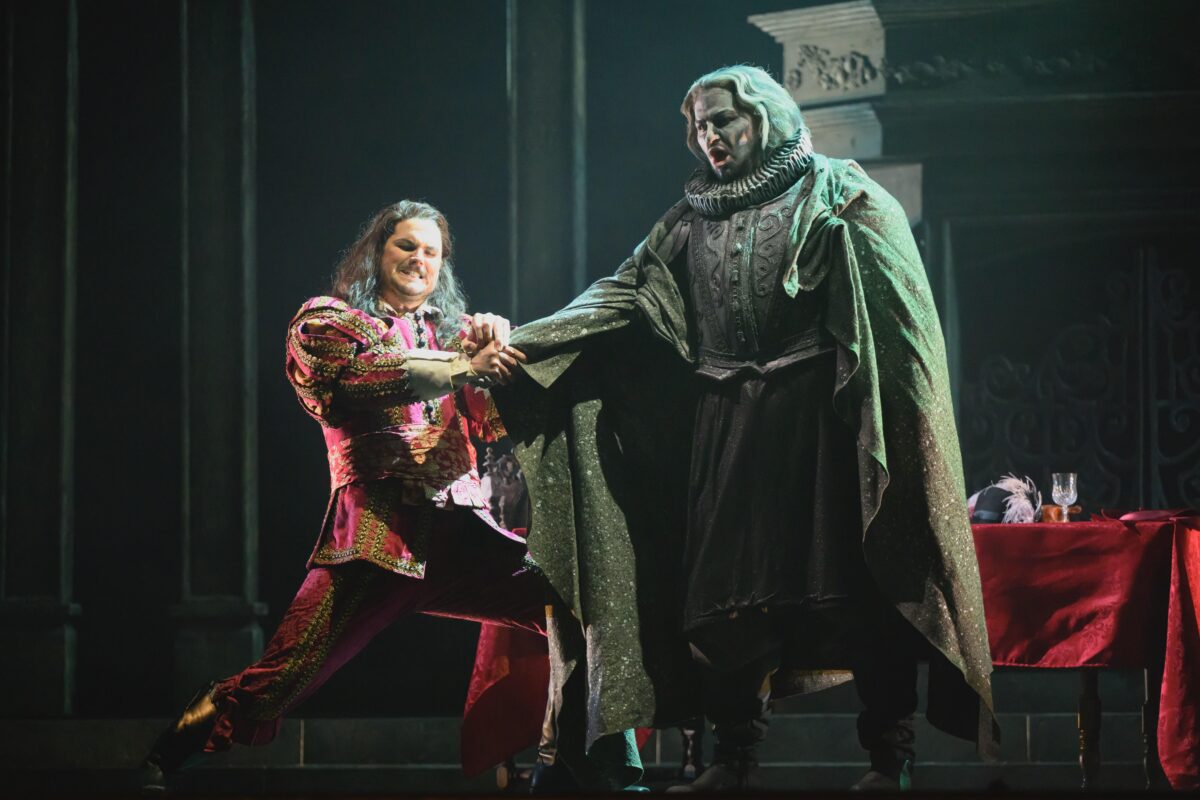
Photo: Opera Baltimore
There’s a scene in the 2011 film Moneyball that sums up what is, essentially, the problem with many small opera companies today. A bunch of grizzled baseball men — and a chubby, scene-stealing Jonah Hill — sit around a table. The Oakland A’s are in a pickle: The organization just lost its left-handed slugger, Jason Giambi, in a bidding war to the big-market New York Yankees, and are debating ways to replace him. Brad Pitt, playing the ballplayer-turned-executive Billy Beane, proposes an unusual solution: the obscure, “defective” veteran catcher, Scott Hatteberg. Objections abound. “He can’t throw, and he can’t field,” a calm Brad Pitt intones over a table crackling with hostility. “But what can he do? … He can get on base.”
Opera companies in smaller markets, like Baltimore, experience a similar problem to the Oakland A’s. These companies don’t have a huge donor base. It’s hard to gin up excitement for any production. Yet, it seems, they continue to crater their budgets on polite, respectful productions perhaps better-described as museum pieces — sets, costumes, blocking, and staging, all unthinkingly regurgitated and placed under a glass for our wonderment. And all of it is safe, palatable, and boring. Such was Opera Baltimore’s performance of Mozart’s Don Giovanni last night: reheated quasi-Zeffirelli for the masses (a co-production with Opera Delaware directed for the stage by Haley Stamats, though I wonder how much say the director of such acclaimed productions as Pittsburgh Opera’s Gluck’s Iphigénie en Tauride and Mazzoli’s Proving Up had in the mise-en-scene for this production). Even the frisson of Mozart, the remaining salvation to the proceedings, was at times foiled by subpar playing, especially in the high strings and with some of the lead singers, though the conductor, Joshua Horsch, kept it light throughout. Taking routine applause as a given, taking a casual theatergoing public as a given, taking the featureless college auditorium as a given, it was, all-around, a middling performance.
Sarah Coit, as Donna Elvira, was thin-voiced and shrill to my ear, with a fast vibrato, yet dealt with the quick leaps of “ah, chi mi dice mai” with precision. There is something to delight in the vigorous, driving strings in this passage, spurring on the jilted Elvira, and the whole scene was musically superlative. Dylan Gregg was capably comedic as the beleaguered servant Leporello; his Catalogue Aria — and pantomime below Donna Elvira’s window — which featured a list that popped out of the book, drew some of the biggest laughs of the night. Hayden Smith, whose voice seemed much smaller here than at the smaller venue of the Engineer’s Club in last year’s Lucrezia Borgia, nonetheless gave a solid, sweet-voiced rendition of Don Ottavio’s aria, “Il mio tesoro.” Yet of the cast, only Katerina Burton truly stood out. Her loud, penetrating, crystalline voice soared over all others. Not only that, she is a serious dramatic talent. Her diction was impeccable, noticeably better than anyone else on stage. Her “Non mi dir, bell’idol mio… ” was, without hyperbole, a slice of heaven, filled with an aching loveliness.
Some may complain that I’m putting too much emphasis on the staging. But this is not a concert opera. Staged opera should also have a scenic and atmospheric thrust; it should inject life into the veins of the work. And on this score, it must be said that the costumes (borrowed from Sarasota Opera Association, Inc.) and scenery (on loan from Tri-City Opera) felt threadbare. A discreet attempt to roll up the 2D trees, for example, met with laughter from my neighbor; several singers, by a mere touch of this scenery, exposed it as cheap, chintzy material. There were some odd choices, too. The mask that the Don (Jonathan Bryan) wears in the beginning, before he fights the Commendatore (played with stentorian heft by Matthew Anchel), covered the singer’s mouth – or it at least sounded like it, producing an irksome muffled effect. One wonders what an alternative approach to this opera, with the same resources, may have been.
I mentioned the driving force behind this above: money. While it has always been hard, if not impossible, to uncouple art from commerce, the extent to which that uncoupling takes place is up to opera producers. More than simply putting on a safety blanket of works, these people are responsible for keeping opera relevant and alive. Dry, dusty stagings, with second rate performance do not accomplish this — and besides, as one opera executive told me recently, big donors will give to a company out of respect for vision. As an urban planner in the public sector, I’m constantly reminded of how the talents of good, hardworking planners and engineers are squandered on the whims of leadership and a fickle public. Likewise, the artistry of these singers, several of whom displayed top-notch dramatic chops, is wasted on rudderless, muddled productions.
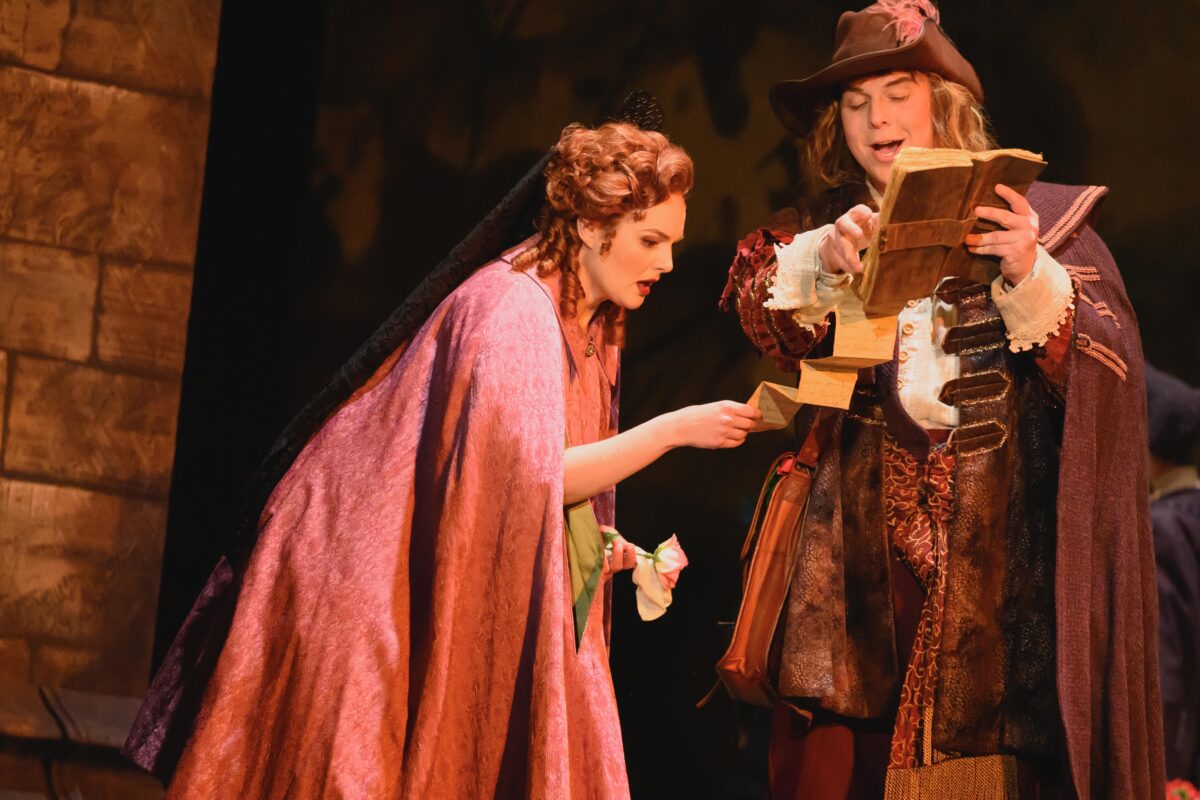
Photo: Opera Baltimore
To extend the baseball analogy for a moment. As I was explaining my thoughts to a friend recently, I was met with a curious response: well, the Baltimore Orioles and Maryland Blue Crabs — a major league and minor league baseball team, respectively — are different organizations giving different products. Indeed, there are plenty of advantages a minor league experience has over a major league one: a more intimate environment and cheaper tickets to name two. But the fixed variables for a company like Opera Baltimore are fewer than with the Blue Crabs. Opera Baltimore can offer something even more provocative and, in some respects, more valuable than the big houses: jarring entrenched art loose from familiarity through unusual approaches, taking liberties with old scores and plots, pursuing venues that respond to the drama, using multimedia approaches in staging, and on and on. Applied to baseball and the same logic devolves into something closer to the Savannah Bananas.
Moneyball, the strategy of doing more with less through unconventional means, succeeded beyond the A’s wildest dreams. It completely rewired the DNA of organizations across baseball, from scouting to player development to free agent acquisitions. But it required courage to go against the grain. So, to the artistic team at Opera Baltimore, to its Board of Directors, to its audiences throughout the region: I’m making the moneyball case for opera. Let us debride the dramaturgical deadweight. Let us pursue living drama through immortal music. There is an opportunity cost to unthinkingly recycled productions, and, in an era of retrenchment for arts funding, it has become increasingly unacceptable to sacrifice good art at the altar of convenience and familiarity. We are trying to cultivate a new generation of fans, after all.
As the pioneering opera director, Gerard Mortier, once said: “We cannot merely offer the audience what it thinks it wants. Instead, we have an opportunity to give them something they never even knew they needed.”

Brendan Latimer
Brendan Latimer is a writer and urban planner based in Baltimore, MD. He invented the dark chocolate with orange juice combo. You can find him on Instagram at @b_lat_ and @operanoises.
-
Topics: mozart, Review, the current state of american opera
-
People: Dylan Gregg, Haley Stamats, Hayden Smith, Jonathan Bryan, Joshua Horsch, Katerina Burton, Matthew Anchel, Sarah Coit
-
Works: Don Giovanni
-
Places & Organizations: Opera Baltimore