Accept this offering
Austin Opera inaugurates its new permanent home with Ofrenda, an intimate tribute to the city’s Latine community.
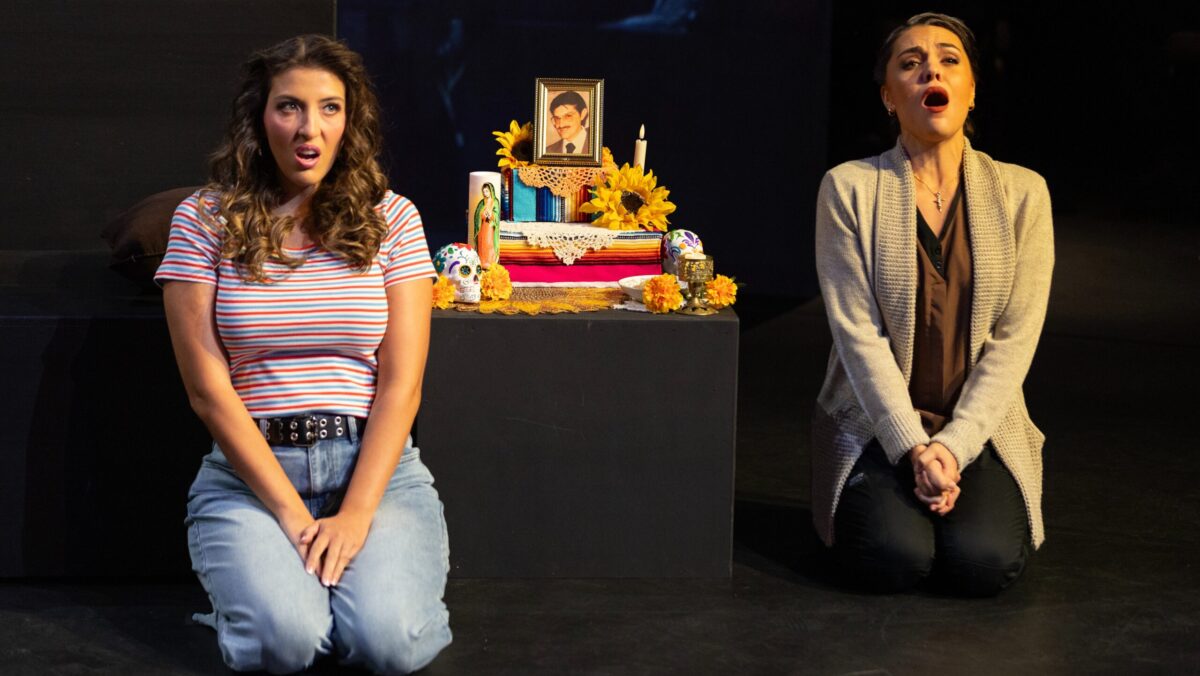
Photo: Erich Schlegel
Premiering during Hispanic Heritage Month, Austin Opera’s first commissioned opera, Ofrenda, engages Austin’s Latine community — representing more than one-third of the city’s population — while making a new contribution to the tradition of Spanish-language opera. At the newly opened Butler Opera Center, the company’s new home, Ofrenda is a collaboration between composer Jorge Sosa and librettist John de los Santos, made possible by Austin Opera’s establishment of the Curator of Hispanic and Latinx Programming position.
The opera arrives amid a growing interest in Spanish-language opera, reflected in the Metropolitan Opera’s performances of Daniel Catán’s Florencia en el Amazonas and Gabriela Lena Frank’s El Último Sueño de Frida y Diego. Ofrenda focuses on the lives of Mexican American women in the United States, drawing inspiration from B. Traven’s adaptation of the Brothers Grimm’s “Godfather Death,” which is set in Mexico. Sung in both English and Spanish and incorporating elements of Mexico’s Día de los Muertos (Day of the Dead) tradition, the opera ultimately turns our attention to questions about life, death, and what it means to be human.
Sosa wrote Ofrenda during the COVID-19 pandemic, a period that led him to think about healing and, in particular, Mexico’s curanderas (traditional healers). In his earlier opera I Am a Dreamer Who No Longer Dreams, Sosa explored the struggles of immigrants, while his Alice in the Pandemic project sought to create “a moment of solace” through music. Ofrenda brings together two concerns that have long informed Sosa’s work — social justice and healing — while the opera uses Mexican American identity as the cultural context for a broader meditation on healing, sacrifice, and care.
Sosa approached de los Santos about adapting an opera from Traven’s tale, and de los Santos expanded the story by incorporating his Aunt Francis’s experiences coping with illness and mortality during her career as a hospital nurse. These stories became part of the character of Macaria, a Mexican immigrant mother who works as a hospital custodian at St. Margaret’s Hospital. De los Santos’s adaptation unfolds across fourteen scenes in a tightly constructed 90-minute chamber opera, moving quickly without making the narrative difficult to follow.
At its center are Macaria and her daughter, Pina. When Pina suddenly falls ill, Macaria encounters Señora, the figure of Death, on her way home by bus and receives from her a bottle of tears with the power to heal the dying. Macaria uses the water to cure Pina and then begins secretly healing patients at St. Margaret’s Hospital. When nurse Gary discovers that she has been healing patients, Macaria is asked to save his and hospital administrator Carla’s premature baby, agreeing to do so in exchange for a chance for Pina to attend medical school. Twelve years later, Pina, now a doctor, visits her mother’s grave, bringing the opera to a quiet conclusion centered on sacrifice, memory, and healing.
Sosa’s music gives wings to a compact, fast-moving story, making its narrative easy to follow without sacrificing musical interest. He occasionally draws on rhythms associated with Latin music, offering the Latine community a sense of familiarity, but these gestures feel motivated by the drama rather than merely decorative. For instance, a habanera rhythm emerges as Gary and Carla seduce one another, underscoring the sensuality and ambiguity of their affair and perhaps evoking the “Habanera” from Bizet’s Carmen. Señora’s appearances are marked by her own recurring theme, set against an ostinato that recalls the opening rhythm of Chopin’s Funeral March. The theme immediately evokes an association with death, but its repeated presence before Macaria’s first encounter with Señora in Scene 4 also invites reflection on the different ways human beings confront and relate to death.
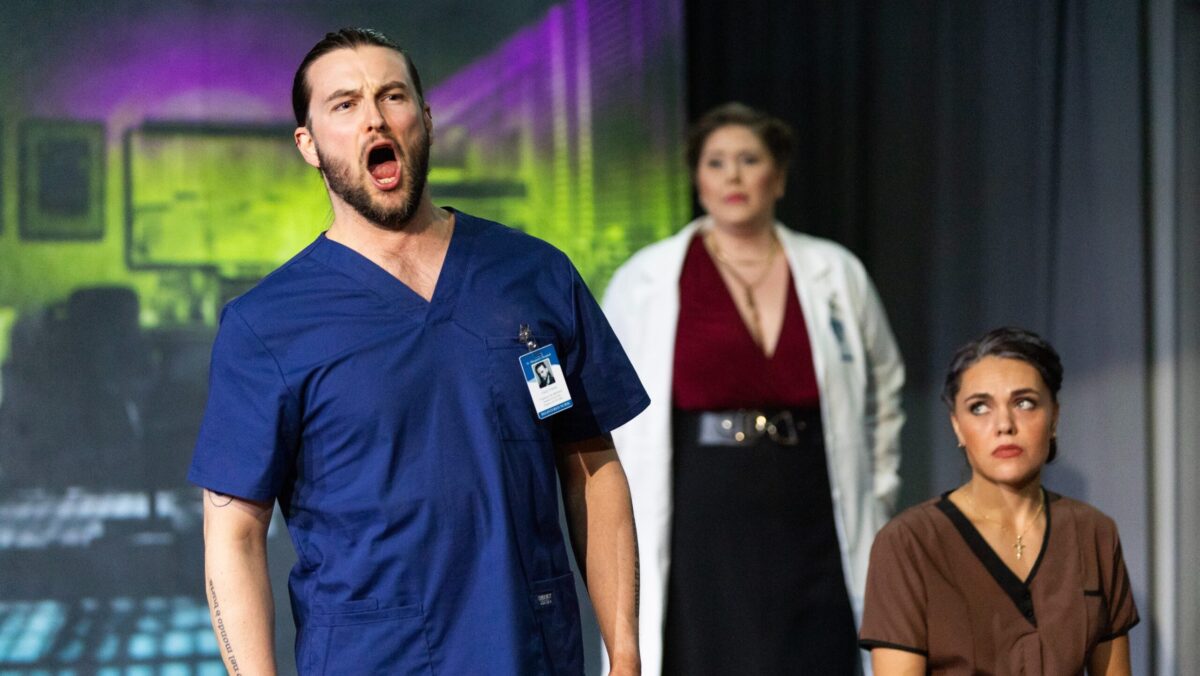
Photo: Erich Schlegel
Conducting the chamber ensemble, Timothy Myers was equally impressive. He brought an alert musical flexibility to Sosa’s score, at times shaping the ensemble with the intimacy and precision of a string quartet, and at others with the energy of a Mexican band, giving the music a palpable sense of life.
As Macaria, Kelly Guerra offered a clear and distinctive interpretation of the character. Macaria appears in most of the opera’s scenes: she works tirelessly at the hospital, sacrifices herself for her daughter’s future, and, as a woman of the middle generation, prays beside an ofrenda for her deceased husband and believes that he has appeared to her in the form of a monarch butterfly. Guerra conveyed her ability to endure the weight of life with a powerful voice and expressive facial expressions and gestures. She also moved seamlessly between Spanish and English, languages that often alternate within the opera, capturing the particular emotional qualities and modes of expression of each and making the character readily accessible to the audience.
Peru-born soprano Maia Aramburu, as Pina, effectively conveyed the contrast between the character’s younger self and her life twelve years later. Pina mocks her mother’s belief in the monarch butterfly and impatiently waits for a call from her boyfriend, while also facing repeated rejection from medical schools. Aramburu brightened and lightened her beautiful voice to capture the younger generation’s spirited and playful energy. In the final scene, when Pina sings an aria at Macaria’s grave, remembering her mother twelve years later, Aramburu added a fuller resonance to her voice, suggesting Pina’s greater maturity. At first, her voice did not quite fill the hall, but in the opera’s final moments, as tears welled in her eyes while she conveyed that her mother’s sacrifice had not been in vain, her voice gained greater presence. As this was the opera’s premiere, it will be exciting to see how she continues to grow into the role.
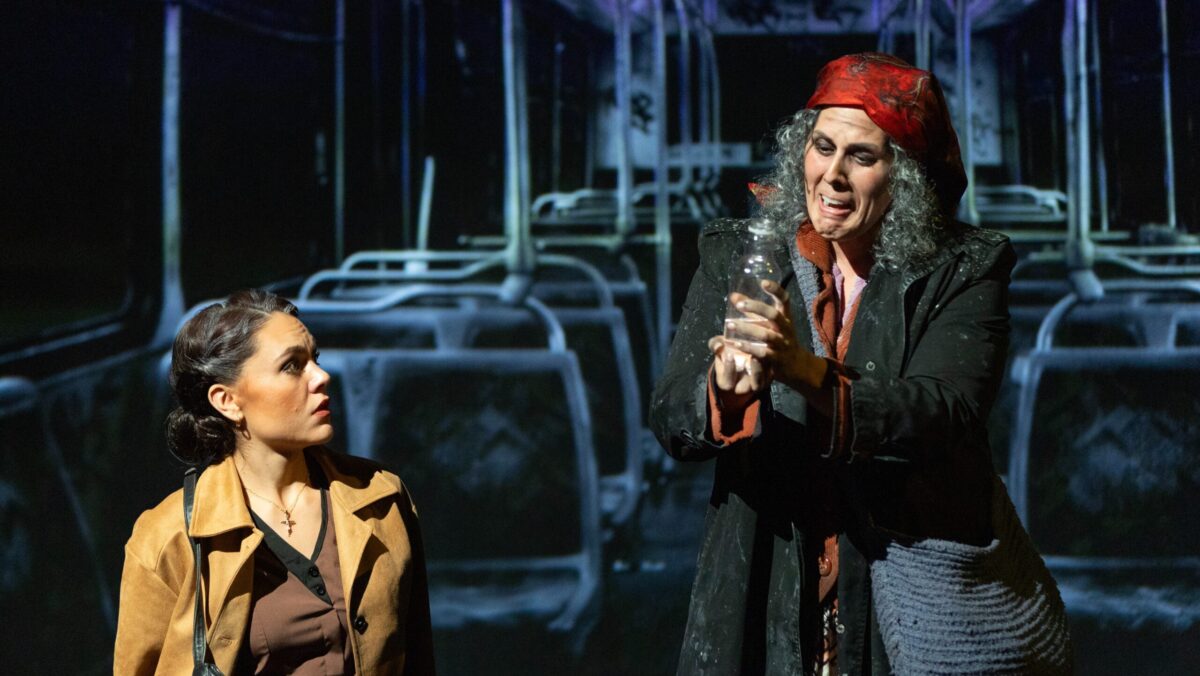
Photo: Erich Schlegel
As Señora, Victoria Vargas vividly embodied the many facets of Death. Her role demands a weighty vocal presence and sustained, melismatic lines, which she handled with ample breath support and a distinctive vibrato. In her first encounter with Macaria, Vargas exchanged jokes with her and deliberately adopted an awkward laugh that elicited laughter from the audience. Later, when Macaria begs her to save Carla and Gary’s baby, Vargas shifts to a firm vocal and physical presence, insisting that only Macaria’s own sacrifice can save the child. Through these contrasting moments, she effectively conveyed the many ways in which human beings confront and relate to death.
Kristin Bilodeau and Kyle White, as Carla and Gary, provided some of the opera’s comic relief while also demonstrating a broad dramatic range. They brought playful comedy to their scenes of seduction, then shifted convincingly to seriousness and desperation when they plead with Macaria to save their baby. Bilodeau’s delivery was consistently precise and assured, while White was particularly effective in his pleading tone.
With Ofrenda, Austin Opera not only marks the opening of its new Butler Opera Center but also demonstrates the possibilities of creating chamber opera on a smaller scale. By telling a Mexican American story that ultimately expands into a story about Austin —and, more broadly, about what it means to be human— the opera offers the city’s Latine community a point of recognition while also proposing one possible answer to the question of where contemporary opera might go next. Ofrenda‘s final performance is October 11.

Seokyoung Kim
Seokyoung Kim is a PhD candidate in musicology at the University of Texas at Austin. Her research interests include opera studies, contemporary music, the use of Eastern materials in American experimentalism, and music criticism. Her dissertation project examines Chinese-born composer Huang Ruo's opera M. Butterfly (2022), an adaptation of Puccini's Madama Butterfly, focusing on interculturality and issues of minority representation.
-
Topics: austin opera, new opera, Review
-
People: John de los Santos, Kelly Guerra, Kristin Bilodeau, Kyle White, Maia Aramburu, Timothy Myers, Victoria Vargas
-
Works: Ofrenda
-
Places & Organizations: Austin Opera