Wedding crashers
Louise Alder enchants in the comically-inclined revival of Claus Guth’s production of Semele at the Bayerische Staatsoper.
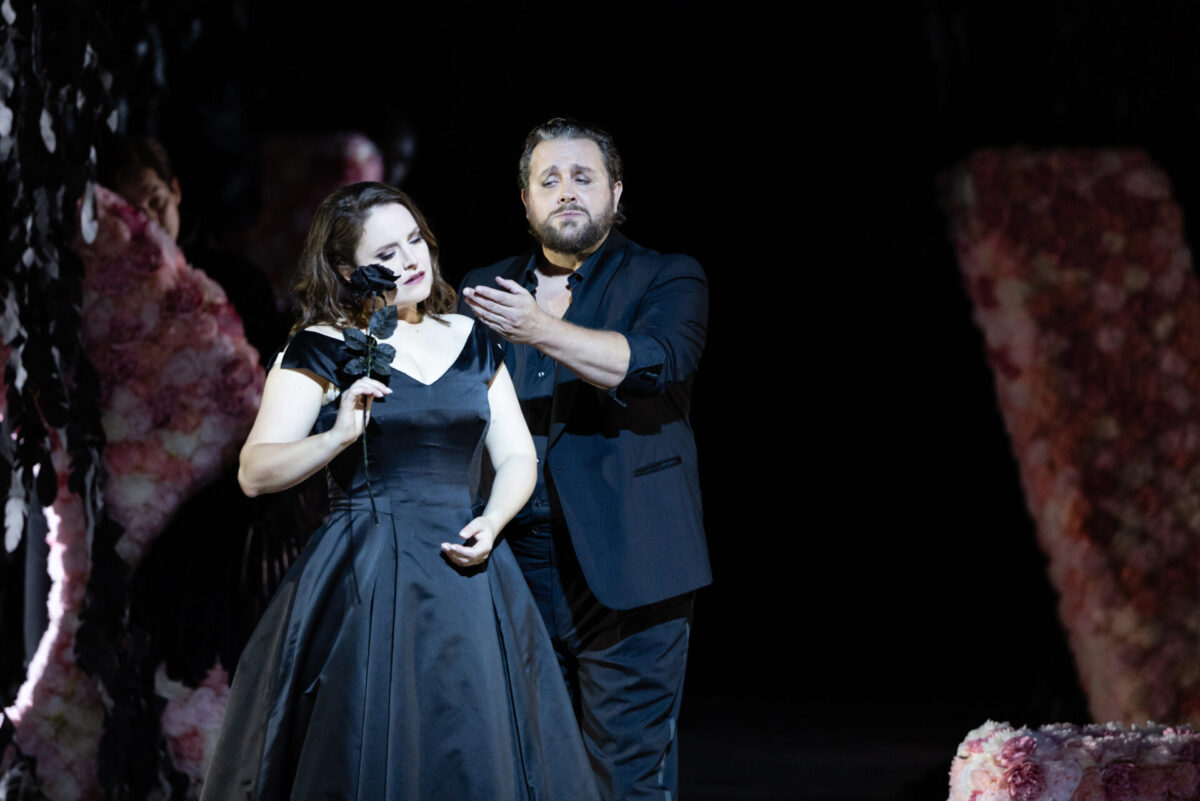
Photo: Geoffroy Schied
Getting cold feet at the altar and deciding to run off with some guy rather than tying the knot: Handel’s Semele tells a tale old as time. Less than usual is the ensuing chaos, as the runaway bride’s new beau happens to be the king of the gods, married to a very jealous wife — ensuring that the divine love affair ends in death and destruction.
Wrapped in the respectable robes of antiquity, Semele, performed “after the manner of an oratorio” at its 1744 premiere, was demeaningly characterized by Handel’s friend and librettist Charles Jennens as “a bawdy opera”. For a good reason: its libretto had originally been written by William Congreve in 1706, and its subject stands out among Handel’s oratorios, as it is concerned not with allegorical, Biblical, or Christian themes, but Jupiter’s romantic exploits. This is undoubtedly why it has been one of the most often staged works of Handel’s oratorio output, too, mixing the essentially dramatic nature of an opera libretto with the greater musical–structural variety of oratorios, resulting in one of Handel’s most dazzling and inventive scores.
Dazzling, too, was Claus Guth’s staging of the work at the 2023 Munich Opera Festival. At its premiere, the production offered some of what Guth does the very best: a stark psychological reading of a woman fatefully caught between two worlds, and a critical look at the repressed, oppressive nature of the patriarchal, bourgeois family. The setting is moved from mythological antiquity to a contemporary high society: Cadmus’s palace is all pristine white walls and shimmering chandeliers (Michael Levine’s brilliant core for the set design), the colorful costumes of Gesine Völlm are neatly tailored and perfectly tasteful for the wedding of a picture-perfect couple.
Being picture-perfect is what this society is obsessed with, offering only empty rituals and a superficial existence. The festivities are minutely choreographed, “fun” group portraits endlessly posed through the opening scene, and any deviation from the routine, any cessation of enthusiastic participation in the social performance — be it Semele’s hesitation, or her and Ino’s emotional outbursts through the ceremony — is met with awkward silence and vehement disapproval. Unusually for Guth, yet most welcome as a new addition, the depiction of all this empty glamour is bitingly comical, a masterclass in ridicule with the chorus expertly directed and the stage action perfectly attuned to the music.
Guth’s approach to Semele’s plight, though, is entirely serious and empathetic. His story of Semele depicts an emotional and psychological crisis, a desperate search for a different way of life while being unable to break free from her previous existence. The divine world provides temporary refuge, but no real alternative — partly, as its inhabitants differ only superficially from their human counterparts: Jupiter being nothing but a self-absorbed playboy, and Semele merely exchanging one empty, insufficient relationship for another, a white wedding gown for a black one.
This duality, the fateful in-betweenness of Semele’s existence, is eloquently demonstrated through the stage design. A flash of the divine is represented during the overture by a single black feather falling down on the white set, disturbing Semele, previously hand in hand with Athamas in cake-topper stillness. This single blot of blackness will grow: Semele, now empowered by Jupiter’s intervention, takes an axe to the walls at the end of Act I. This first act of defiance and disruption allows for the supernatural to gradually invade the human space with a black-clad chorus taking the place of the wedding party, then seaweed-like columns of black feathers coming through the holes torn in the ceiling, ultimately covering the entire stage in Act III. With the two worlds collapsing on each other, the divine periodically withdrawing then gaining foothold again, Semele is left flitting between the two realms (emphasized by Michael Bauer’s lighting design, shifting between cold and warm lights), caught in a tragically liminal state that pushes her towards psychosis. Her demise, rather than destroyed after witnessing Jove, is ultimately being shunted back into the human realm for good, left catatonic by her experiences. She reappears in Cadmus’s palace just in time to disturb Athamas and Ino’s wedding, where nothing of the ceremony shown in Act I has changed, only the bride. There can be little illusion of happy, happy, happy shall they — or Semele, gaining consciousness again after Apollo’s prophecy and cradling an imaginary child — actually be.
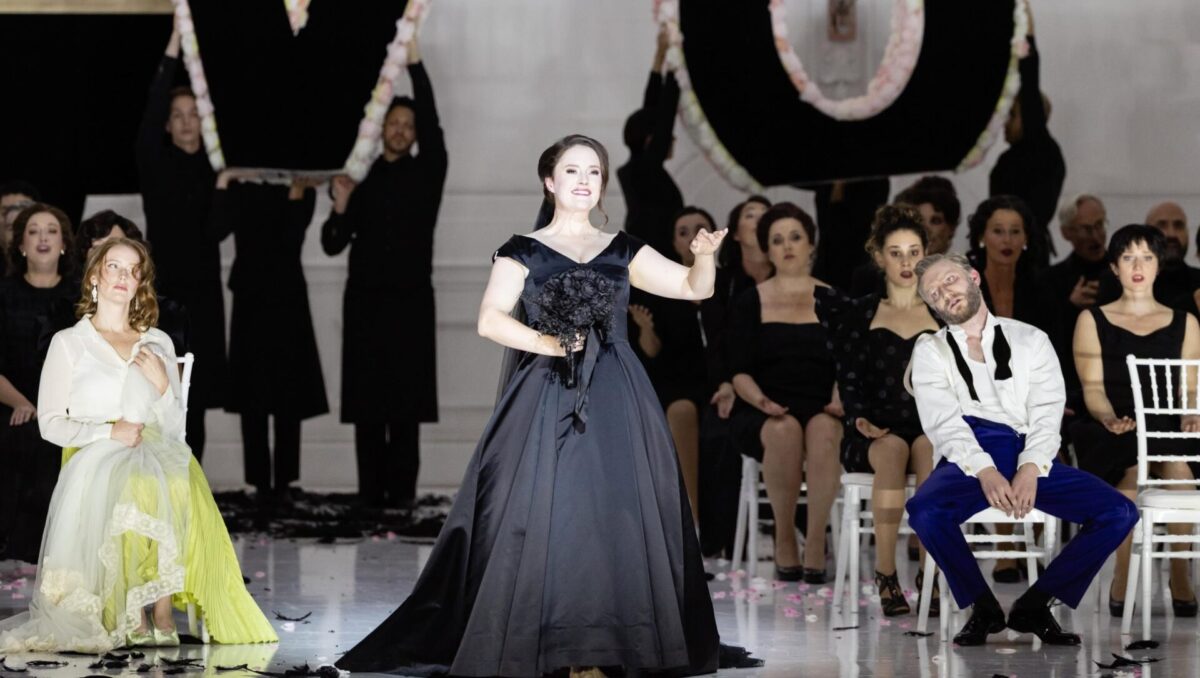
Photo: Geoffroy Schied
This revival, unfortunately, has smoothed over many of the premiere run’s cutting edges, resulting in a considerably less taut and compelling drama. (I’m not sure if this comes as a directorial reworking via the production’s Amsterdam outing, or is merely a question of revival laxity mixed with trying to make a work of demanding length kinder to its cast.) Episodes that emphasized the psychologically destructive cruelty under the pristine, elegant surface of Semele’s world are now gone: “Come, Zephyrs”, depicting Athamas shoving his catatonic bride back into her discarded wedding dress and forcing a smile on her face, is cut, as is “The morning lark”, where Semele busies herself wrecking her wedding venue in an impotent act of rage. The aged patriarch Cadmus is played more as comic fodder than the man who rules (and ruins) his children’s life with an iron hand. Characterizations in general tended to be softer: Louise Alder’s Semele was milder and more sensual than Brenda Rae’s tightly wound, headstrong princess, and little of the prickly severity of Emily d’Angelo’s Juno was seen in Marina Viotti’s spunky portrayal. (This is not at all to knock the revival cast’s acting, but to note the marked shift in tone.) Adjustments accounting for new performers are par for the course, but I’d be hard pressed to say that the changes made here have been for the better.
Thankfully, there is little to complain about the performance’s musical accomplishments. The second Alder (in her stage role debut!) opens her mouth to sing, one will not wonder why her Semele is the object of divine obsession: her honeyed, velvety soprano is a delightful instrument, and her singing is unfailingly stylish, sumptuously ornamented, and perfectly assured. Semele’s slow, lyrical arias were spun like silvery threads, beautifully moving in depicting her vulnerability, while “Myself I shall adore” was delivered with charming flair and “No, no, I’ll take no less” tossed off with tour-de-force virtuosity.
At her side, Michael Spyres often threatens to steal the show, flexing his full versatility as a singer and an actor. Few things have been as memorable in my opera-viewing life as watching him in I must with speed amuse her, joining a kickline with desperate enthusiasm to impress his complaining nymph, and he puts the extremes of his vocal range to caricaturistic use during “Lay your doubts and fears aside.” But his Jupiter is no mere clown show: Spyres is also properly terrifying in his thundering “Ah! take heed what you press”, and moving in his rendition of “Ah! whither is she gone”, calling his Jephtha to mind in his woeful enumeration of a hasty vow. His Fach-defying tenor, now with an unmistakably heroic ring, has become somewhat rigid at the top, but his smooth legato, impressive breath control, and remarkable lyricism still ensured a heartrendingly beautiful delivery of “Where’er you walk.”
From the Staatsoper’s marketing, however, you would think that Jakub Józef Orliński is the real star of the show. The Polish countertenor does own the most memorable piece of the staging — a breakdance routine set to “Now the everlasting boy”, where Jupiter, unable to amuse Semele, drags Athamas onto the stage in a swiftly backfiring attempt to humiliate his rival. Orliński depicts both swagger and insipid sliminess with aplomb, and his warm, rich-toned, sonorous countertenor is audibly at home portraying an unlucky Greek prince.
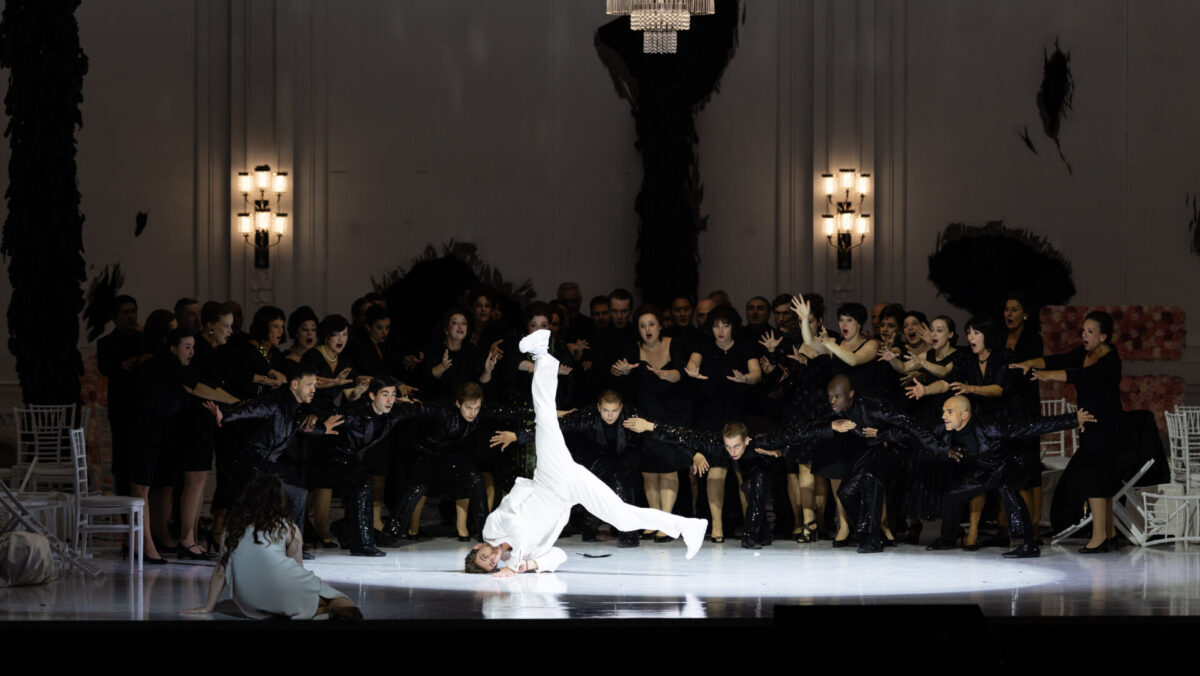
Photo: Geoffroy Schied
Munich stalwart Avery Amereau brought a vivivd stage presence and mellifluous, copper-hued voice to Ino, hilariously petulant in Act I, and nothing short of ethereal in her rendition of “But hark! The heav’nly sphere turns round.” Marina Viotti showed off a remarkably sonorous, pleasantly dark voice as Juno, thundering through “Hence, Iris, hence away” with virtuosic ease, and offering great stage rapport with her partners-in-crime. Speaking of which: Sarah Dufresne’s songbird Iris offered charm and vivacity in spades, tossing off a stunning “There from mortal cares,” while Sam Carl impressed more as Somnus than Cadmus, with a hypnotic “Leave me, loathsome Light” and an uproarious “More sweet is that name.” Contributions from the Staatsoper’s chorus were ever appealing and dramatically striking, if occasionally calling to mind (along with some of the cast) the old quip about non-English singers making “rare work with the English tongue”.
In the pit, Leonardo García Alarcón led such a bluntly brisk overture that it completely collapsed any distinction between Maestoso and Allegro, but reined himself in for the rest of the evening, offering a finely accentuated, colorful, compelling account of the score – if one that, for all the fine playing from the Bayerische Staatsorchester, didn’t quite have the propulsive force and full-blooded sense of drama of Gianluca Capuano’s rendition. Not the Sternstunde of July 2023, perhaps, but a remarkable, and tumultuously applauded performance.
Orsolya Gyárfás
Based in Budapest, Orsolya Gyárfás has been publishing opera reviews in English and Hungarian since 2016. Currently wrapping up a PhD focusing on Metastasian opera seria; general interests and obsessions include all things Baroque, queer, Regietheater, and any given combination of the above.
-
People: Avery Amereau, Claus Guth, Jakub Józef Orli?ski, Leonardo García Alarcón, Louise Alder, Marina Viotti, Michael Spyres, Sam Carl, Sarah Dufresne
-
Works: Semele
-
Places & Organizations: Bayerische Staatsoper