All-American girl
A new English translation of Puccini’s La fanciulla del West gallops into a high school in Pacifica with as much grit and gumption as its titular frontierswoman.
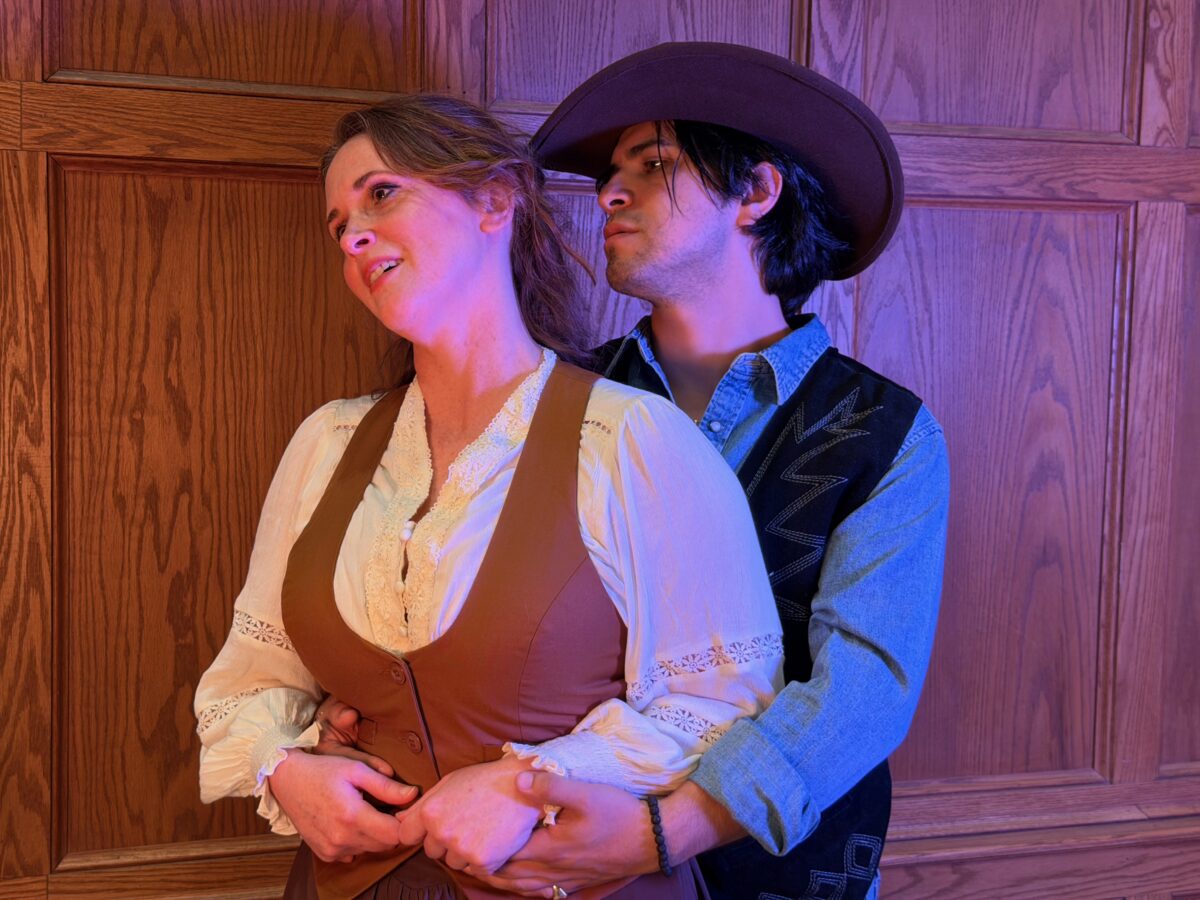
Photo: Russell Low
When you think of an “opera,” you immediately picture a glamorous night at the world’s biggest opera houses, watching the world’s biggest stars belt their hearts out. Given how much tickets cost these days, this is a very valid expectation, and most opera houses bank on it: opera as a form of escapism. Nevertheless, as opera lovers know, there is so much more to this art form than a mere diversion from everyday life; it’s the culmination of the arts, merging singing, acting, conducting, directing, staging, and fashion to tell stories that tug at our heartstrings. In other words, opera becomes our passion.
One man’s passion became the driving force behind the excellent production of Giacomo Puccini’s The Girl of the Golden West (La fanciulla del West) that I saw last Friday (third of the run) at Terra Nova Theater at Terra Nova High School in Pacifica, presented by The Voice Studio of Thomas Clark Inc. Thomas Clark not only produced the show — as a celebration of the USA’s 250th anniversary — but also provided a new English translation of the Italian libretto and even sang the role of Nick, the bartender at Minnie’s Polka saloon. In his producer’s note, Clark admitted that The Girl of the Golden West (GGW) was “a fulfillment of a lifetime dream,” having sung Larkens as a young college student at the University of Montana and, years later, graduating into Dick Johnson for the now-defunct San Francisco Lyric Opera. The show also starred his “star soprano,” Jordan Best, in the title role of Minnie, and features Italian pianist and conductor Umberto Barisciano on accompaniment.
Having seen the show last Friday, it was clear that Clark’s affection for GGW became a labor of love, inspiring everyone on stage to give their best and making it one of the best displays of cast camaraderie in any opera I’ve ever seen. It felt like watching a group of close-knit friends putting on the show for the audience. After all, Gary L. Stanford, Jr., who directed the production, also sang Larkens and, with Clark and Best, designed the costumes. Everyone on stage became part of the stage crew, helping set up props and the set. It was truly heartwarming to see this level of commitment from all the singers.
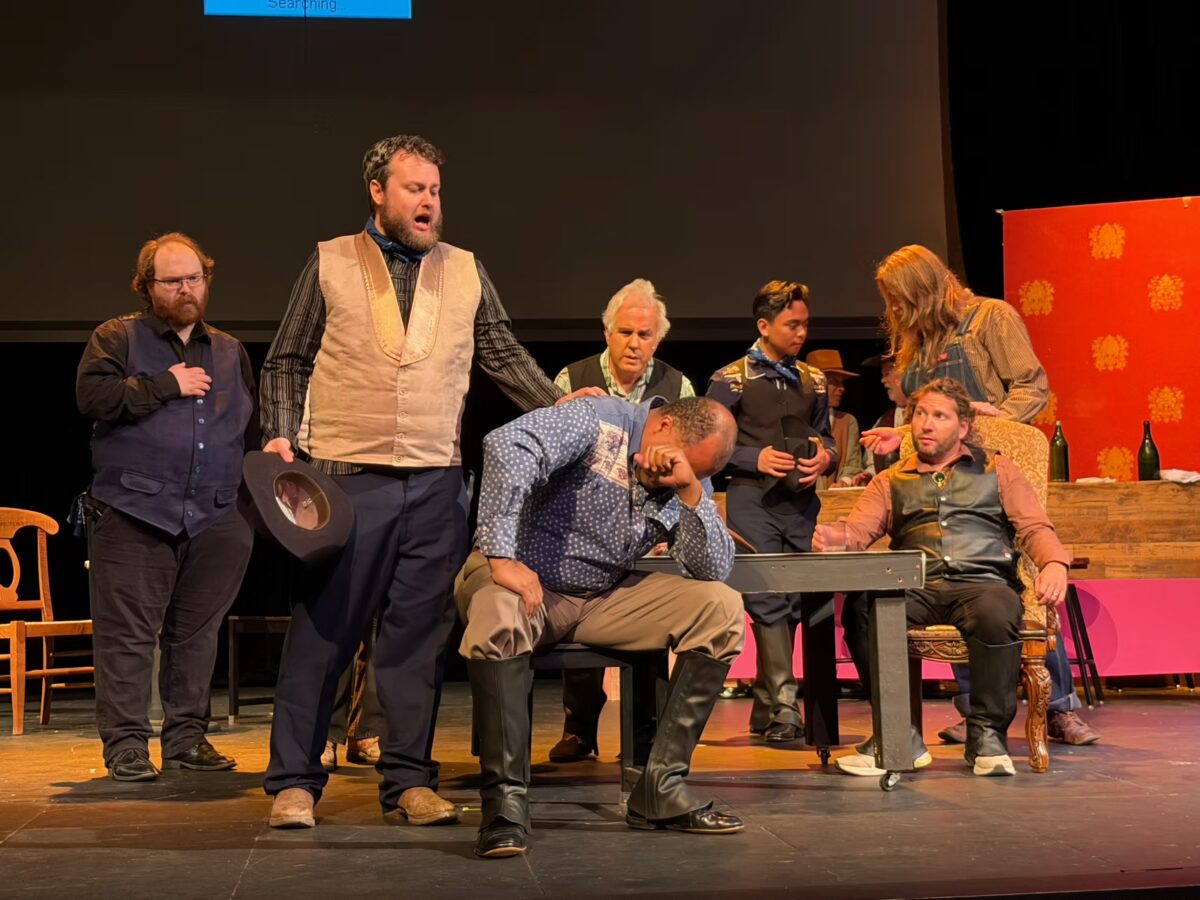
Despite the rather modest staging, nothing felt remotely “cheap” about the production; in fact, it was astonishing to see how much they could achieve with relatively few props, beating many higher-budget productions. Billie King’s sets set the tone, transporting the audience to the Gold Rush era, while the colorful costumes appropriately identified the gold miners at the Polka saloon. A slight glitch in Act 2 notwithstanding, Zachary Wilson’s projection helped connect the dots, for example, when Castro led Rance and the miners on a wild goose chase, and Megan Thompson’s lighting clearly indicated the time of day.
Stanford directed the show with sensitivity and restraint; the characters moved with a gentle naturalness. In his Director’s Note, he explained that they presented the opera in English so that “Puccini’s characters become immediate and recognizable.” In that regard, Clark’s intelligent translation achieved that goal, though I wished they had projected the words on the screen, since not everyone enunciated clearly, especially during the choruses. Nevertheless, it was a faithful adaptation that told the story gloriously and advanced the action.
Clark engaged a trio of well-known local artists as the principals, and they didn’t disappoint. Best embodied Minnie wholeheartedly, delivering a well-rounded portrait of an independent, strong woman. A stage animal, she was utterly captivating, wearing her heart on her sleeve. Initially, her top notes could sound pinched, especially when she pushed hard, but she eventually warmed up and settled into warm, soft tones for this beast of a role, particularly in the crucial Act 2.
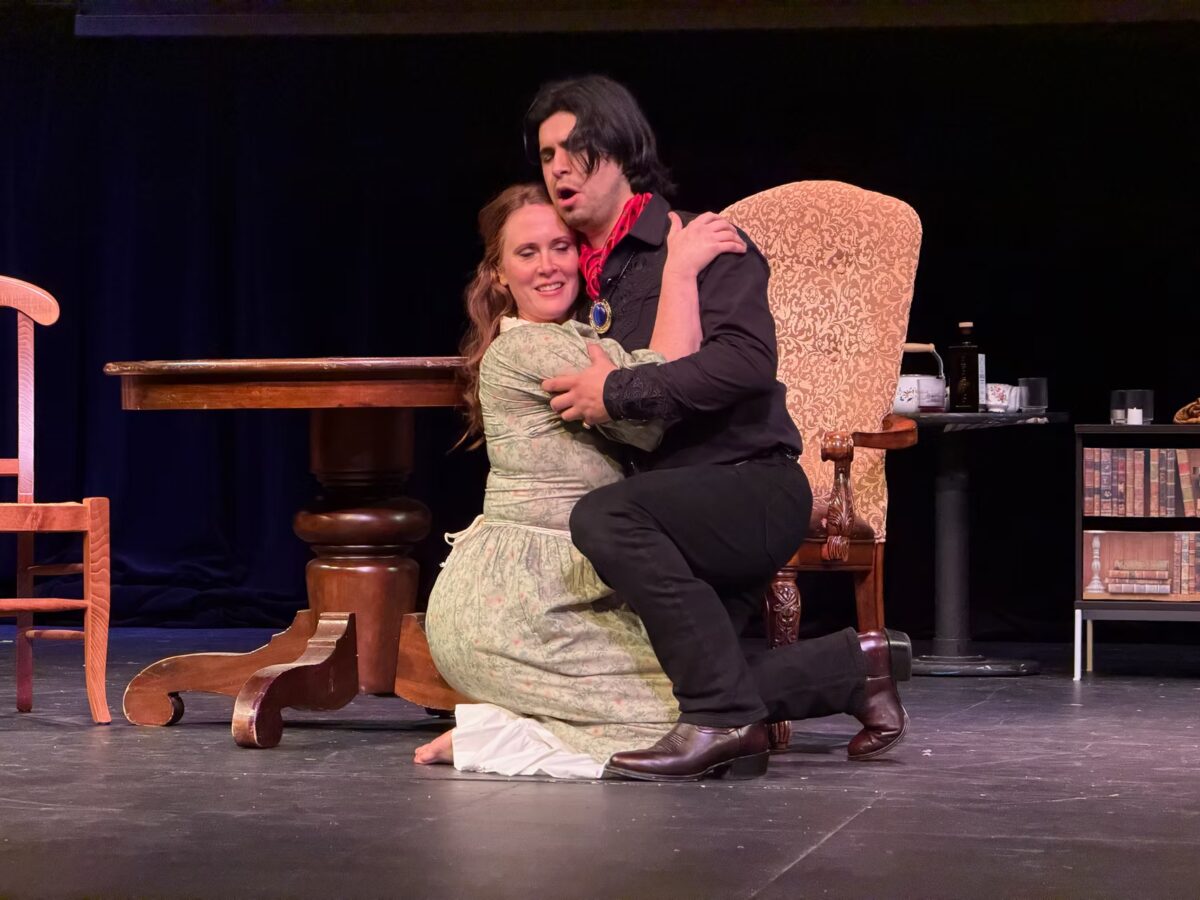
As her love interest, Dick Johnson, young Chilean-American tenor Xavier Prado sang earnestly, though he lacked a certain dangerous aura (Johnson is a bandit, after all!). Nevertheless, he maintained a strong rapport with Best, and their duets were marked by passion and tenderness. Prado finally poured his heart out in the showstopper Act 3 aria “Let her believe that I have gained my freedom” (“Ch’ella mi creda”), one of the show’s highlights.
Robert Balonek completed the trio as Sheriff Jack Rance, bringing a booming, robust voice to the role. He performed Rance almost with glee, alternating between a stern demeanor and a lovelorn puppy that gave way to jealous rage. The leather costumes he wore made him a standout on stage, and he stole the show every time he was on.
The comprimario roles were handled beautifully, with some singers taking on multiple roles. Among the highlights were Sebastian Stock’s kind Sonora, Joshua Porter’s effective Sid and Harry, Stanford’s heartbreaking Larkens, and Lizz Hodgin Weihrauch’s lovely little lullaby as Wowkle. Collectively, they made a considerable effort, so much so that many in the audience scrutinized the bios during intermissions.
Personally, the star of the show was undoubtedly Barisciano, who ferociously tackled the piano throughout the opera and conducted the chorus scenes and the a cappella moments. It was truly amazing to hear how many colors and nuances he coaxed from the piano. Act II was especially an edge-of-the-seat moment for me, all because of the accompaniment. My opera companion even commented that she envisioned Puccini himself playing the piano, a feeling I shared. In addition, the piano score seemed to anticipate some aspects of Turandot to my ears, particularly in Act III.
This was such a mammoth undertaking for Clark and the whole ensemble, and I was so glad they pulled it off beautifully. Congratulations to the whole cast! It definitely exceeded my expectations. I wish I could experience it all over again, as it was so rewarding in so many ways. There are four more opportunities to catch this show, as they will move to Colligan Theater in Santa Cruz for the next two weekends (the last two shows, John Kun Park will sing Dick Johnson). Make sure you don’t miss this production if you are around!
-
Topics: Review
-
People: Billie King, Gary L. Stanford, John Kun Park, Jordan Best, Joshua Porter, Lizz Hodgin Weihrauch, Megan Thompson, Robert Balonek, Sebastian Stock, Thomas Clark, Umberto Barisciano, Xavier Prado, Zachary Wilson
-
Works: La fanciulla del West
-
Places & Organizations: The Voice Studio of Thomas Clark Inc