What passion cannot Music raise and quell?
American Bach led a stirring rendition of Handel’s Ode for St. Cecilia’s Day, full of big questions and even bigger musical highlights.
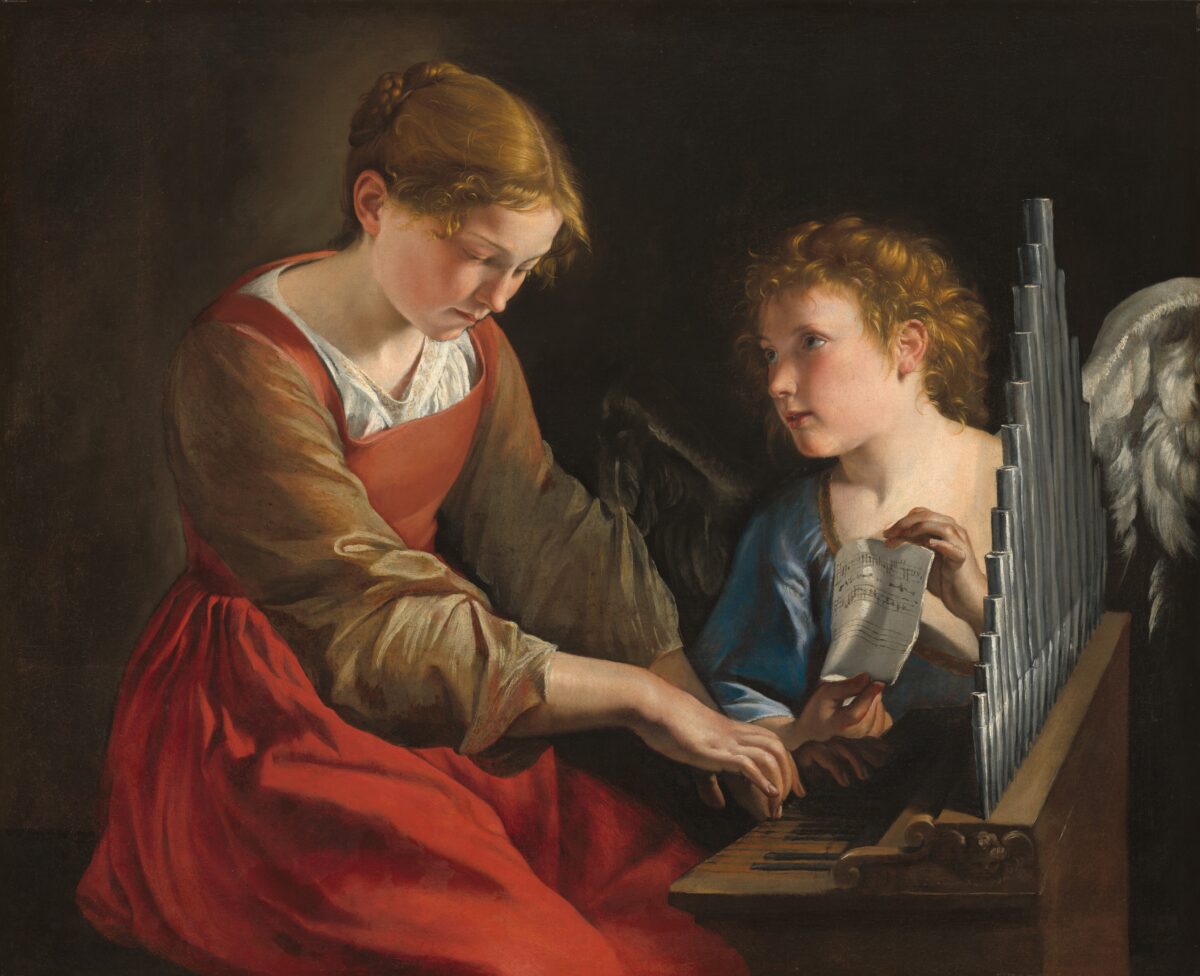
Image c/o the National Gallery of Art
If I were to describe an opera composer summoning the orchestra to depict the creation of the world and then, at the end, summoning that orchestra to then depict its destruction…you might think I was talking about Richard Wagner. 136 years before the first full Ring cycle was performed in Bayreuth in 1876, George Frideric Handel premiered his Ode for St. Cecilia’s Day (setting a poem of the same name by John Dryden) at the Theatre in Lincoln’s Inn Fields in London. In it, Handel summons the orchestra to depict the creation of the world, then its vanishing.
Unlike Wagner, Handel uses music and words to depict creation, setting the words of the poet John Dryden:
When nature underneath a heap
Of jarring atoms lay,
And could not heave her head,
The tuneful voice was heard from high:
“Arise! Ye more than dead.”
Then cold, and hot, and moist and dry,
In order to their stations leap,
And music’s pow’r obey.
At the end we get the world dissolving again:
So when the last and dreadful hour
This crumbling pageant shall devour,
The trumpet shall be heard on high,
The dead shall live, the living die,
And music shall untune the sky.
Handel’s cantata is dedicated to the patron saint of music, and it celebrates and meditates on music itself, an almost postmodern meta-musical work. There is no real attempt at a narrative here, but a catalogue of music’s importance to humanity. Even Wagner’s tetralogy, steeped in Schopenhauer, didn’t attempt something as (elegantly) heady as Handel’s musical treatise and in the space of a single hour, instead of 18.
When Handel wrote Ode for St. Cecilia’s Day, he might be forgiven for doubting the power of music. His opera career was all but finished. His London audience grew tired of Italian opera and embraced ballad operas like John Gay’s The Beggar’s Opera, itself a brutal satire of Handelian excess and silliness. It’s a satire based on some truth. Handel’s operas have their charms, depth, and great beauty. They can also be formulaic, long, and dramatically leaden affairs in which the drama is subordinate to the talents of the singers.
As his opera career faded, Handel turned toward oratorios and cantatas to keep himself in front of the public. It’s from this pivot that we get masterworks like Messiah and Semele (ironically both have been staged as operas many times since Handel’s death). In 1729, Handel set John Dryden’s poem Alexander’s Feast for performance on St. Cecilia’s Day, another piece of music about the power of music. A few years later, a revival was on the books, but Alexander’s Feast was too short to perform on its own. Composed in just two weeks, thanks to some heavy borrowing from existing instrumental works (and from the keyboard works of Gottlieb Muffat), Handel tacked on Ode for St. Cecilia’s Day onto its predecessor. It was a hit.
After the opening sections depicting a sort of history of melody and harmony (literally and figuratively), each section focuses on a specific instrument (in order: trumpet, flute, violin, organ, lyre, organ again). Handel pairs each instrument with the human voice: either tenor, soprano, chorus are a combination thereof.
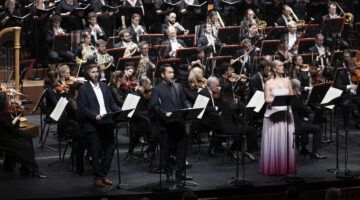
To conclude its annual San Francisco Bach Festival and its 2025-26 season, the San Francisco-based period instrument ensemble American Bach (comprising the American Bach Soloists and American Bach Cantorei) presented a ringing account of Handel’s cantata at the Caroline H. Hume Concert Hall at the San Francisco Conservatory of Music.
By way of a short curtain-raiser, the orchestra offered Georg Philip Telemann’s Concerto in A-major for four violins and Johann Sebastian Bach’s Orchestral Suite No. 3 in D-major. Both were serviceable and pleasant, if not to the level of the Handel. Frankly, the pieces seemed a bit tacked on to make the program of sufficient length. The Handel cantata was the star of the show, and the ensemble rose to the occasion.
Music Director Jeffrey Thomas marshaled his orchestra and chorus for a charming and fleet performance of the Ode for St. Cecilia’s Day. A virtue of Thomas’ conducting is that he will never let moss grow on a score. His Bach and Handel are never heavy or penitential. Thomas is also a tenor, and I like to think that he has a singer’s instinct for what makes a work appealing to an audience. A small, lithe orchestra also helps (and is much more in keeping with the forces Handel would have had at his disposal). At the same time, he doesn’t rob the music of its majesty when it needs it. Handel’s oratorios and cantatas are often operas in disguise, but works like Ode for St. Cecilia’s Day are also self-conscious (and glorious) musical events, meant for occasions, for public ceremonies.
That sense of majesty is entrusted to the chorus, and the American Bach Cantorei did precisely as Handel asked. When the chorus entered for the first time on the words “From harmony, from heavenly harmony”, there was harmony — and it was heavenly. The Cantorei is not a large chorus (not even 20 members), but they filled up the concert hall like a chorus twice its size without pushing too hard or sacrificing purity of tone. Handel clearly enjoyed writing choral music (perhaps the truest sign of his adopted Englishness), and while the harmonic writing isn’t ornate or even necessarily complicated, it shows off a chorus while also potentially exposing its flaws. No such flaws to worry about here.
Steven Soph was the tenor soloist. A recent review of a Mozart performance celebrated his “virile lyric” sound. And virile it was. In this creation of the world that I cited earlier (“From Harmony, from heav’nly Harmony/This universal frame began”) it’s the tenor who intones it. Lots of tenors would like to think the voice of God is a tenor’s voice, and that’s how Handel casts it here. The almost military thrust of Soph’s voice was more Big Bang than God shaping chaos into matter. Soph’s sound is layered and baritonal (he’s no willowy Ian Bostridge), which gave his Handel a thrilling muscularity. But it also robbed the music of some elegance and made some of his English diction a bit woolly.
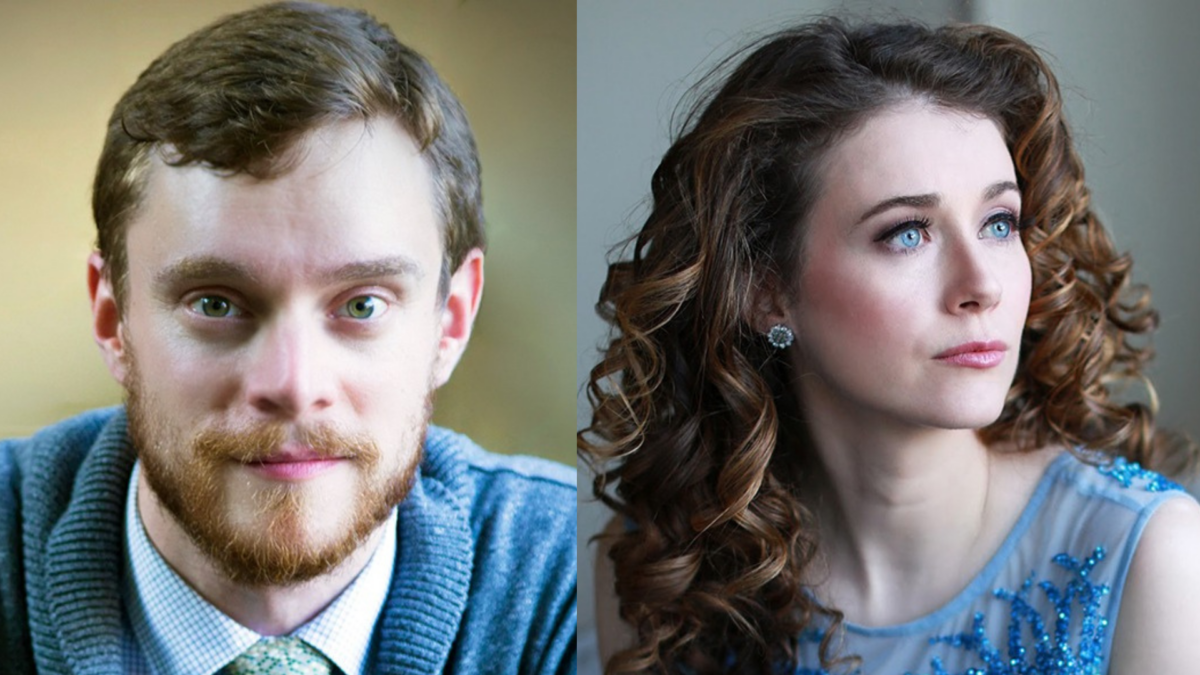
(From right) Steven Soph and Nola Richardson
Later, when the tenor reappears to double the trumpet (“The Trumpet’s loud clamor/Excites us to arms”), Soph’s voice was a much better fit. Handel’s writing for tenor is not for the faint of heart. Soph’s tendency to hurl himself at the music was wise here, irrespective of some on-the-tippy-toes notes in the highest reaches of the voice (forgivable given Handel’s octave leaps). His is a burnished sound which paired perfectly with the natural trumpet. Speaking of difficult leaps, natural trumpeters William B. Harvey and Charles Ryan deserve medals for how they negotiated Handel’s writing on an instrument notoriously difficult to play in tune, let alone accurately. They acquitted themselves beautifully.
Nola Richardson, no stranger to the Bay Area early music scene, was the soprano soloist. I got to see and hear her in Rameau earlier this year with the Philharmonia Baroque Orchestra, and her Handel was frankly just as accomplished. In fact, hers is easily one of the most flawless lyric sopranos I can ever remember hearing in the concert hall. Her concurrent mastery of both bel canto technique and early music ornamentation make her a true gem. What also helps is her laser beam accuracy and purity of tone. No scooping, no affectation, no fuss. As such, the voice conveys authentic pathos.
Handel doesn’t do his soprano quite as dirty as his tenor, pairing her with two quite mellow instruments, first with the cello (played with lilting focus by Gretchen Claasen in “What passion cannot music raise and quell!”) and later with the natural flute (a pitch-perfect but difficult-to-hear Bethanne Walker in “Orpheus could lead the savage race”). This only left Richardson more room to captivate the room with perfect legato phrasing, something Handel absolutely demands from his singers (never forgetting his roots in Italian opera).
Unlike the tenor, the soprano’s role is less about announcing music’s power than it is to revel in its beauty and portray music as something that connects us to the divine:
But oh! What art can teach
What human voice can reach
The sacred organ’s praise?
It’s a rhetorical (and ironic) question. Handel’s writing for the soprano reaches and yearns, something Richardson’s voice does with such ease without becoming syrupy. The tenor almost must fight to be heard, the soprano is allowed a certain ecstasy.
That is perhaps the genius of Handel. In a secular oratorio based on a 17th-century poem that could have been an academic exercise, Handel manages to encompass so much of what makes us human. Some days we fight to be heard. Some days we sit back and take stock. Some days we try for something better, higher, more exalted.
I personally find Handel’s oratorios and cantatas more compelling than his operas. Stripped of the pageantry and special effects, the stock characters and stock situations, Handel’s music is exposed for the alternately charming and moving stuff that it is. In Dryden’s poem that forms the libretto, the speaker asks: “What passion cannot Music raise and quell?”
Handel takes this as his thesis and his challenge. What a glorious way to honor St. Cecilia’s Day.
Matthew Travisano
Matthew is a San Francisco-based educator and actor. He has taught and lectured on the performing arts for more than two decades. He has trained a generation of actors in the greater Bay Area at both Oakland School for the Arts and Ruth Asawa School of the Arts, where he has also taught literature, composition, literary theory, and aesthetics. He holds a BA in English from UC Berkeley and a Master's in Teaching (MAT) from San Diego State University.
-
People: Bethanne Walker, Charles Ryan, Georg Philip Telemann, George Frideric Handel, Gottlieb Muffat, Gretchen Claasen, Jeffrey Thomas, Johann Sebastian Bach, John Dryden, John Gay, Nola Richardson, Richard Wagner, Steven Soph, William B. Harvey
-
Works: Alexander's Feast, Concerto in A-major for four violins, Messiah, Ode for St. Cecilia's Day, Orchestral Suite No. 3 in D-major, Semele
-
Places & Organizations: American Bach Cantorei, American Bach Soloists, Caroline H. Hume Concert Hall, Philharmonia Baroque Orchestra, San Francisco Bach Festival, San Francisco Conservatory of Music