Life’s a Blitch
Shakespeare Opera Theatre presented two American operas exploring themes of hypocrisy and deception — in a church!
 By
Andrew Lokay
By
Andrew Lokay
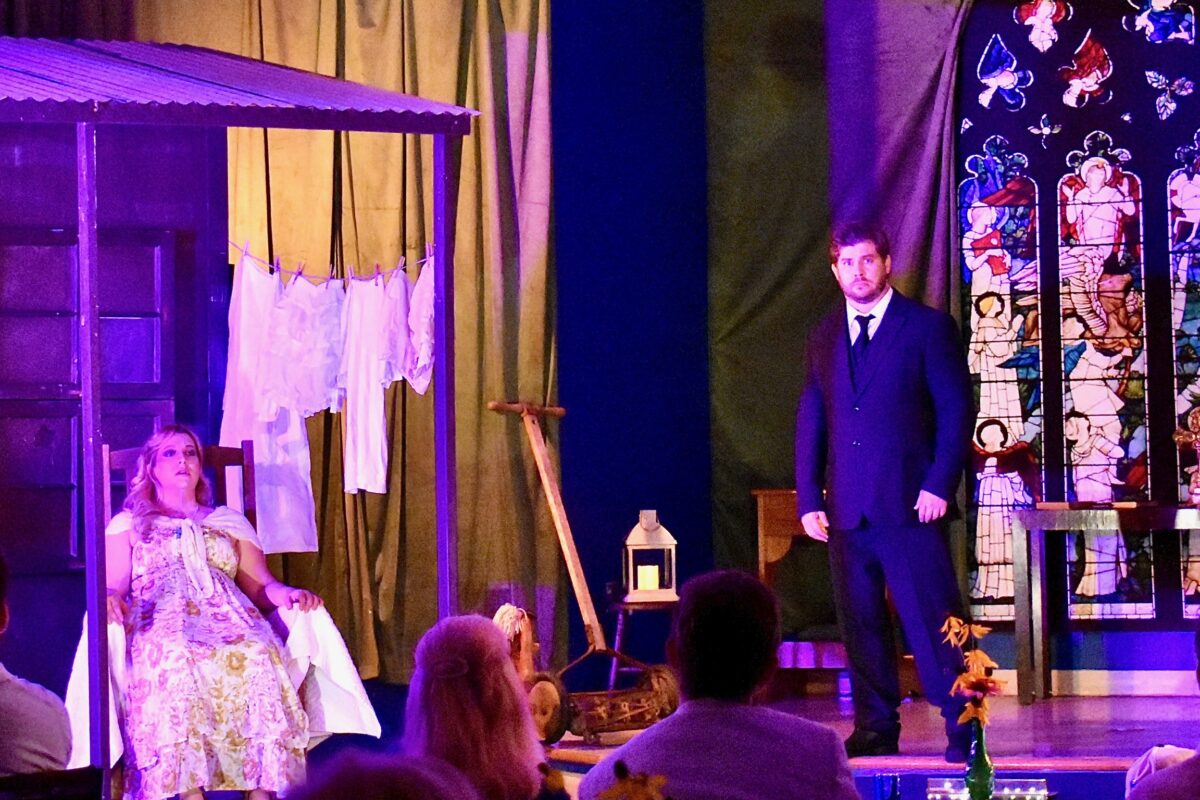
Photo: Lori Lind
Based in northern Virginia, Shakespeare Opera Theatre has presented opera, classical theatre, and classical music since 2015. For its 2026 summer season, the company presented Carlisle Floyd’s Susannah and Kirke Mechem’s Tartuffe, two works that center on moral and religious hypocrisy, in repertory at St. Thomas Episcopal Church in McLean, VA. Though not as frequently performed in major houses today, Susannah is a mainstay of the American opera canon, while Tartuffe is more of a rarity. Mechem was born just a year before Floyd and celebrated his 100th birthday last August. Based on Molière’s play Le Tartuffe ou l’imposteur, his opera debuted at the San Francisco Opera in 1980. It’s perhaps best known for the soprano aria “Fair Robin I Love,” sung by the maid Dorine as a piece of romantic advice, which has become part of the recital repertoire. Shakespeare Opera Theatre’s artistic and managing director, Lori Lind, served as director and production designer for both productions. Lind deployed the same stained-glass windows for the sets of Susannah and Tartuffe, underscoring the common themes between the two operas, one a tragedy and the other a comedy.
The company opened with Susannah, a retelling of the Apocryphal story of Susannah and the Elders set in the mountains of eastern Tennessee. While searching for a creek for the visiting Reverend Olin Blitch to perform baptisms, the local church elders spy Susannah Polk bathing nude, sparking a firestorm of false accusations of her being guilty of sexual transgressions. Ultimately, it’s Blitch who sexually assaults Susannah, for which he is killed by her avenging brother, Sam. The opera ends with Susannah isolated and ostracized by her community.
As Susannah, soprano Kristine Overman boasted a warm, big voice with effective squillo. Overman’s solid diction made it easy to understand Floyd’s libretto, which closely tracks patterns of human speech. An effective actress on stage, Overman conveyed a wide emotional arc from syrupy Southern charm to anguished falsely accused fallen woman. As Blitch, baritone James Myers persuasively adopted the cadence and mannerisms of a stuffed-shirt preacher. Floyd originally wrote Blitch for a bass-baritone, and the lowest parts of this role were perhaps not the strongest vocal fit for Myers’s range. His tautly etched dramatic tension in “I’m a lonely man, Susannah,” the aria he delivers just before taking advantage of Susannah’s emotional numbness to have his way with her, was a highlight of his performance. Nico Caruso sang Sam with a pleasing light, woody tenor and excellent chemistry with Overman’s Susannah. As Little Bat McLean, Susannah’s young admirer who also plays a key role in her undoing, tenor Kurt Lannetti effectively portrayed the character’s conflicted nature, torn between his infatuation with Susannah and his loyalty to his parents who seek to ruin her. Members of the ensemble capably played the judgmental and vindictive church elders, their wives, and residents of New Hope Valley.
As pianist and conductor, Andrew Kraus kept Floyd’s melodies nicely humming along. The piano reduction worked well for this opera, which has heavy orchestration at times. Lind’s direction cleverly took advantage of the venue’s intimate space to emphasize the opera’s themes. The set design fit the Polks’ front porch, the church, and the creek in a condensed space, reinforcing the claustrophobic nature of the geographically isolated and religiously devout New Hope Valley. Lind’s immersive staging had the church ladies wind through the cabaret-style table seating, close enough for the audience to hear their whispering, driving home the viciousness of the backlash against Susannah.
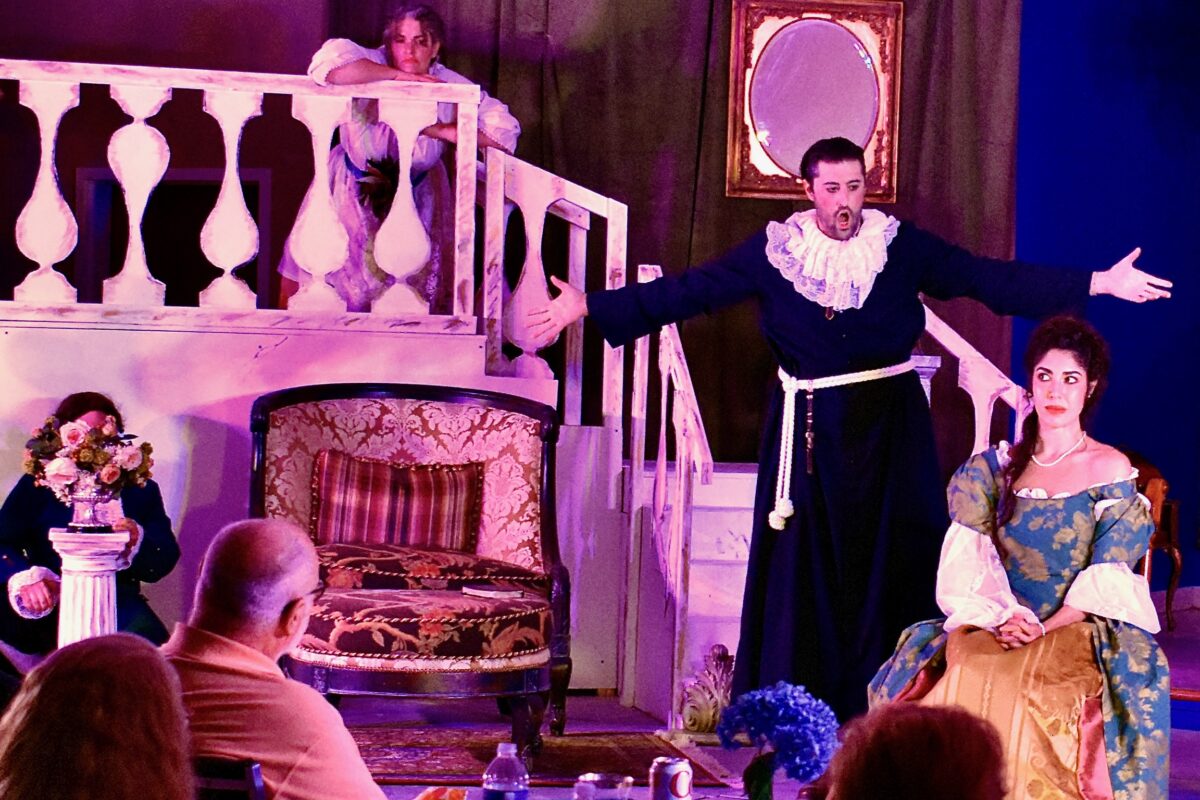
Photo: Lori Lind
Hypocrisy is a timeless theme, whether in early 20th-century Appalachia or 17th-century France. Tartuffe’s titular character is a fraudulent “spiritual counselor” who has duped the wealthy bourgeois Orgon into following his pious guidance. Despite the protestations of his family, Orgon believes in Tartuffe wholeheartedly, even promising to give him his daughter Mariane (who is currently involved with Valère) in marriage and signing away his property to the imposter. Like Giuseppe Verdi and Arrigo Boito’s approach to Shakespeare in Otello, Mechem’s opera pares down its source material considerably while leaving the core theme intact. Mechem drops one of the principal characters, the gentlemanly Cléante (a foil to Orgon), and replaces Molière’s deus ex machina ending in which King Louis XIV gets the credit (a concession to the political realities of his era) with a clever caper by Mariane, Valère, and Orgon’s son, Damis. Like Floyd, Mechem wrote his own libretto, and his rhymes are a tribute to the rhyming couplets of Molière’s verse. Molière’s comedy sparkles with wit and wordplay (the neologism “tartuffiée,” or “Tartuffified,” is a highlight). Mechem takes a similar approach by parodying operatic conventions in Tartuffe. “Molière had fun with language and so did I. He invented words, he punned, and he told literary purists that the end of comedy was to please—that his success was his justification. I have taken the same attitude as composer. The score abounds in musical jokes, parody, caricature, even musical puns,” Mechem writes in a statement on his website. Such a musical “translation” of Molière’s work proves effective; the magic of the playwright’s French verse can be difficult to capture for English-speaking audiences (Richard Wilbur’s delightful translation comes closest) but his spirit lives on in Mechem’s 20th-century opera buffa. Tartuffe’s vocal line parodies the musical language of sacred Baroque cantatas and motets, while Mariane’s contemplation of suicide, taken from Molière, becomes in Mechem’s hands a humorous send-up of the operatic trope of heroines dying by suicide. The composer’s quotation of Beethoven’s most famous four notes at a dramatic climax of his opera is a clever touch.
Baritone Michael Pistorio was a standout as Tartuffe, who, like Turandot, is a titular character who doesn’t sing until Act II. He lived up to the anticipation. Pistorio portrayed the slick charlatan with an oily baritone, nice legato, and a robust bottom to the voice. He effectively executed the humorously exaggerated displays of piety in Lind’s staging, including a funeral for a swatted insect (complete with tiny coffin) and a flail worthy of Sweeney Todd’s Judge Turpin. Soprano Monica Niemi brought a full-bodied sound and delightful camp to the overdramatic character of Mariane. As Orgon, Vincent Fung boasted a velvety bass-baritone and solid attention to musical phrasing. Emily Rich lent her sweet and clear mezzo to the role of Elmire. Lisa Bloy served as pianist and conductor. She effectively conveyed the heart of Mechem’s complex score but the disproportionate volume of the piano, particularly in the first half, overpowered some of the singing, and the opera’s ensembles often sounded muddled. Attractive period costumes effectively conjured the aesthetics of Molière’s world.
Andrew Lokay
Andrew Lokay began his career as an opera fan at the San Francisco Opera, where the first performance he saw was Madama Butterfly. He graduated Phi Beta Kappa from Stanford University with a Bachelor of Arts in international relations and French with honors in international security studies. He now lives in Washington, DC and is a frequent audience member for opera and theatre in the nation’s capital.
-
Topics: american opera, regional opera, Review
-
People: Andrew Kraus, Carlisle Floyd, Emily Rich, James Myers, Kirke Mechem, Kristine Overman, Kurt Lannetti, Lisa Bloy, Lori Lind, Michael Pistorio, Molière, Monica Niemi, Nico Caruso, Richard Wilbur, Vincent Fung
-
Places & Organizations: San Francisco Opera, Shakespeare Opera Theatre, St. Thomas Episcopal Church