I could escape this feeling with my China girl
Tired of Turandot? “The Dancing Goddess” at the China Institute Gallery gives us a glimpse at a real Peking Opera queen.
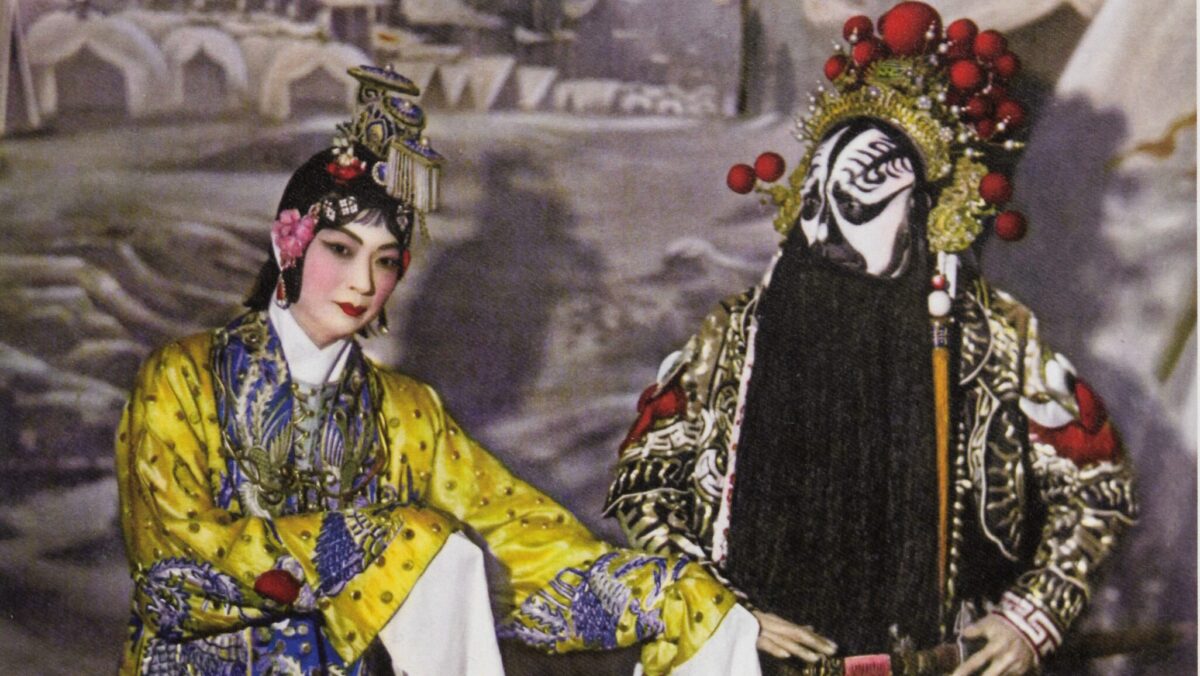
Performance photograph of Mei Lanfang and Yang Xiaolou in The King Parting with His Favorite
It sounds like the unlikeliest of stories.
The year is 1930, and New York City is in the grips of the Great Depression. Touring from China, a Peking Opera singer appears on Broadway. The music is “exotic” and “unfamiliar” to Western ears. And yet, the audience seems to love it. Newspapers praise the performance. The show sells out, night after night. Broadway extends its run.
The singer is a female impersonator.
“What is crazy,” says Charles A. Riley II, director of the China Institute, is that even though Peking Opera was unlike anything New Yorkers had heard or seen, “they got it and accepted it.”
This singer, Mei Lanfang, is the subject of the exhibition “The Dancing Goddess: Mei Lanfang in America” at the China Institute Gallery, which runs through July 12.
Curated by Dr. Catherine V. Yeh — whose book Improbable Stars: Female Impersonators, Peking Opera, and the Birth of Modern Star Culture in 1910s China is forthcoming — the exhibition engages with questions of what is “authentic” and what is truly “new” when it comes to performance. For that reason, it should be of interest to Parterre readers.
Mei’s Broadway run was part of a multi-city U.S. tour, organized by the then-newly-established China Institute of America, influencing the likes of Bertolt Brecht and Thornton Wilder.
But Mei was as influential in China as America. In a March 12 talk, Yeh explained Mei’s reinvention of dan, or female impersonator roles, transformed Peking Opera’s aesthetic.
Mei gave female characters more depth by making a composite of several different “types,” not unlike commedia dell’arte characters. These heroines could be dignified and virtuous one moment, lively and flirtatious — even “sexy,” said Yeh — the next.
The tradition’s transformation ruffled some Chinese contemporaries. But Mei had a different audience in mind: the world stage.
The China Institute exhibition captures some feeling of the stage. Pompomed headdresses. Sequined robes catching the light. Wrinkles in the fabric evidence Mei’s body. In Peking Opera, these spectacular costumes often contrast with a spare set, as can be seen in stills of Farewell My Concubine.
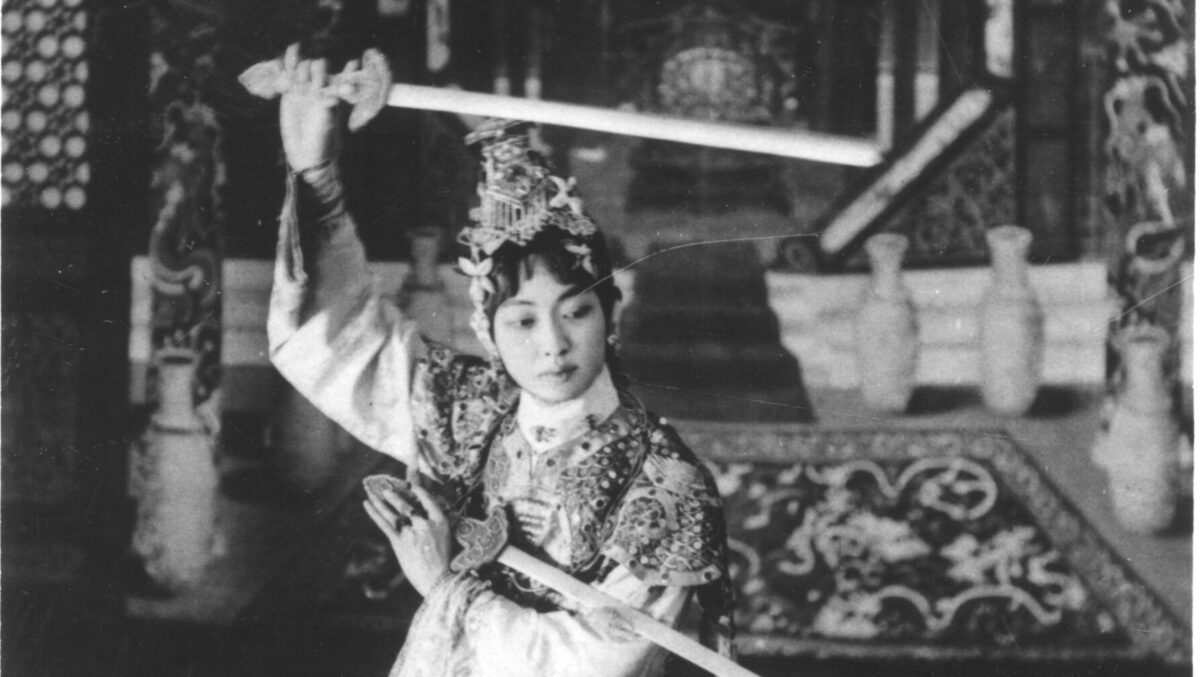
Photograph of Mei Lanfang Performing The King Parting with His Favorite
But the highlight of the exhibition is the footage of Mei’s ornate and high-voiced singing, which could be heard through headphones. As a listener coming from the Western operatic tradition, this style of vocalizing is arresting. The “Mei School” of singing is crystal clear and piercingly bright.
Though American reviewers lauded Mei, there was still some culture shock. While the New York Times called Mei’s acting “no impersonation,” bringing to life “the qualities of suppleness, rhythm, daintiness, delicacy,” the “exotic orchestrations,” including “queer string, wind, and tympani instruments,” were deemed “generally disagreeable to the Occidental ear.”
Likewise, the Herald Tribune described “the whine of a bowed instrument, which suggests a bagpipe or a squeaky violin,” adding that Mei “chants his lines in a curious falsetto.”
One exhibition wall displays such reviews. Another includes a timeline, with events like the 1926 debut of Puccini’s Turandot in Milan. How does Mei’s American tour relate to such Orientalizing works?
Even with the timeline, and especially for someone unfamiliar with Chinese history, it is difficult to situate Mei. Though supposedly “apolitical,” Mei was certainly engaging in cultural diplomacy and nation-building.
In advance of the American tour, Mei designed a songbook for Westerners. Using a method devised by Liu Tianhua, Mei transcribed Gongchepu, a kind of tablature, into staff notation. The songbook is displayed in the exhibition, its pages opened to “Kuei-Fei Intoxicated with Wine.”
What is lost — and what is changed — in translation? One takeaway from the exhibition is that Mei made Peking Opera legible to different audiences by mixing modalities: Old and new, refined and popular, “Eastern” and “Western.” In this way, the exhibition shows how the “traditional” is always a modern re-invention. This is true of Western operatic productions which reimagine classic works with contemporary stagings.
And while the exhibition elegantly sidesteps certain issues of identity, what is perhaps most “queer” about the “Mei school” of Peking opera is the “crossing over” implied in transcription, translation, and transformation.
-
Topics: China Institute Gallery, exhibit, Review
-
People: Bertolt Brecht, Gioachino Puccini, Mei Lanfang, Thornton Wilder
-
Works: Turandot