“Modern convention is the oddity”
Michael Spyres talks to Kevin Ng about his winding path as a baritenor, which composer he wants to conquer next, and how he makes Wagner work in his voice — and in his native Ozarks.
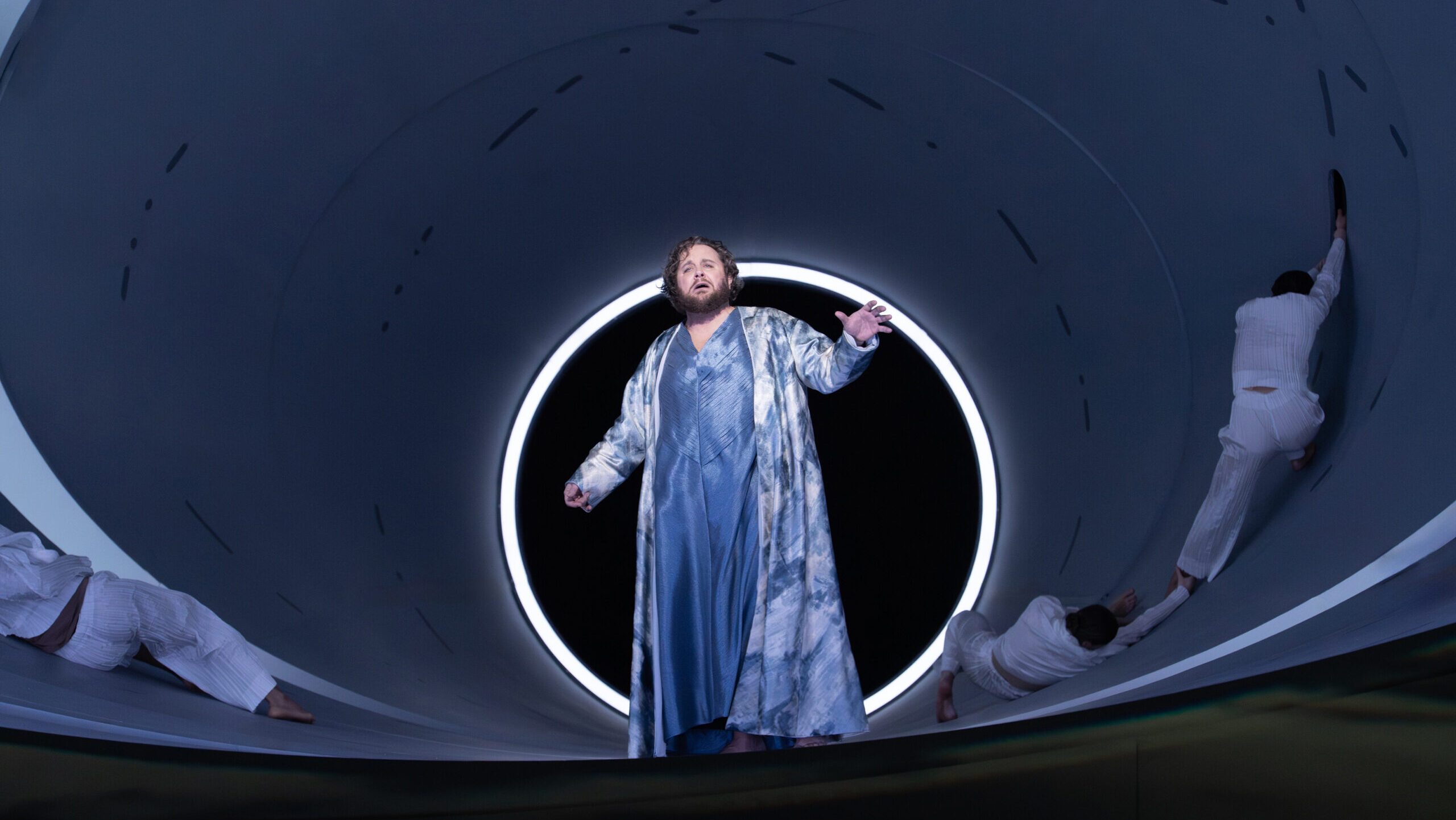
Michael Spyres as Tristan in Wagner’s Tristan und Isolde. Photo: Karen Almond / Met Opera
Good Isoldes are rare; good Tristans are even less common. But Michael Spyres’s role debut at the Met was the breakout event of the season, even opposite Lise Davidsen’s titanic Isolde. “By the end of the run, I began to trust myself more and realize that the role is less a mountain to be conquered and more a landscape you have to learn to live in,” he tells me over email after his last performance. “The first performance is survival because the adrenaline alone messes with your perception of time, space, and connection with your body. I just had to focus on text and remember to constantly listen to the orchestra!”
The stakes couldn’t possibly higher for a role debut, but even on opening night, Spyres showed total command of the part — most notably in the relentless third Act, where he managed not only to sustain the beauty of his timbre but also proved an effective actor. “Acting-wise, the early shows are about mapping out the logistics and adjusting your responses in real time,” he explains. “When you are nervous you tend to become a sort of puppet, but after a few performances I can allow more stillness and it allows me to step into the puppeteer mode rather than feeling out-of-body. The stamina becomes psychological as much as vocal.”
Spyres’s first Tristan comes after a series of successful role debuts as Siegmund and Walther von Stolzing at Bayreuth. “Bayreuth is a pressure cooker because you are not just singing Siegmund or Walther: you are singing them in a place where every stagehand and every person in the audience has an opinion about how they should sound, and many of those opinions are shaped by ghosts. It’s discovering the role under a magnifying glass!”
But he only has positive things to say about his summers at Bayreuth. “The acoustic is unique; the covered pit and the sound coming from below and behind you demand a different sense of projection. You can’t bark! The house punishes brute force and rewards focus and resonance. It’s reinforced my conviction that Wagner, sung well, is bel canto in German. It’s all about declamation, breath management, legato, and a disciplined approach to color.”
Spyres’s move into Wagner follows nearly two decades of specializing in the punishingly high tenor roles of French grand opera. Does he see a through line from Berlioz’s Énée and Meyerbeer’s Raoul to Tristan? “People tend to say my way into Wagner is unconventional because I didn’t start with heavy or dramatic repertoire, and because the Fach system now wants to put Wagner in a separate, unscientific box marked ‘Heldentenor.’ But if you look at Wagner’s own singers, my path is not strange at all. It mimics the exact route they took. My argument is that the modern convention is the oddity.”
Anyone who has listened to Spyres’s recordings knows him as a keen historian, and he rattles off a list of Wagnerians who also sang Mozart, Rossini, and Meyerbeer. “A perfect example is Heinrich Vogel, who created Siegmund in Munich,” he explains. “He was a celebrated Don Ottavio. Albert Niemann, who sang the role at Bayreuth, studied bel canto with Gilbert Duprez. And of course there’s Ludwig Schnorr von Carolsfeld, the first Tristan. Wagner saw him as the ideal voice for his music, and just weeks after Tristan he was rehearsing for his debut as Don Ottavio — unfortunately, he fell ill and died!”
“For me, coming through Rossini, Meyerbeeer, and Berlioz is not a detour: it’s the apprenticeship Wagner assumed. This is why I tend to say, provocatively perhaps, that there really is no other safe way to learn Wagner! Of course, a talented singer can be thrown into these roles young and survive for a while on raw material and adrenaline, but in order to navigate Wagner for years without destroying yourself you need that bel canto spine.”
How does his path into Wagner differ from, say, Lise Davidsen? “Someone like Lise is a beautiful example of a voice that honestly seems born for this repertoire. Early on she was recognized as a once‑in‑a‑generation Wagner and Strauss soprano, and the big houses wanted her for these roles from the start. But that doesn’t mean the work is any less demanding for her than for the rest of us. Having a phenomenal natural instrument is like being given a Formula 1 car when you are too young to drive!”
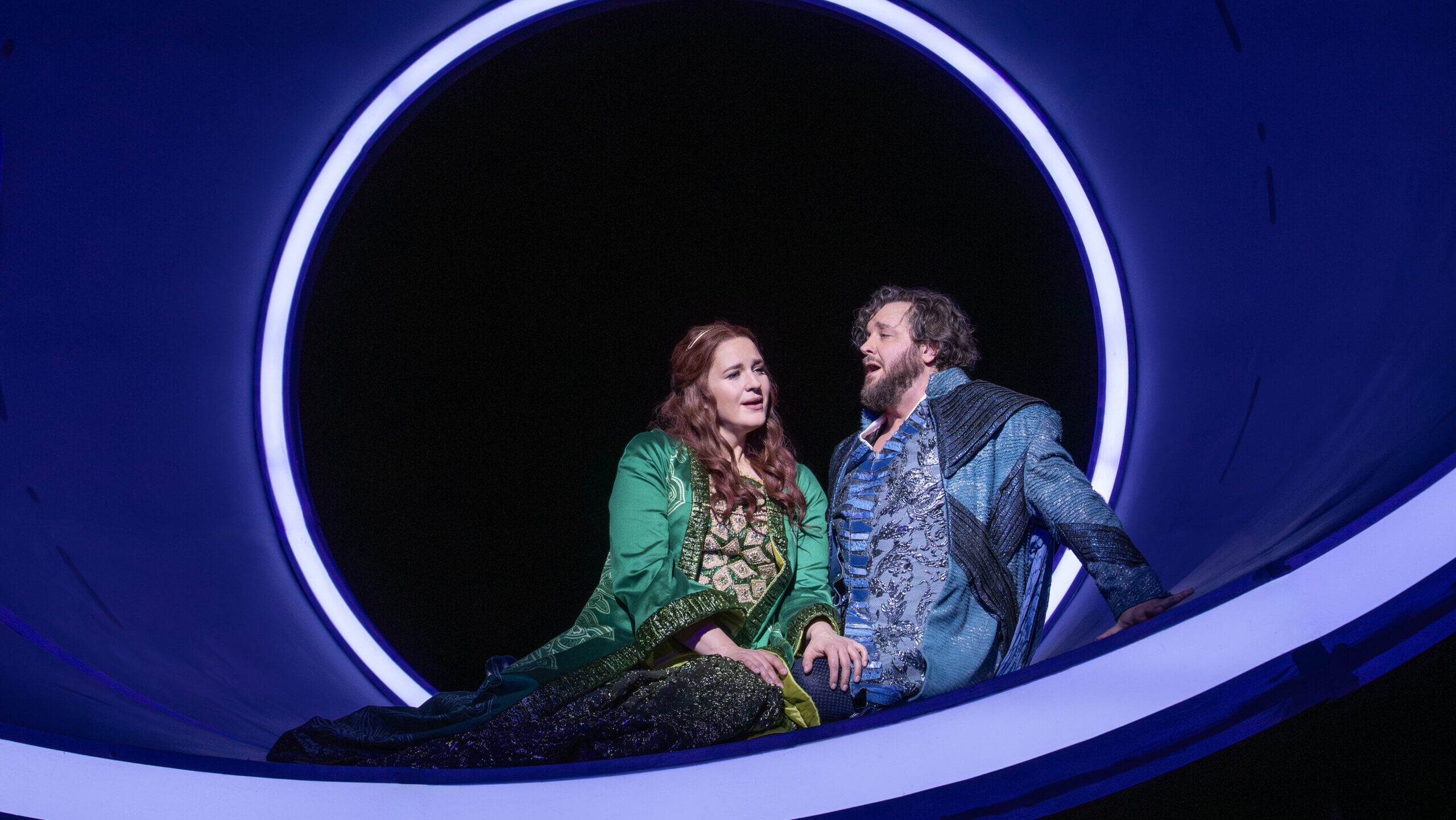
Lisa Davidsen as Isolde and Michael Spyres as Tristan in Wagner’s “Tristan und Isolde.” Photo: Karen Almond / Met Opera
“Lise, to my ears, has an instrument that naturally sits in that heroic Germanic soundscape but she has worked just as hard to control her instrument and has successfully become a Lieder artist alongside her Wagnerian triumphs. In the end, Wagner doesn’t let anyone off the hook: not the ‘born Wagnerians’ nor the baritenors who arrive there by a more circuitous route. Slow, patient, technical work, day after day, until the voice and the music start to speak the same language is the goal.”
Spyres’s 2026-27 season includes several unexpected role debuts. He sang his first Nemorino in Barcelona, recently debuted Captain von Trapp in Missouri, and then takes on Rosenkavalier’s Italian Singer in Vienna and Frau ohne Schatten’s Kaiser in Aix-en-Provence. “This season does look a bit schizophrenic,” he admits. “But it makes sense when your instrument lives at the crossroads! Nemorino is the distilled essence of innocence; the Italian Singer is a wonderful caricature of the tenore di grazia and the cult of the high note; the Kaiser is a test of steel in the middle voice and the ability to ride Strauss’s orchestral waves without losing the line. And Captain von Trapp is different because there is very little singing at all! The text and voice there should be more spoken and anchored in the chest voice because the character is armored, and the journey is in how that mask softens when he starts to sing again, both literally and metaphorically.”
“When I decide to take on new roles: I always ask three questions,” he explains. “First, does this lie within the healthy center of my voice? Second, does it open doors artistically and does it teach me something about the instrument or about storytelling? Third, can I place it in a season where it is balanced by repertoire that feeds me rather than drains me? The calendar is a long legato phrase, and I think you have to phrase your career the way you phrase a French grand opera!”
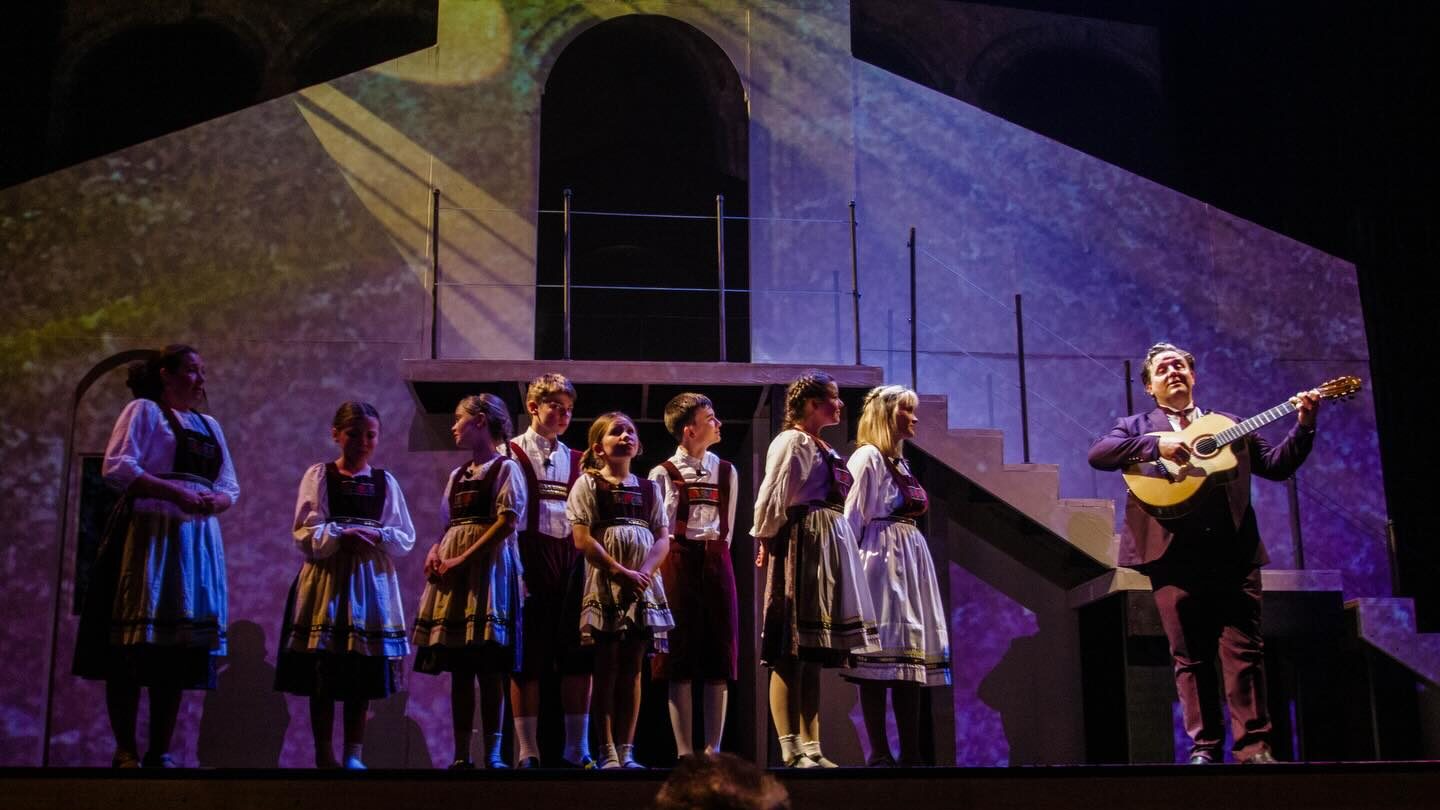
Michael Spyres in The Sound of Music at Ozarks Lyric Opera / Photo: Ozarks Lyric Opera
Spyres is the artistic director of Ozarks Lyric Opera in Springfield, Missouri, a position he’s held for over a decade. “For me, it’s both a homecoming and a statement of belief about opera in America. I began my life musically very far from the traditional European centers, and now, after years of singing abroad, I feel a responsibility to bring that experience back to the place that shaped me. The company’s identity, as I see it, is about proving that you can have world‑class artistry in a region that many people overlook, and that opera can be both rooted in local community and connected to an international conversation.”
He has big plans for his company: a competition aimed at mid-career singers (“a kind of professional no-man’s land,” as he describes it), a training program specializing in French grand opera, bel canto, and baroque, and touring productions. “The Midwest audience is often treated as if it were incapable of digesting anything beyond the most familiar titles; I think it’s exactly the opposite. If you respect people’s intelligence and give them context, they will follow you anywhere, whether that is Tom Waits’s The Black Rider or Tristan und Isolde.”
“One of the most exciting, perhaps slightly mad, ambitions we have,” he adds, “is to create our own versions of Wagner’s operas. Not ‘Wagner lite’, but thoughtfully scaled renditions that keep the musical and dramatic DNA intact. Historically, this is nothing new — Liszt and Mahler did arrangements and reductions constantly — but it has fallen out of fashion. I want us to bring it back and imagine a Tristan or a Walküre that can be played in a mid‑sized house, with a chamber orchestra that still gives you the harmonic world but allows the voices to carry with genuine bel canto technique. We want to be the model for other regional companies and help create a grassroots operatic shockwave!”
And what’s next after Tristan? “There are several Wagner roles I’d like to live with more deeply. Letting Tristan, Siegmund, and Walther mature with me interests me more than racing to take on new roles. Outside of the German repertoire, I’m excited to explore more Verdi: there are many roles that sit beautifully for a baritenor instrument when approached with the line first, rather than decibels. Soon I’ll be debuting Don Carlos, Ernani, and Otello.”
After the success of his previous recital discs, he’s currently preparing an all-Verdi recording — though he is quick to emphasize that it won’t be a “greatest hits” album. “This upcoming Verdi album grows out of a curiosity and obsession that Verdi and I share about pitch. He took an almost scientific interest in the physical conditions of singing. He worked with physicists and acousticians, wrote letters, and signed petitions! He championed what we now call 432 Hz as the ideal pitch for the human voice: low enough to respect the natural instrument, high enough to retain brilliance.”
“Today, 440-444 Hz has become the norm, and even goes up to 447-450 Hz in some houses. It’s like asking a marathoner to run on a slight permanent incline and then wondering why they tire sooner! My Verdi album will be recorded at 432 Hz, and once you bring the tuning down something fascinating happens with the strict border we draw today between a ‘Verdi tenor’ and a ‘Verdi baritone.’ The baritone roles no longer sit in an artificially high, almost tenor-ish strain, and the tenor roles no longer sound like they require a trumpeted, quasi-baritonal push to get through the evening. At that pitch, they become two faces of the same vocal archetype: a flexible, dramatic male voice capable of moving across the range with color rather than brute strength.”
“So when I talk about upcoming roles and this Verdi project,” he concludes, “I’m really talking about the same mission. I want to show that Verdi’s vocal world is richer and more fluid than the modern Fach system admits, and that respecting his ideas about pitch is not a fetish but a way of restoring balance between singer, orchestra, and drama. I’m interested in parts where our modern casting habits have obscured the original vocal logic!”
-
Topics: feature, michael spyres
-
People: Franz Liszt, Giacomo Meyerbeer, Gioachino Rossini, Giuseppe Verdi, Gustav Mahler, Hector Berlioz, Lise Davidsen, Michael Spyres, Richard Wagner, Wolfgang Amadeus Mozart
-
Works: Der Rosenkavalier, Die Frau ohne Schatten, Die Walküre, Don Carlos, Ernani, Otello, The Sound of Music, Tristan und Isolde
-
Places & Organizations: Bayreuth Festival, Metropolitan Opera