Photo: Chris Lee
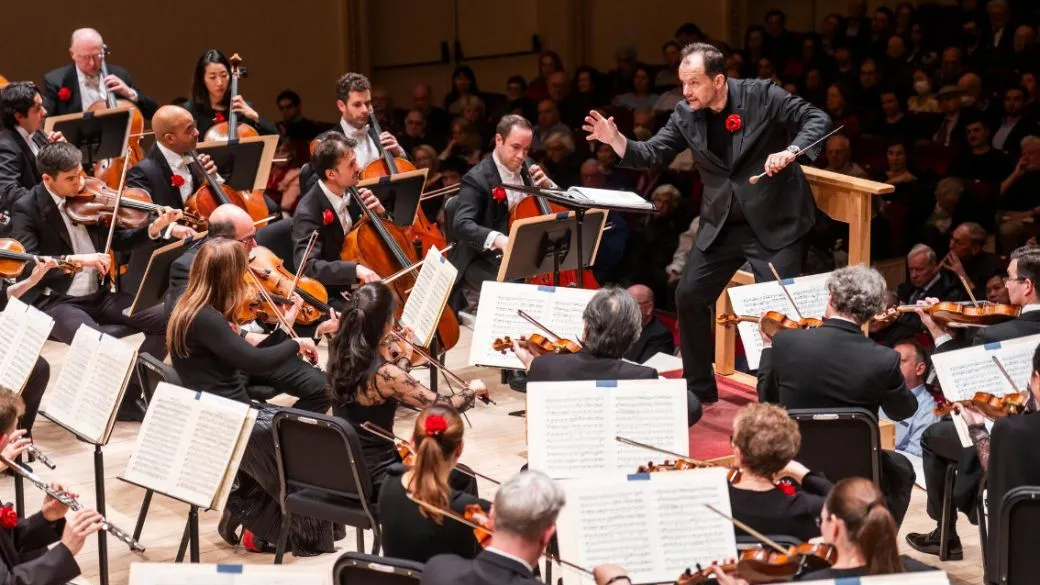
The musicians wore red roses. So, too, the maestro.
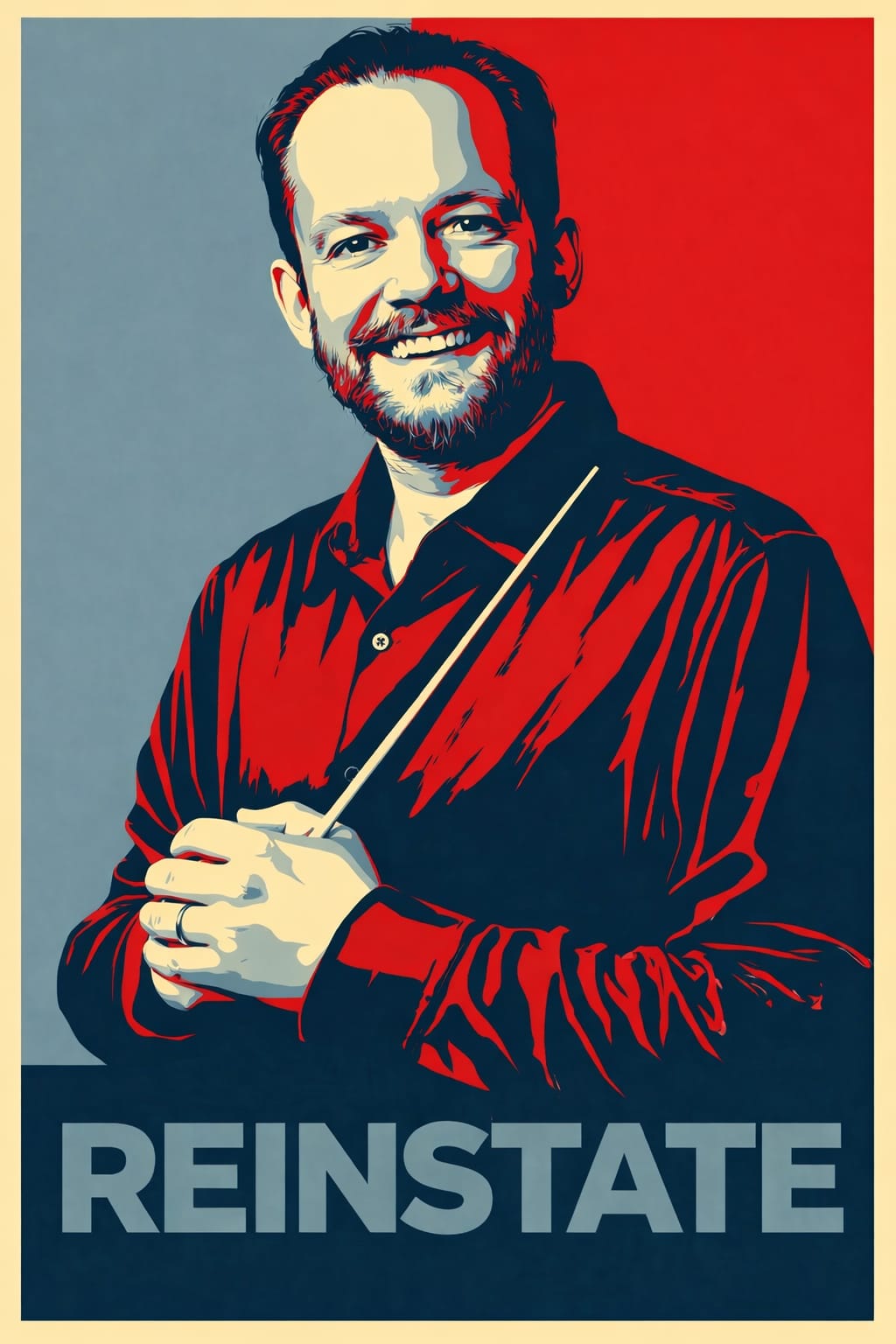
Red roses were also on offer outside Carnegie Hall last Thursday night, which marked the first appearance of the Boston Symphony Orchestra in New York since news broke of Andris Nelsons’s unceremonious dismissal from his post as Music Director. A small group of Nelsons supporters, carrying a near-life-sized cutout of the maestro, had followed the orchestra from Boston to distribute these roses and flyers (featuring the conductor in Obama-esque colors) to rally New Yorkers to the BSO musicians’ cause: recentering their voice in the conversation about the Orchestra’s future.
As the orchestra filed onto the Perelman Stage, an unusual sense of purpose for a midweek concert descended over the hall. The musicians, red blooming from their boutonnières or behind their ears, turned to face the waiting audience, who applauded in the way a crowd greets someone who has undergone some horrendous ordeal and emerged “brave.” Then Nelsons, flanked by Renée Fleming (also in red) and Thomas Hampson, emerged to the audience’s roar. The tone of the evening came into focus: This was symphony as solidarity.
It did not help matters that the program, conceived as part of the orchestra’s semiquincentennial-adjacent E Pluribus Unum: From Many, One series, opened with selections from John Adams and Alice Goodman’s Nixon in China; an opera that deals in diplomacy, leadership, and the fraught image-making of modern politics came to comment on the BSO’s current struggles with its management. Yet, the ironic, knowing charge that surged through Carnegie could not be matched by the first half’s musicmaking – a failure of leadership persisted.
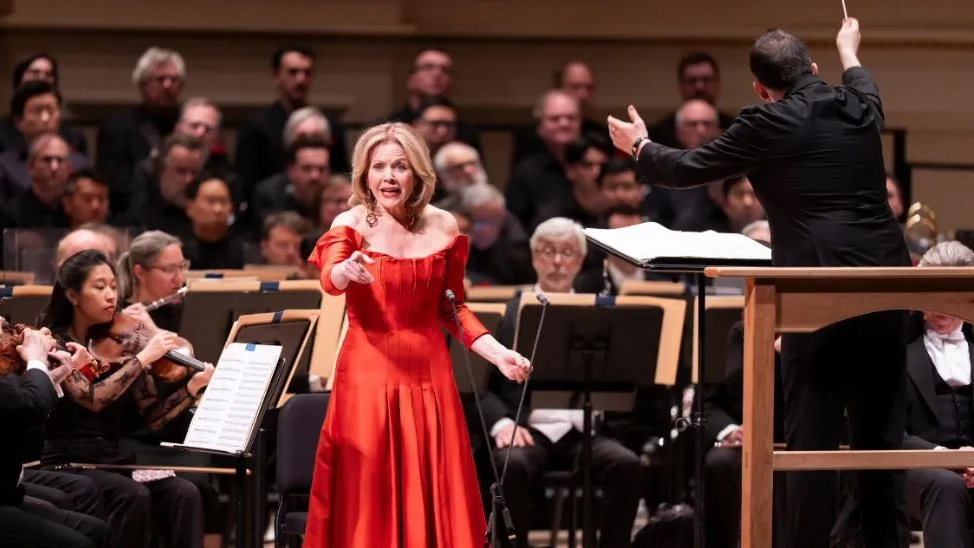
Photo: Chris Lee
Adams’s score is urgent and propulsive, magisterial in fanfare, dreamily woozy in its more intimate moments. Under Nelson’s baton, the opening arpeggios of Act I slacked, and his jerky, tentative gestures did little to coax texture or momentum from Adams’s crackling, repetitive structures. By the time the Tanglewood Festival Chorus entered to intone “Soldiers of Heaven Hold the Sky,” the sound veered dangerously towards disorganization. Matters improved when Nelsons settled into the sweeping buildup to “Landing of the Spirit of ’76,” and the formerly tepid brass section grew assertive.
Coordination issues returned when Hampson, who recently performed the entire opera in Paris alongside Fleming, launched into Nixon’s aria “News Has a Kind of Mystery.” Nelsons again seemed bewildered on how to build tension from Adam’s unrelenting triads, and the communication conductor and baritone lapsed at various points, resulting in a disjointed interpretation. At 72, Hampson’s baritone has frayed at its edges, and he blustered and bellowed through the much of the aria, striking Nixon’s signature double V sign (though, with his tie and tails and plume of white hair, he resembled Andrew Jackson). He was at his best when he could snarl through Nixon’s paranoia (“The rats begin to chew”), though his wistful delivery of “I know America is good” added a pointed poignancy to the aria.
Renée Fleming proved an unusually glamorous Pat Nixon. The role sits in a good place for her voice, which has retained much of its creamy incandescence and depth. And her signature swoony thing lent itself well to the wistful strains of “This is prophetic!”, wherein the first lady’s stream of quotidian images transforms into surreal visions of the future. Despite the text’s strangeness, her phrasing was appropriately grounded and nuanced, at times nearly plainspoken.
The chorus expertly conveyed the momentous ceremony of Act I, Scene III, in which Nixon toasts his Chinese hosts and declares he was wrong to have opposed China. Nelsons was on firmer ground here, as he could focus his efforts more on building expansive chords than teasing out rhythmic texture from his orchestra. Unevenness be damned, the audience responded enthusiastically.
If the quality of Nelsons’s Nixon left me confused as to why, beyond the question of respect for the musicians, one should care so intently about his professional fortunes, his reading of Dvořák’s Symphony No. 9, From the New World, clarified matters. The BSO finally sounded as it should – like a world-class orchestra. Even if Nelsons’s gestures on the podium struck me as inscrutable, the musicians responded with an expansive and cohesive playing. He took the second movement, with its famous, quasi-spiritual main theme, at a relaxed pace, making space in which each limpid phrase could settle gently. Robert Sheena gave a luminous English horn solo. A feverish intensity swept through the scherzo, bolstered by some crisp work from the percussion section, while the final movement took on a stately, if self-consciously deliberate, cast. A symphonic crowd-pleaser done well.
Nelsons and the BSO concluded to thunderous applause. The young men who were handing out flyers gave him a bouquet of roses. The orchestra stamped their feet in unison; the audience responded in kind. Perhaps due to high ticket prices, American audiences demand each performance be a triumph, and they tend to manufacture it with their enthusiasm, regardless of actual merit. In this fraught moment, the BSO musicians needed their maestro to triumph to assert their position – and Carnegie’s patrons were more than happy to oblige.