Photo by Monika Rittershaus
Just in time for the Passover season, Naxos has released a new DVD of Fromental Halévy’s La Juive taken from performances at the Frankfurt Opera in 2024. The opera takes place in Constance in 1414. Éléazar, a Jewish goldsmith (oy!) is despised and threatened by the populace, but he is saved by the intervention of Cardinal Brogni who is attending the Council of Constance. Éléazar’s adopted daughter Rachel is in love with Prince Léopold who has disguised himself as the Jew Samuel. He attends Éléazar’s clandestine seder. Léopold promises to take Rachel away with him. They are confronted by Eléazar, who curses Léopold.
Rachel follows Léopold to his palace and offers her services as a lady’s maid to Princess Eudoxie, his wife. Éléazar arrives at the palace to deliver a jewel to Eudoxie. There is a celebratory ballet (because, Paris). Eudoxie gives her husband the jewel. Rachel recognizes Léopold as Samuel. Rachel tells the populace that Léopold seduced her, a crime. She, Éléazar, and Léopold are arrested.
Eudoxie persuades Rachel to withdraw her allegations. Brogni will commute Léopold’s sentence and spare the Jews if they convert. Brogni does not know that Rachel is actually his daughter. Éléazar rescued her from a fire in Rome years earlier. If she dies, Éléazar will avenge his own sons’ death at the hands of the church. He wavers (Aria: “Rachel, quand du Seigneur”) and then after hearing a crowd demanding death to the Jews, he decides that he and Rachel must die as martyrs to their faith (Cabaletta). The two are brought to a platform to be thrown into a boiling cauldron. Éléazar tells the terrified Rachel that she can be saved if she converts, but she refuses. Just as she is dying, Éléazar reveals her true identity to Brogni and jumps to his own death. The crowd rejoices in their vengeance on the Jews as Brogni collapses.
The frank depiction of anti-semitism was unprecedented at the time and the theme attracted Halévy, an assimilated Jew. Interestingly, Meyerbeer — another assimilated Jew — passed on the libretto before it was offered to Halévy. It’s unclear whether the librettist Scribe intended to engage the audience on antisemitism or just wanted a novel milieu for his usual melodramatic shenanigans. The near-Shylockian characterization of Éléazar, does not make him a sympathetic character, but his motivations are very clear.
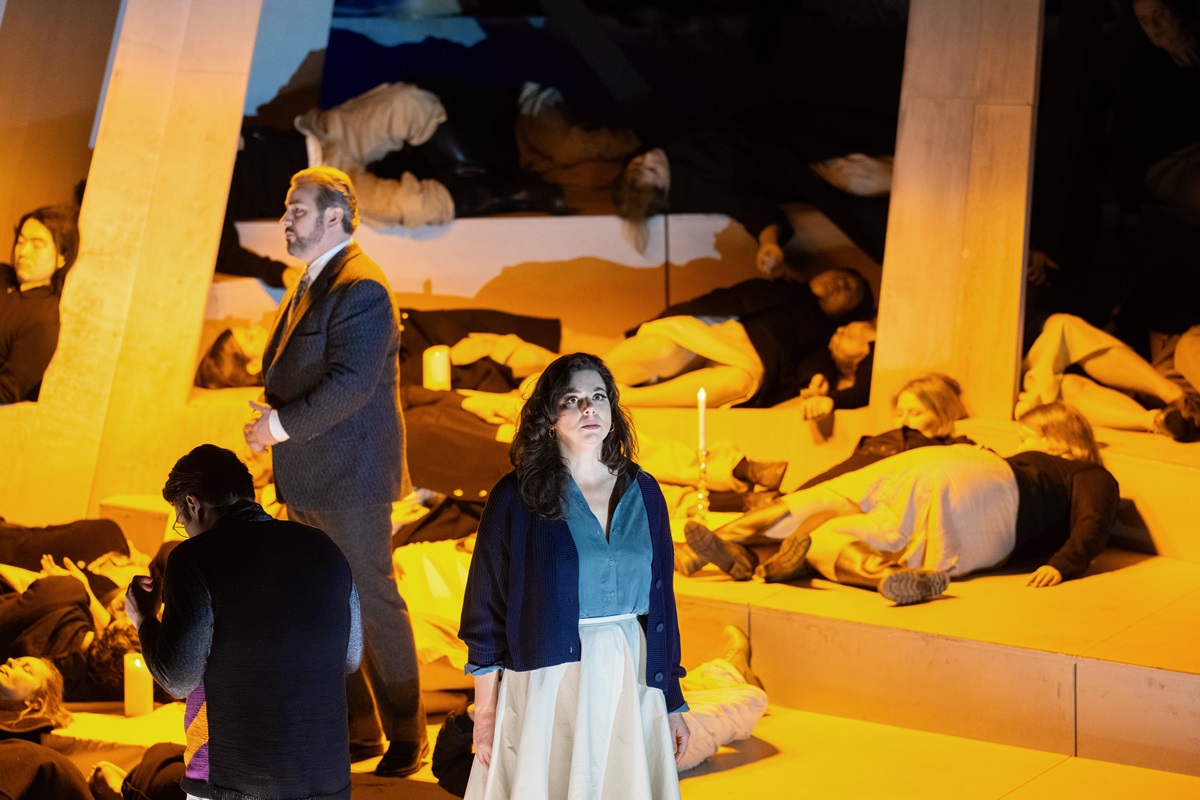
Unfortunately, the production by Tatjana Gürbaca does this fascinating work no favors. It gives us all the usual regie tropes ( ugly unit set, metal bowls filled with blood, expressionistic lighting, random mix of modern and medieval-adjacent costumes spanning centuries, a Spirit Halloween sexy maid costume, twitching chorus, etc.) without bringing any insights on the work’s themes or character’s motivations. Her production also doesn’t establish a milieu where the Catholic Church and monarchy work together to persecute the Jews, which is the key engine of the plot
The one aspect that I liked was the use of a propaganda film for the celebratory ballet in Act III. This highlighted the historical events of the Council of Constance including the arrest and execution of the reformer Jan Hus. This historical context and specificity was needed elsewhere, even if the film showed that Rachel should have recognized Prince Léopold, disguised as he was by wearing a hoodie.
Musically, this is a dark and relentless work. Even the ballet music is unsettling. Wagner admired and appropriated several distinctive elements in the score including the opening chorus with organ accompaniment and the sudden intrusion of Eléazar,’s hammering into the solemn goings-on in the town square. Halévy had a cast of legendary singers at the premiere including Cornélie Falcon as Rachel, Nicolas Levasseur as Cardinal Brogni and Adolphe Nourrit as Eleazar. Nourrit is credited with inventing the modern tenor sound and was known for his extensive power across a broad vocal range; the part of Eléazar highlights these strengths and creates a formidable challenge for anyone else. John Osborne acquits himself very well demonstrating the intensity, flexibility and thrilling high notes that the part calls for. He may tire slightly towards the end, but it’s a satisfying, well-characterized performance
Cornélie Falcon was the eponymous Falcon Soprano. Her voice was known for its dark timbre, powerful mezzo-like low notes and her 2.5 octave range. Again, Rachel was written to capitalize on these special traits. Ambur Braid, a Canadian soprano who has been getting attention recently on this site makes an extremely strong impression in this part. The voice easily rides over the cast and chorus. She brings sensitivity and delicacy to the role where necessary, not just volume. Unfortunately, she is costumed and directed as if she might burst into “Rataplan” at any moment. Definitely, a singer that I’m eager to hear in person.
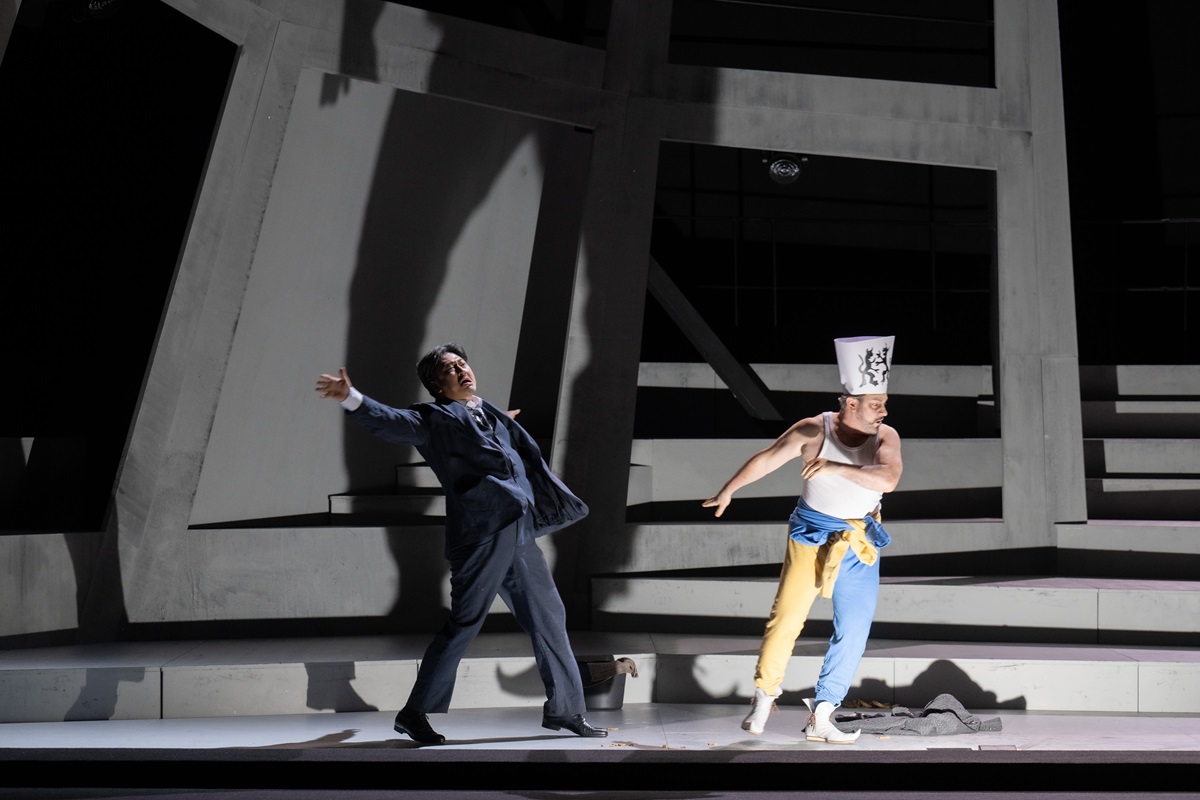
Photo by Monika Rittershaus
Nicolas Levasseur was a bass known for powerful lower notes. He also originated Marcel in Les Huguenots, which gives us an idea of just how cavernous his voice was. Simon Lim, the Brogni in this performance, lacks those extremely powerful low notes. Still, he sings with authority, when the tessitura allows, and sensitivity throughout
As our royal pair, Léopold and Eudoxie, we have Gerard Schneider and Monika Buczkowska. She has the necessary flexibility, finesse, seductiveness, and stamina for the part. It’s an exciting performance of an occasionally thankless role. He sings with charm and grace and is unfazed by the florid writing. Schneider is convincing in his seduction of Rachel and has the proper degree of entitled self-confidence that the part required.
Conductor Henrik Nánási leads the orchestra and chorus of the Frankfurt Opera. He keeps this long score moving without ever seeming to rush or hamstring the singers. He also highlights the distinctive color and mood of this piece. I’m not enough of a scholar to speak to the edition used, but the performance runs for nearly 3 hours and 15 minutes, which is as much of the opera as we seem to get nowadays.