Photo by Scott Suchman
The midpoint of WNO’s spring season, which Zambello has referred to as an “American triptych,” Robert Ward’s The Crucible closely follows Arthur Miller’s original 1953 play. Miller wrote his fictionalized account of the 1692-1693 Salem witch trials in response to the era of McCarthyism (the playwright himself later testified before the House Un-American Activities Committee), and his work continues to resonate today. Bernard Stambler’s taut libretto largely draws from Miller’s original text, condensing the drama down to the essentials, with additional text added to provide characters with arias. The opera diverges from the stage play by including a scene, dropped by Miller, in which John Proctor and Abigail Williams meet in the woods, as well as adding a visit from Abigail to John in jail. These choices emphasize the interpersonal drama of John and Abigail’s affair more heavily, making it more clearly central to her motivations. Ward’s elegant setting of Miller’s often antiquated-sounding language has a keen sense of rhythm and flow not always easy to achieve in English-language opera. WNO diction coach Ken Weiss deserves credit for the cast’s success in parsing this text.
The Crucible, which debuted at New York City Opera in 1961 and won a Pulitzer Prize, hails from the American neo-Romanticism movement that has fallen out of favor among major opera companies in recent decades. Ward’s score indicates his careful study of the past: emotional swells recall Giacomo Puccini, while a pastoral theme that opens Act II, set in the Proctor farmhouse, evokes Ward’s mentor Aaron Copland. Miller’s tale of mass hysteria and persecution lends itself well to the operatic medium. The Crucible opens with frenzied strings; the propulsive score drives towards a dark conclusion in just about two hours. The composer’s hymn melodies (which got stuck in my head—I was rocking out like a Puritan on the way home) help bring the era to life.
Under the baton of WNO Music Director Robert Spano, the WNO Orchestra effectively conveyed the energy and drama of Ward’s score. Limited space in Lisner Auditorium’s pit required that some sections of the orchestra be housed in a separate room and linked to the pit via audio and video connections, a workaround solution that proved smoothly unnoticeable with Spano on the podium. This bit of jury-rigging would also have been required if WNO had performed The Crucible in its original venue, the Kennedy Center’s Eisenhower Theater.
Ward’s vocal writing for ensembles effectively conveys the social dynamics of the witchcraft panic that seized Salem, particularly in the pivotal Act III courtroom scene and in Act I, when Abigail sings her own prayer in isolation opposite a group of denizens of Salem, who have just burst into a second round of “Jesus, My Consolation” (which is something of a banger). The Crucible’s ensemble cast (there are over a dozen roles even in the version with reduced orchestration performed by WNO) has made the opera a popular choice for academic settings and was a good fit for WNO’s roster of Cafritz Young Artists, who filled many of the parts.
Bass-baritone Ryan McKinny and mezzo-soprano J’Nai Bridges sang John and Elizabeth Proctor. This production marked the pair’s return to WNO after their March 2020 runs of Don Giovanni and Samson and Delilah, respectively, were interrupted by the onset of the COVID-19 pandemic. McKinny’s sturdy, fiery bass-baritone made him a strong fit for the complex role of John, the idealistic Salem farmer who refuses to bend the knee to his inquisitors but also engaged in an affair with the Proctors’ young servant, Abigail Williams. Committed to his values yet quick to anger, McKinny’s John captured the complicated nature of the character. The cavernous depths of his voice anchored John’s role as a conscience of Salem. Bridges’s smoky, emotionally throbbing mezzo and commanding stage presence conveyed an Elizabeth simmering with resentment yet torn by her love for her husband. Bridges exhibited a strong top in this demanding part, but she sounded a little rougher around the edges in transitioning between registers.
Soprano Lauren Carroll, in her first year as a WNO Cafritz Young Artist, gave an excellent performance in the challenging role of Abigail Williams, which required rapid acceleration up the scale and showed off her impressive upper register. Ronnita Miller boasted a plummy mezzo as Tituba, the enslaved woman who was the first to be accused of witchcraft, and her mournful rendition of the character’s Act IV aria, a reprise of her forced confession to witchcraft that’s turned into a plaintive cry for freedom, was poignant. Miller was the only member of the cast making a WNO debut and her performance made a memorable first impression for Washington, DC audiences. Tenor Chauncey Packer sang a perfectly severe Judge Danforth, embodying the unyielding jurist so completely that it was hard to recognize him as the hedonistic Sportin’ Life in WNO’s revival of Porgy and Bess last season.
Mezzo-soprano Michelle Mariposa portrayed a sympathetic Rebecca Nurse, one of the oldest women accused of witchcraft, her sweet, gentle tone turning steely when facing her fate. As her fellow victim Giles Corey, tenor Nicholas Huff sang with a righteous and resonant delivery. Recent Cafritz alumna Kresley Figueroa’s silvery soprano and vocal agility made her a gripping Mary Warren, the Proctors’ servant who recants her participation in the witch trials but then disavows her recantation. As Abigail’s fellow accusers Ruth Putnam, Betty Parris, and Susanna Walcott, soprano Anneliese Klenetsky and mezzos Veronica Siebert and Alexandra Christoforakis gave vividly expressive performances of the “spectral evidence” that doomed those suspected of witchcraft. Other standouts in the ensemble cast included baritone Chandler Benn, who cut a threatening figure as leading accuser Thomas Putnam, and Tiffany Choe, who showed off a crisp soprano as his grief-stricken wife Ann.
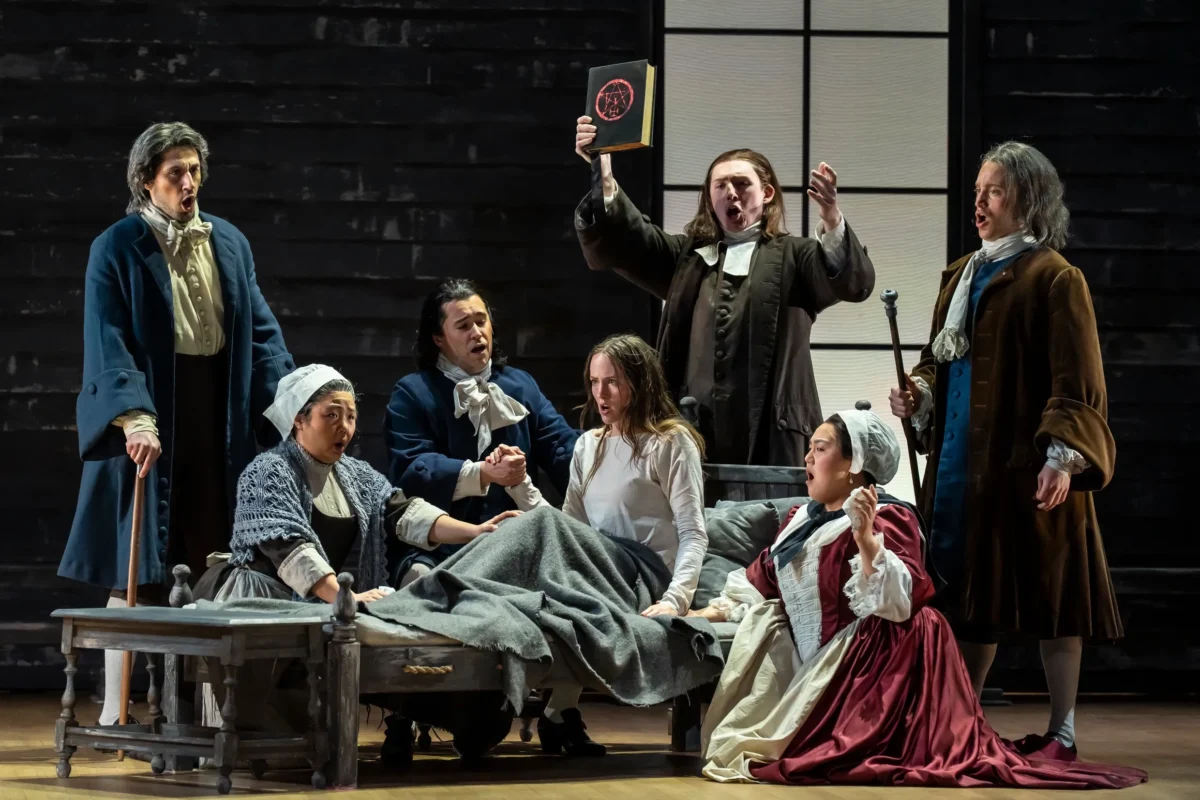
Photo by Scott Suchman
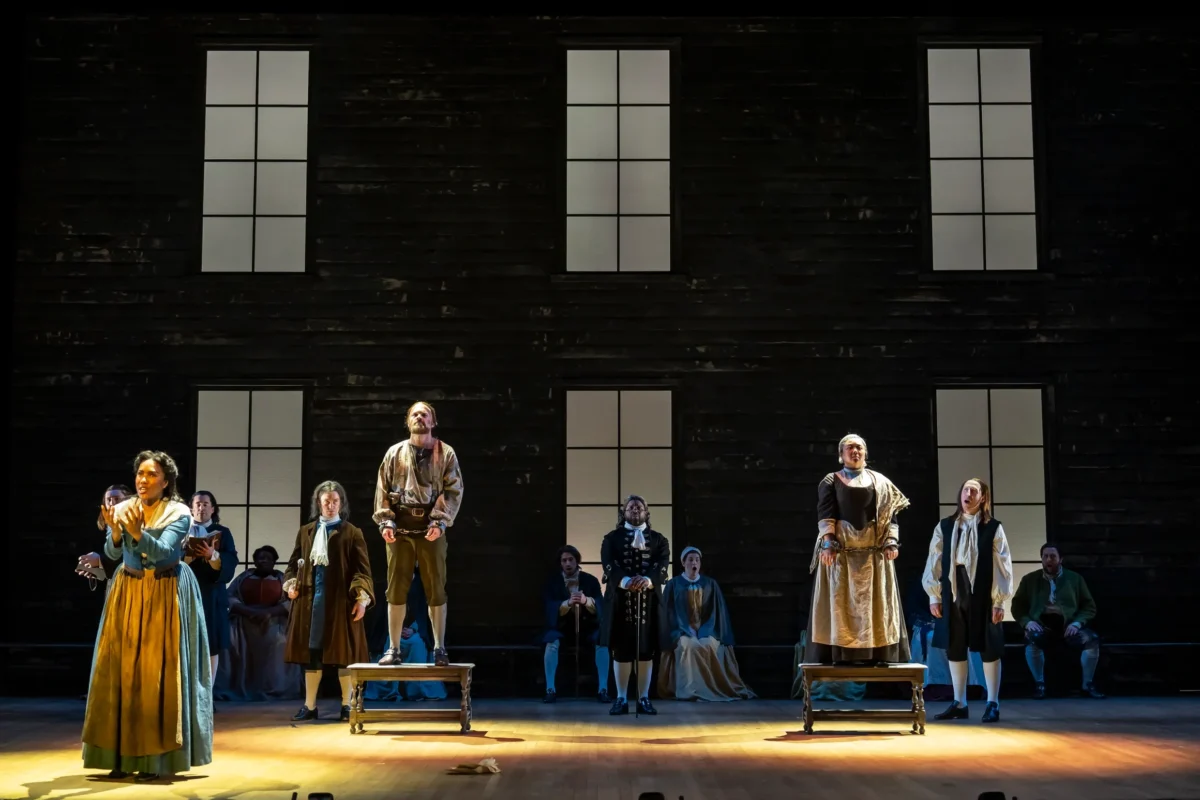
Zambello’s riveting production, which debuted at the Glimmerglass Festival a decade ago, is as fresh as if it had been rolled out today. Zambello began with a scene of Tituba, Abigail Williams, and the other young girls involved in the witch trials cavorting around a cauldron in the woods at night to the sound of drums, a reverie broken by Samuel Parris’s discovery that launched into Ward’s score. Under Zambello’s direction, the characters were fully three-dimensional: heroes had flaws while even the villains had some sympathetic qualities. Shadowy silhouettes, shifts in lighting, and colorfully illuminated windows (lighting for the revival by Jason Lynch, original lighting by the late Mark McCullough) had psychologically probing effects, especially during the accusations of witchcraft. Sound design by Mark Rivet nicely supplemented the outdoor nocturnal scenes without distracting from the music. Neil Patel’s set used a clapboard house to serve in turns as the Parris residence, Proctor farmhouse, and courthouse by virtue of shifting furniture; the claustrophobic space powerfully evoked a stifling atmosphere of paranoia and suspicion. Dark scrims effectively conjured the Salem woods and jail. Jessica Jahn’s costumes, replete with a panoply of Puritan wigs, effectively represented the colonial era.
WNO will continue its spring season with performances of West Side Story at the Lyric Baltimore (fully staged) and the Music Center at Strathmore (semi-staged) in May.