Photo by Lawrence Sumulong
As part of its season-long tribute to Jeanine Tesori, Lincoln Center presented a one-off performance by Deaf Broadway of the musical Violet featuring music by Tesori and book and lyrics by Brian Crawley. The work tells of a young woman whose face was scarred in an accident when she was a girl. After her father’s death, she leaves her home in rural North Carolina rural village to be healed by a televangelist in Oklahoma City. Along the way she meets two soldiers. The televangelist does not heal her, but she still finds love with one of the soldiers and comes to accept her disfigurement. The work is strong: It avoids bathos and easy sentimentality while demonstrating Tesori’s ability to write compellingly in a variety of styles.
Deaf Broadway, was established in 2020 with the goal of providing “unprecedented visual language access to classic musical works of the American theatre for those whose primary and native language is American Sign Language (ASL).” The creative teams and casts for their productions are composed entirely of deaf artists. Deaf Broadway’s approach to presenting these works and its focus on accessibility create a fascinating theatrical experience that provides some useful lessons for performing arts organizations and performers.
When you enter the theater, a short video is playing on repeat on the large screen that fills the rear of the stage. It introduces all the main characters — in costume — and the special “sign names” that the company has devised for each character. Wouldn’t it be helpful if opera companies did something similar or had photos of the performers in costume in the playbill rather than microscopic out-of-date headshots?
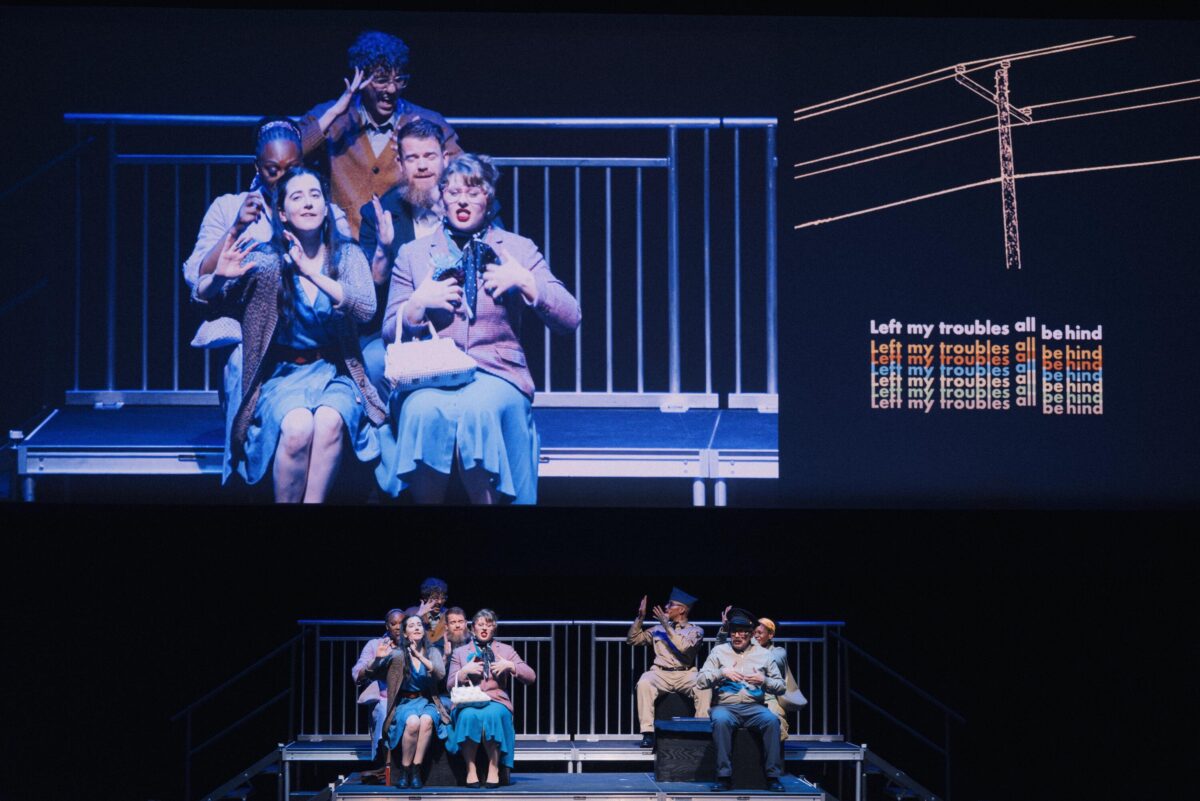
Their performances use a pre-recorded soundtrack. In this case, it was the Original Broadway Cast Album. During the performance, the large screen is divided into two sections: One features medium shots of the performers that can clearly show their faces, ASL, gestures and overall movements. Sometimes this part of the screen is split further to show multiple performers at once. The camera work was alert without being excessively busy. Overall, this let me appreciate the nuance of a performance (from the back of Alice Tully). Various opera companies have experimented with live video during performances, but too often these second screens are away from the stage and show such extreme closeups that they don’t illuminate the singer’s overall performance. Not surprisingly, those experiments don’t last long.
On the other half of the screen, we see the text as it is performed, but these are not typical titles. The text layout shows the shape of the musical phrases; imagine the words flowing along an unseen musical staff. Typography and iconography are used to indicate long, held notes, key instrumental solos, and the different participants in ensembles. I’ve never seen something like this that so clearly depicted the shape, content, and experience of the music for an audience. So often, titles are treated as a necessary evil, rather than an essential part of the viewing experience. Some directors have experimented with projecting titles onto the set so that the audience never has to look away from the stage, but this is not common. I wouldn’t necessarily want to see this style of titles this for every opera, but I would want directors to see a Deaf Broadway show so that they could see how much potential titles have when deployed creatively.
And then there is the use of ASL. If you’ve seen a viral clip of a captivating ASL interpreter (such as this one), you will have an idea of how vivid these ASL performers were. ASL and gesture were layered together to create lively distinctive characterizations. These performers really “sang” with their whole bodies and it was a refreshing antidote to the opera house or recital stage where singers can get stuck in the same stock movements.
I thought the entire cast was excellent. The characterizations were vivid. Synchronization to the soundtrack and execution of the choreographed movement was impressively precise. I cannot judge their ASL, but the largely deaf audience cheered the performance very enthusiastically. Overall, it was enthralling and enlightening to watch. The main performers were Erin Rosenfeld ( Violet ), Alona Jane Robbins ( Young Violet), Tyrone Giordano (Violet’s Father) Chris Corrigan and Rayly Aquino (as the soldiers Monty and Flick).
I would certainly recommend experiencing a Deaf Broadway performance, and kudos to Lincoln Center for highlighting their work.