Photo: Brandon Patoc / The New York Philharmonic
On a January evening in 1970, journalist Tom Wolfe snuck into Leonard Bernstein’s Park Avenue duplex on the Upper East Side. The 39-year-old Wolfe was at the time best known for applying his audaciously unconventional prose towards countercultural trends such as California’s hot rod culture and the psychedelic adventures of the Merry Pranksters. Bernstein, for his part, was on a career high after over a decade as music director of the New York Philharmonic.
They were gathered for a cocktail reception in honor of the Black Panthers, after a turbulent year for the political organization — activists Fred Hampton and Mark Clark had been killed by the police just over a month prior, following FBI director J. Edgar Hoover’s pronouncement that the organization was “the greatest threat to the internal security of the country.” Over the course of 29 pages in New York magazine, Wolfe gleefully skewers the performative activism of Bernstein and his circle of cultural jet-setters. “Do the Panthers like little Roquefort cheese morsels rolled in crushed nuts?”
The blowback was immediate and severe. The New York Times’ report described the party as “elegant slumming” and “guilt-relieving fun spiked with social consciousness;” the Bernsteins responded indignantly. By the time Wolfe’s piece came out in New York magazine six months later the damage was done — Bernstein’s out-of-touch political activism would be immortalized for generations of journalism students studying Wolfe’s “New Journalism.”
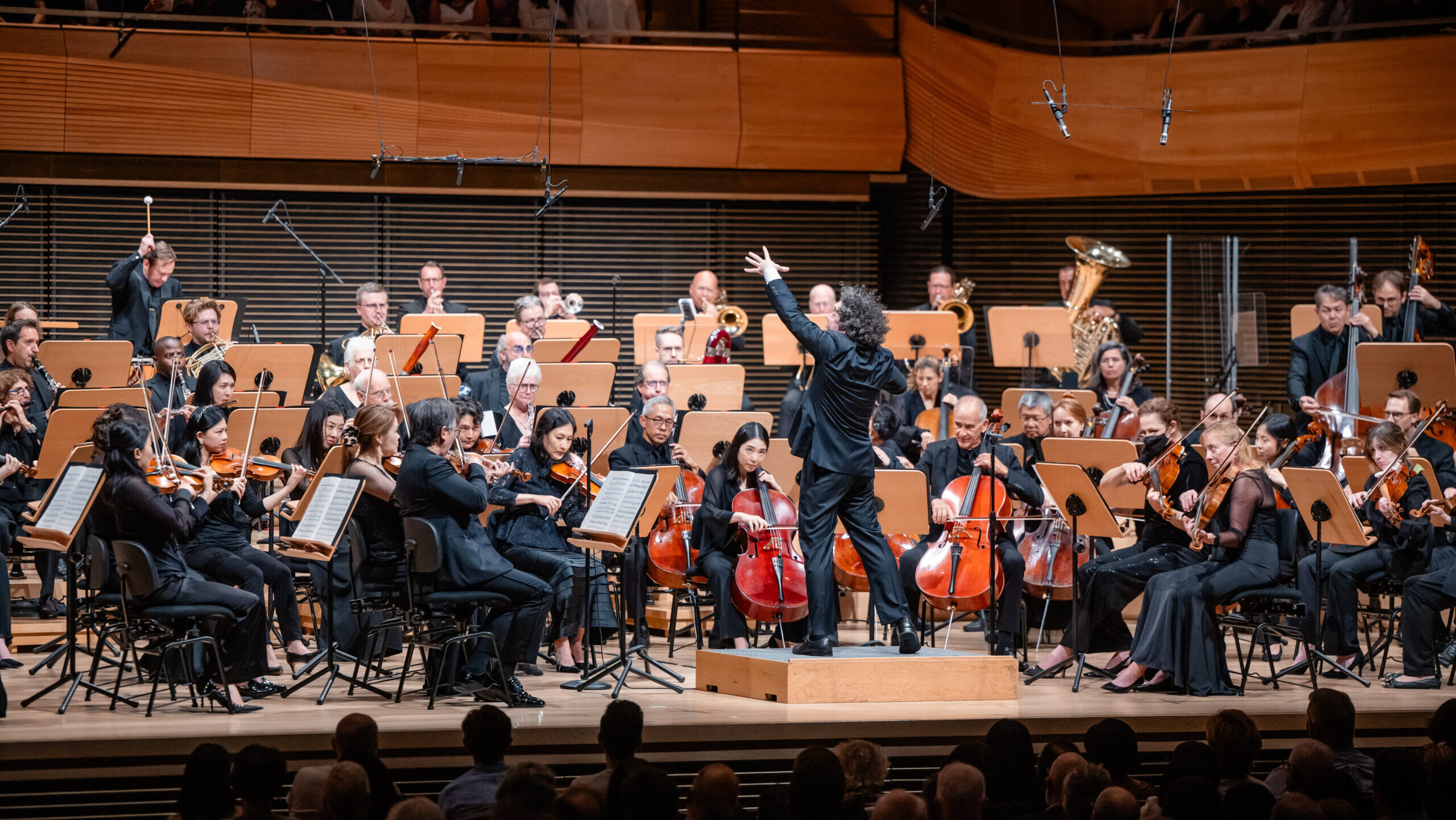
This year sees Gustavo Dudamel take over Bernstein’s position at the New York Philharmonic after nearly two decades at the helm of the Los Angeles Philharmonic. The energetic Venezuelan, with his trademark bounce of curly black hair, got his start in his home country’s government-funded El Sistema music education program learning the violin; by eighteen he had been appointed music director of its flagship youth orchestra. Though his international conducting career would take off he would always remain loyal to his first orchestra — between performances of John Adams’s The Gospel According to the Other Mary in LA, he returned to Caracas conduct the Simón Bolívar Youth Orchestra at then-President Hugo Chavéz’s funeral.
Thirteen years later, Chavéz’s successor Nicolás Maduro sits in prison in Brooklyn, ten miles south of Lincoln Center. Maduro’s political record of electoral fraud, human rights abuses, and economic hardship are not defensible — nevertheless, the Trump administration’s decision to launch a military operation to capture and imprison a foreign head of state represents a brazen escalation of an already-volatile world order.
El Sistema, and by extension Dudamel, have always been closely linked to the Venezuelan government: Chavéz placed El Sistema under the executive branch of the government and funded it to the order of $100 million a year. Government support flourished under Maduro’s reign — he personally backed the construction of the Frank Gehry-designed Sala Dudamel in the conductor’s home city of Barquisimeto and announced a $9 million budget to support El Sistema’s top ensembles tour the world as a form of cultural diplomacy. Following a 2016 performance at the United Nations, Venezuela’s current acting president Delcy Rodriguez called Dudamel “our best ambassador to the world.”
At the end of January, Dudamel announced a five-year project bringing the New York Philharmonic to Carnegie Hall performing operas in concert. For two nights in November, New Yorkers can see Marina Rebeka, Jonas Kaufmann, and Ludovic Tézier in Tosca — these performances mark Rebeka’s role debut as well as Kaufmann’s first performances in the city after declaring he would never sing at the Met again.
Puccini’s opera keeps finding itself at the center of political discourse. Anna Netrebko’s Covent Garden return in the title role last September found itself amidst a sea of protests, sparking endless debate over the soprano’s checkered past with Putin and Russian separatists that threatened to overshadow the performance onstage. “Leave politics out of the opera house,” grumbled a few disgruntled operagoers, who then went onto enjoy an opera about authoritarian politics. Who better, really, than Netrebko or Dudamel disentangle the cognitive dissonance between art, politics, and identity?
As Alex Ross puts it, Dudamel “has never been a brazenly political artist, yet politics has a way of catching up to him.” El Sistema musician Frederick Chirino Pinto was one of millions protesting the Maduro government in April 2017; images of police snatching his French horn and aggressively detaining him quickly went viral. Dudamel remained silent. A month later, El Sistema violist Armando Cañizales Carrillo was killed in a protest, one of over a hundred protestors killed that year in brutal government crackdown. In a statement on Facebook, Dudamel called on Maduro to “rectify and listen to the voice of the Venezuelan people” and end the bloodshed. “The only weapons that can be given to people,” he said, “are the necessary tools to forge their future: books, brushes, musical instruments”.
Dudamel’s words echo those of Bernstein, who after the assassination of John F. Kennedy remarked that “This will be our reply to violence: to make music more intensely, more beautifully, more devotedly than ever before.” It’s a quote that pops up after every school shooting, every incident of police brutality, every international disturbance. Art, suggest Bernstein and Dudamel, is the best and only tool at an artist’s disposal in the face of political repression.
Dudamel told The Telegraph a year ago, “Everything is over-politicized in the world right now.” His programming with the New York Philharmonic, though, tells a different story. Last week’s programme combined Beethoven’s Eroica Symphony, a struggle between Napoleonic ideals and authoritarianism, with a new orchestration of Frederic Rzewski’s The People United Will Never Be Defeated, a set of variations on a popular Chilean protest song in opposition to Pinochet’s regime. This program comes as a part of a wider series of commissions celebrating the USA’s 250th birthday, which also sees Dudamel conduct Thomas Adès’ America (A Prophecy), a foreboding view of the country’s future incorporating apocalyptic Mayan texts, and the world premiere of David Lang’s the wealth of nations, an oratorio based on the very American bible of free-market capitalism. The politics of music are both intrinsic and extrinsic: what do the text and music express? What were the circumstances of its composition? And what are the who, when, and why of its performance in the present day?
Classical music, especially in America, has always presented itself as a unifying force, one that transcends the ugliness of politics. That’s why Bernstein’s Black Panthers party was so roundly criticized — for daring to upset the balance between a largely left-leaning artist base and their right-wing donors. The utopian vision of classical music as a universal, humanizing force and, therefore, one that can bring people of all political leanings together hides the dull, incessant inequities that underlie the machinery of classical music: the canonization of old white men; the ever-increasing ticket prices that restrict audience access; the near-complete demolition of publicly-funded music education in schools; the gentrification process that accompanies every fancy new performing arts venue. Social justice, however well-intentioned, doesn’t mean much without challenging the institutions of power and capital that support it.
Silence has been the default response from legacy classical music institutions and their figureheads not because they are not compelled to speak out, but rather because they fear the consequences if they do. A snarky Times article is the least of its worries, though Bernstein presumably wouldn’t have wanted inspiring the term “radical chic” to be such a memorable part of his legacy. Donors and audiences may disappear, international tours may be cancelled, entire institutions may collapse altogether.
But all of that is happening anyway. The Kennedy Center is shutting down for two years, minus Trump ally Ric Grenell at its head, after a tumultuous year. A planned El Sistema tour last year was cancelled, presumably for visa reasons, and Dudamel’s plans to bring classical music to New York’s Latino communities through the New York Philharmonic’s famed Young People’s Concerts seem irresponsible while ICE seeks out any gathering to round up and deport adults and children alike. What could a Dudamel-led New York Philharmonic look like, if he possessed even a sliver of Bernstein’s political outspokenness? As classical music struggles to justify its relevance, there are wins to be found in being political: Francesca Zambello’s bold step to move the Washington National Opera out of an increasingly politicized Kennedy Center may have very well saved the company. And judging from ticket sales for the company’s upcoming Treemonisha, it’s doing just fine.