
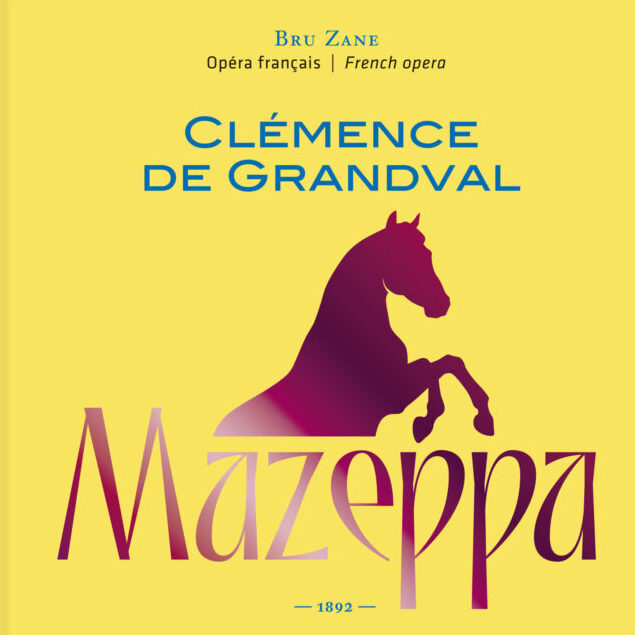
In a just world, Mazeppa (1892) by Clémence de Grandval would be well known today among Parterre Box cognoscenti. The plot is timely as it features the struggle of the Ukrainians against their foreign oppressors. Consider, too, the Prologue: the music portrays a buff warrior lashed naked, as punishment, to a horse sent galloping across the steppes from Poland to Ukraine. The orchestra surges and throbs in a rousing, attention-grabbing opener. What titillating possibilities! Intrigued? The team at the Bru Zane label has lovingly restored this fine example of French Romantic opera in a new recording featuring Tassis Christoyannis as Mazeppa, Nicole Car as Matrena, and the forces of the Müchner Rundfunkorchester and the Chor des Bayerischen Rundfunks under the baton of Mihhail Gerts.
Clémence de Grandval (1828-1907) was a prolific and successful composer with some advantages atypical of female artists in the nineteenth century. She was a wealthy vicomtesse, had a loving and supportive husband, and was friendly with the important figures of the French musical world: Berlioz conducted her work in public, and she was considered a colleague by Gounod, Massenet, and especially Saint-Saëns.
Still, she was forced to endure the obligatory indignities and bullshit that being a woman in a man’s world required. She was denied access to the commercial venues like the Opéra de Paris, was obliged to pay for her music to be performed, was deemed ineligible for important prizes and committees, and endured charges of dilettantism because she had money. She wrote heartbreakingly to Saint-Saëns around the time she completed Mazeppa: “Audiences may call me on the stage and applaud me…people may do justice to my music, it doesn’t matter, the sour bitter prejudice remains, and will remain…Ah, what torture the good Lord inflicted on me by making me a composer!”
Mazeppa takes it inspiration from the legend of a seventeenth-century Ukrainian noblemen who may have endured the naked ride discussed above and later lead his people to resist their Russian oppressors. It inspired visual artists like Delacroix, poems by Byron, Hugo, and Pushkin, and music by Liszt and Tchaikovsky. Grandval’s librettists Charles Grandmougin and Georges Hartmann adapted the story somewhat confusingly as follows: Matrena, the daughter of Kotchoubey, the Ukrainian leader, discovers an exhausted Mazeppa next to the horse which has died from the long ride. He recovers and agrees to help the Ukrainians defeat their enemies, in this case the Poles. Iskra, in love with Matrena and suspicious of Mazeppa, accuses him of being a traitor to the Ukrainian cause. Mazeppa and Matrena fall in love. Mazeppa does indeed betray the Ukrainians, but to the Swedes. He is exiled and is remorseful; Matrena, Ophelia-like, goes mad and dies.
This new recording on Bru Zane gives Mazeppa its due. Conductor Mihhail Gerts elicits a robust and energetic performance from the players of the Müchner Rundfunkorchester. The music is meticulously architected and well-crafted and this serves the singers well. Baritone Tassis Christoyannis is convincing as Mazeppa, conveying the emotional range required as warrior, lover, and contrite traitor. His voice is slightly wan in the occasional soft passage, but he quickly recovers his clear, articulate tone. He has a particularly strong finish in Act V as he realizes the consequences of his betrayal of the Matrena and the Ukrainians.
Christopher Corwin recently profiled soprano Nicole Car (and her husband Étienne Dupuis) here and she brings her experience to bear in the role of Matrena. She communicates the complexities of her character with her dynamic voice: her innocence, her passion for the Ukrainian cause and for Mazeppa, and her decent into madness. She sings shimmeringly in the love duets, soars seemingly effortlessly above the chorus and ensemble at the end of Act II, and delivers the pyrotechnics during her mad scene in Act V.
Baritone Ante Jerkunika is fittingly imposing as Materna’s father Kotchoubey. Julien Dran as Iskra has a pleasing ring in his tenor and sings with the intensity of the true believer he portrays. The writing for the chorus is particularly fine, and the Chor des Bayerischen Rundfunks under Stellario Fagone make the best of their prominent role. The sound quality of the recording is excellent: the instruments of the orchestra are clear and articulate even in the most fortissimo passages, and an organ interlude in Act II and a plaintive English horn passage in Act IV (hommage à Tristan?) sound especially ethereal.
Alex Ross wrote about the mission and accomplishments of the Bru Zane label and its parent organization, the Palazzetto Bru Zane–Centre de Musique Romantique Française in The New Yorker last year. They have produced over forty recordings of works that have essentially been forgotten, not because they were bad operas, but because of the vicissitudes of the marketplace and tastes and prejudices of the times may have denied them a hearing in the first place. Grandval’s Mazeppa is their latest effort in this recovery.
Oper Dortmund is presenting a new production of the opera this month, the first in over one hundred years. One phrase that stayed with me from Ross’s piece was that Bru Zane’s projects “lay siege to the concept of a fixed repertory of masterpieces.” There is no impartial historical process that determines what should live on as a “masterpiece” and what deserves to be forgotten. As we well know, history is a cruel and unjust master. The next time you’re thinking of giving Manon or Faust a listen for the umpteenth time, give Grandval’s Mazeppa a try. You will not be disappointed.