Photo by G. Schied
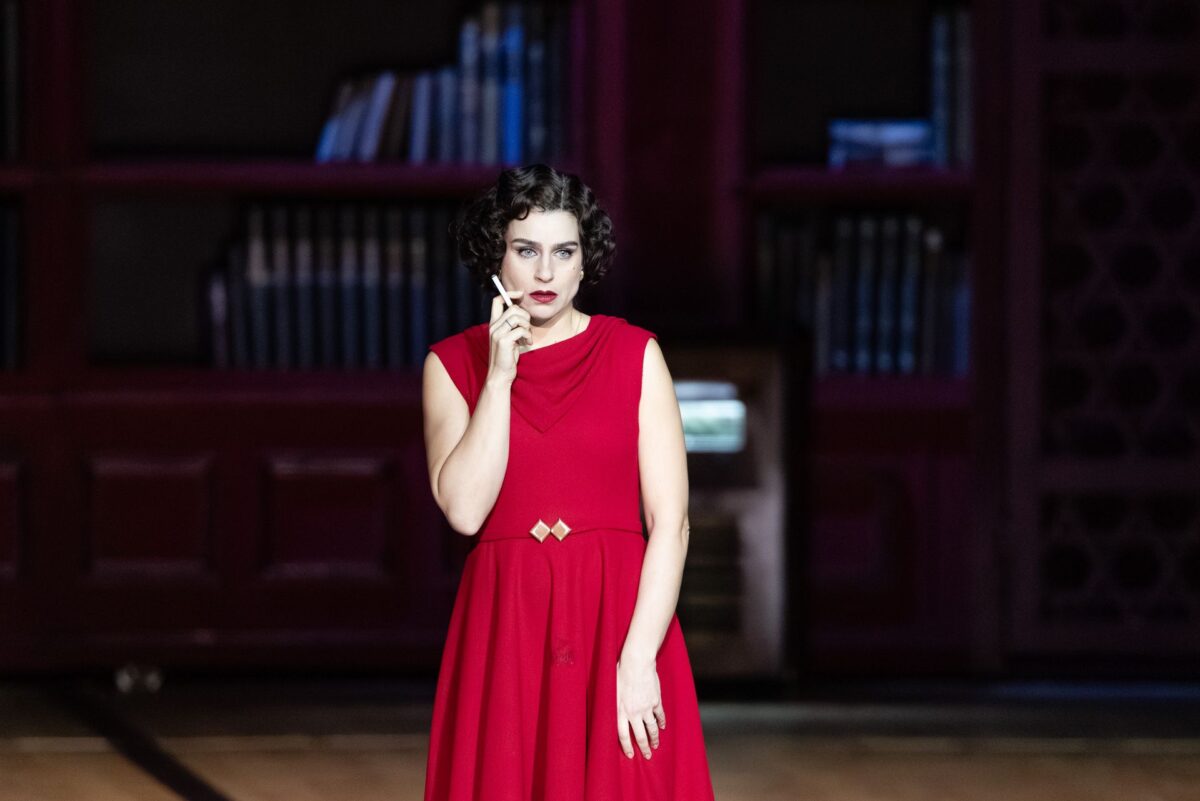
Krzysztof Warlikowski’s 2019 production of Salome returned to the Bayerishce Staatsoper this season, in its third outing since its premiere. Previously headlined by Marlis Peterson and Camilla Nylund, this new incarnation (seen March 1) features Asmik Grigorian in the title role and Frankfurt Opera director Thomas Guggeis at the podium.
Warlikowski’s production trades biblical Judea for central Europe between the wars, reimagining the characters as members of the persecuted Jewish bourgeoisie. The curtain rises, not on Strauss’s ascending clarinet, but to the strains of Mahler’s “Songs on the Death of Children” (spoiler!), sung for a group of families assembled in a decaying library. This grim entertainment, a direct allusion to an antisemitic cabaret performance watched by Alain Delon in the 1976 film “Monsieur Klein,” is interrupted by a thunderous knock at the door, which terrifies the group and reveals a hiding place behind the stacks. It’s a false alarm, at least for now, and a young woman initiates the next diversion: a pantomime of Salome.
Through this framing, Warlikowski foregrounds controversial questions of Jewish representation in the work (as well as controversial elements of the composer’s biography). But what unfolds is less an indictment and more an exploration of the meanings that can emerge from grafting this more resonant context onto the play.
A key concern is exploring the idea of the community surrounding these characters. Instead of a generalized representation of a debauched and declining society, the community in this Salome serves as a source of culture and social constraint that shapes Salome’s actions and her understanding of herself.
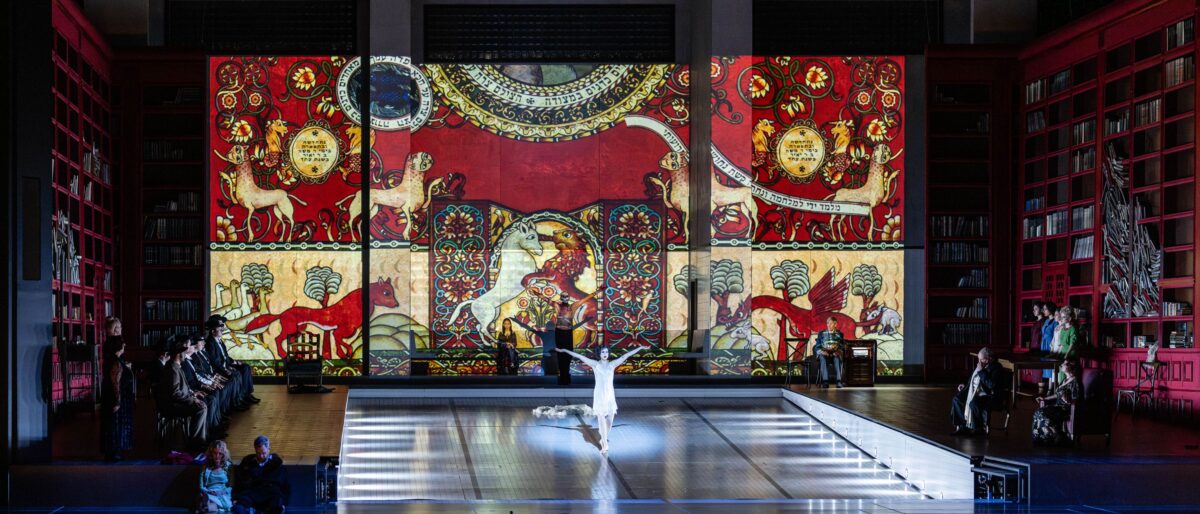
In Salome’s dance, the audience of partygoers is presented not as casual accessories to Herod’s deviance, but families that have come to bear witness to a common ritual. Salome dons a bridal gown, and the dance plays out against a backdrop of animated figures drawn from the relief of a medieval synagogue, her desire inextricably tangled up in the stories and history that structure her worldview. But pervading all is the community’s impending doom, which permeates Salome’s burgeoning understanding of love and sexuality, and instead of a bridegroom, she dances an erotic duet with a skull-faced partner (Staatsoper ballet veteran Peter Jolesch).
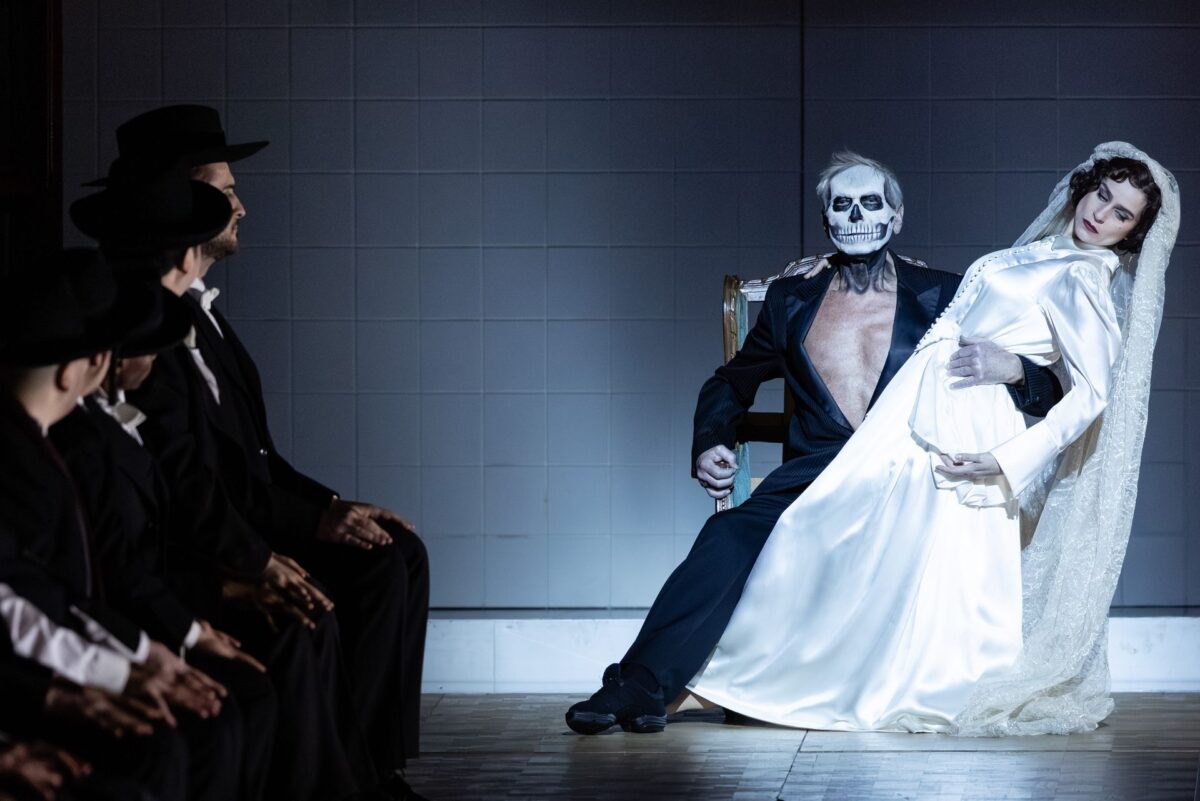
Photo by G. Schied
This elevation of community also allows Warlikowski to wring greater meaning from the closing bars of the opera. Herod’s terrors are not abstract premonitions but very real forces of death and destruction. In the final chilling moments, the blood-covered executioner begins a last-ditch defense, Salome is (possibly) offered up as a sort of sacrifice, and the larger group drinks poison as an alternative to the inevitable. It’s a visceral series of images that heightens the impact and depth of the work’s shocking conclusion (though it does ask the audience to do a bit too much regie-math at the same time one is trying to appreciate “Ich habe deinen Mund geküßt”).
In general, though, the production manages to avoid the feeling that one is spending two hours with a decoder ring. The basic mechanics of the libretto remain legible, and the singers aren’t tasked with doing anything that veers too far from naturalistic action in the interest of meeting the needs of the konzept. This is a production that values ambiguity and play over slavish devotion to a framing device.
Against this boisterous set of ideas, Asmik Grigorian held the evening’s center with a sublime demonstration of her prowess as a singing actress. This was the kind of performance that surprises and draws you in with the dramatic choices being made minute by minute, a performance that did not simply present a characterization but allowed you to follow the character’s own compounding discoveries.
In the initial scene with Jochanaan, one could trace Salome’s progression as her initial starstruck curiosity is complicated by notions of beauty, sensuality, and revulsion. Grigorian’s initially naive sound is complicated by simmering crescendi and richer hues that grew organically from the character’s intoxication.
The color and quality of her sound can almost be a secondary thought when focused on what she is doing with the voice, but it’s a formidable vehicle for her interpretive powers. A rich, pleasing middle and distinctive chest tones anchor the sound, with a silvery upper extension that is well integrated into the rest of the voice, allowing her to maintain intensity and direction through her approaches to Salome’s ecstatic high notes. A hint of pressure can appear up top, with a quicker vibrato and slight loss of color, but she hits her mark every time with riveting consistency and commitment.
Salome’s final scene was a further triumph, Grigorian vividly conveying the twists and turns of Salome’s internal monologue, from acid sarcasm to bittersweet resignation. Warlikowski’s production wisely pauses other stage business and lets the focus remain on the singer here (save for the very end), and Grigorian utterly commanded the audience’s attention throughout.
Wolfgang Koch was a grizzled, pitiless Jochanaan, his cool, resonant bass-baritone a sturdy vehicle for the prophet’s condemnations; a warm, melting tone in the tender passages about Christ was a highlight. A tireless Gerhard Siegel kept the show spinning through Herod’s begging and bargaining, his biting tenor only flagging a bit just before the ultimate arrival of the head (never shown here, Salome sings to a box found in the library).
Claudia Mahnke delivered a serviceable Herodias but didn’t quite have the cutting vocal edge or outsized personality necessary to compete with the most memorable evil queens. Joachim Bäckström’s ringing tenor made for a vigorous Narraboth, who Salome tests out some of her new desires on while keeping her eye on Jochanaan. Also nice to see DMV favorite Frederick Ballentine as a standout Dritter Jude.
Guggeis elicited a lean, driven performance from the Bayerische Staatsoper Orchestra. The 33-year-old made Strauss’s music a precision instrument for dramatic impact, eschewing self-indulgence in the extravagant score. Sensitive coordination with Grigorian during her extended scenes and keen attention to the ebb and flow of the singers’ speeches contrasted with chair-rattling climaxes, allowing just a few shaggy edges to intrude along the way. The orchestra handled the micro-management with a stunning degree of responsiveness, while solo instrumental passages consistently made distinctive impressions.
The physical production is organized around Malgorzata Szczesniak’s evocative ruined library set, which splits in two to reveal a sort of swimming pool and industrial hiding place, used during the scene with Jochanaan as a cistern-ish locale and to create the more expansive playing space for Salome’s dance. Lighting, by Felice Ross, creates a moody world of shadows for the transplanted story, while Kamil Polak’s digital projections during the dance effectively realize one of the production’s riskiest visual ideas.