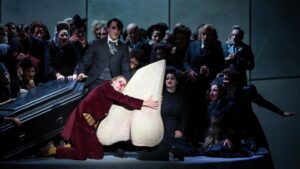
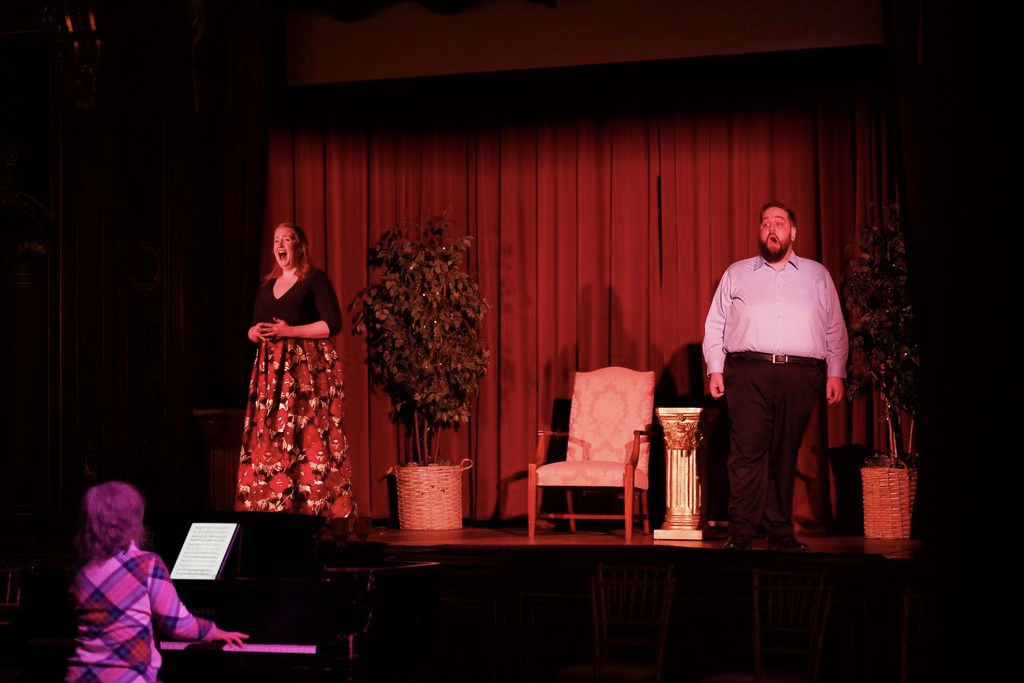
This Wednesday, Opera Baltimore presented a semi-staged concert version of Lucrezia Borgia, a lesser performed work containing some of Gaetano Donizetti’s finest tunes. Lucrezia Borgia is the company’s second of three shows this season, including Puccini’s Tosca last October and culminating next month in Debussy’s Pelleas et Melisandre. The theme of this season – “Power, Passion, and the Price of Truth” – is provocative. I was keen to know how the artistic direction would integrate this work into the theme. Despite excellent singing from some of the evening’s principals, the drama faltered as the convoluted plot unfolded, leaving me and my companion befuddled as the opera ended in a sudden flourish.
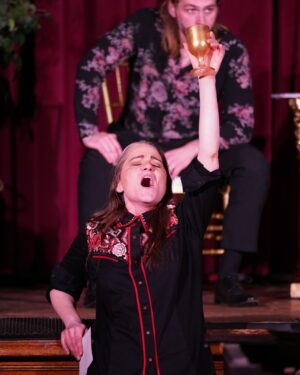
The twists and turns of this opera can be difficult to follow. The action begins with the young soldier Maffio Orsini, played by a plucky Megan Marino, decrying the crimes of Lucrezia Borgia and her brother. Marino’s husky mezzo feels perfect for the role of the brash soldier. During Maffio’s drinking song, she strides up and down the center aisle with appropriate mischief in the small gilded space of the Engineer’s Club. The rest of the plot (poison, mistaken identities, suicidal sacrifice, and an implied mother-son romance) exceeds my capacity to summarize (in any case, how many people show up to bel canto for the plot?).
Caitlin Crabill in the title role had a full, round voice, with a rippling middle and even vibrato. She tiptoed up and down Donizetti’s runs with great vocal control; her whirring, fluttering trills were executed with exquisite precision. Crabill faltered just once, falling short of the high note to close “Di pescatore ignobile,” the Act I duet between her character and Gennaro. Later, Crabill’s long, anguished note just before Borgia reveals her identity raised the hairs on the back of my neck.
Along with Crabill’s solid interpretation was Hayden Smith as Gennaro, whose radiant tenor ranged from loud to louder without losing purity of tone. His acting was superb as well, bringing electricity to the space as he drew his dagger on Borgia. Sam Weisner as Alfonso wavered on some low notes but triumphed with a big, booming middle. He clearly relished the villainous role of Don Alfonso, demonstrated by his rendition of “Vieni la mia vendetta.” Pianist and conductor Husan Chun-Novak’s leadership on the keys drove the action all night. The maestra knew how to draw down the action, creating a rare space within which the drama could breathe.
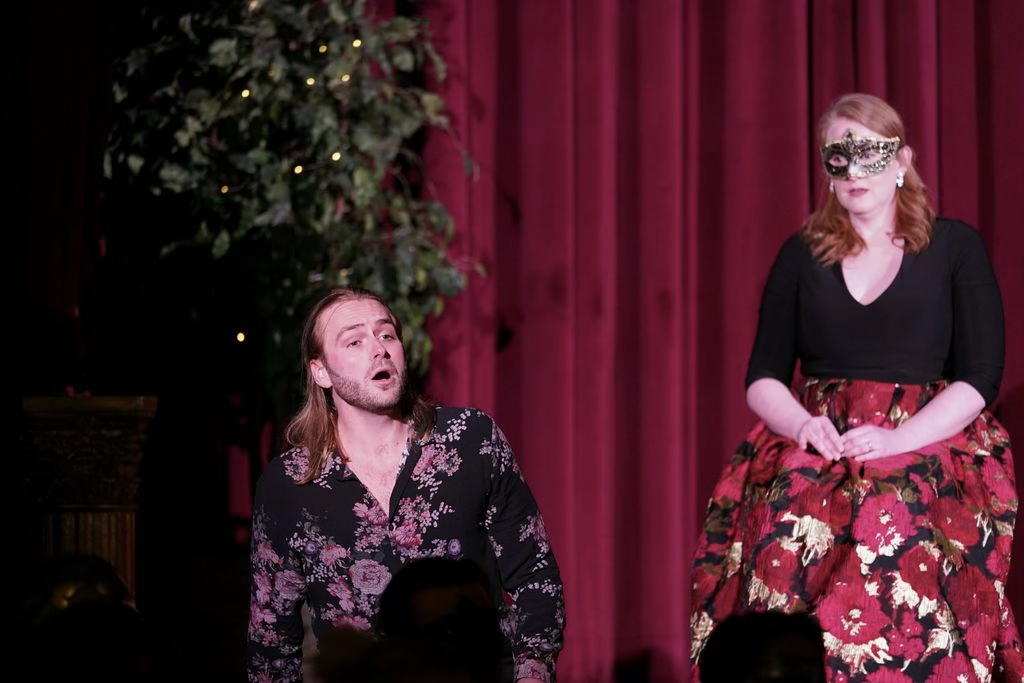
Julia Cooke, President and Director of Opera Baltimore, noted in her program letter that the company “set aside excess ornament in favor of intimacy…” This would be well and good… if there was any ornament at all. Cooke claims that “a story unfolds that is at once centuries old and strikingly present.” But with a traditional staging and concept, I struggle to agree. There are the obligatory costume masks and plastic silver and gold pitchers of wine, but there was little else to distinguish between characters. Further, I wished that Mary Elizabeth Williams’s direction used the charming space to enhance the contours of the drama. We are supposed to be in a Venetian palace, after all. Perhaps the best measure of dramatic legibility came from my companion, who was taking in an opera for the first time. In his estimation, the ascending drama in the first half was clear enough, but the second half was perfectly incomprehensible.
The seams may show in this performance, but this can also be endearing. The projection of the supertitles, for example, shook up and down throughout the show, which somehow worked. It was as if we were in someone’s dream of a silent movie with wonderful young voices bounding around the red and gold interior of the venue.
I have to applaud Opera Baltimore’s guts for staging such a difficult piece. The song is the thing here. This music overcomes even the most confused dramaturgy and weak worldbuilding. I was reminded of an apocryphal story my dad used to tell about Puccini. Stopping at a small town during one of his travels, the composer took in a performance of La bohème at a local theater. During the show, the company’s executive director was shocked to see the maestro visibly upset. He promptly visited the composer’s box and apologized. “Maestro,” he said, “forgive us, we are but a small house.” Puccini shook his head, responding through tears. ”My good man,” he said, “it’s the music, you see – it’s just so beautiful.”
Baltimore has a long operatic history. According to Wayne Koestenbaum’s The Queen’s Throat, it was in Baltimore that Jenny Lind once “dropped her shawl from a balcony, and fans ripped it up and pocketed fragments.” The great Rosa Ponselle made this city her final home. At the top of the show, Cooke responded to actor Timothee Chalamet’s recent disparaging remarks about the art form. The company’s director was defiant, declaring that “opera is alive in Baltimore.” Thanks to the fine efforts of the night’s musicians, that assertion rings true.
Lucrezia Borgia is playing March 4, 6, & 8 at the Engineers Club in Baltimore, MD.