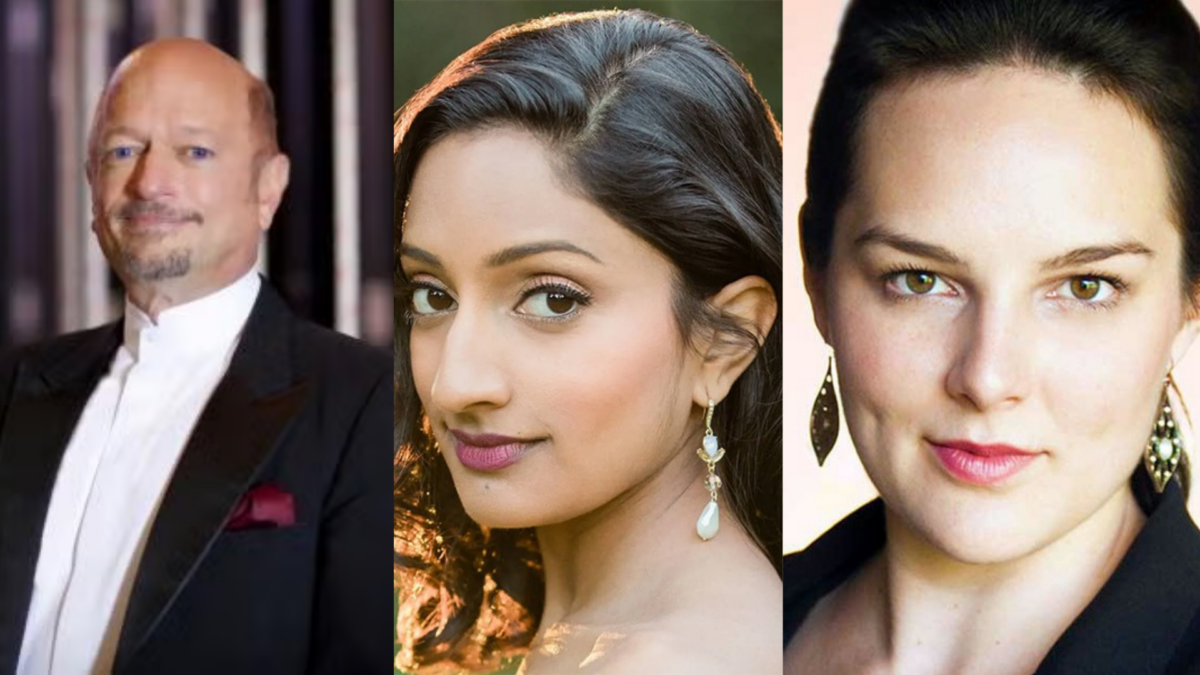
From left: Jeffery Thomas, Maya Kherani, and Sarah Coit
What isn’t an opera and isn’t an oratorio but needs an operatic voice and allows a composer to show off their skills at setting text to music? That would be that genre-bending form known as the cantata. It’s technically a secular work for soloists and instrumental and/or choral accompaniment. Yet the cantata was changing shape and purpose from its inception. In the hands of the great Baroque era composers, the cantata was essentially a chamber opera that could suit any number of needs.
Perhaps the most famous of cantata writers was Johann Sebastian Bach. His Lutheran faith and the fact that the opera house in Leipzig closed three years before he settled there meant Bach really didn’t have any need to write opera. In fact, Leipzig couldn’t really support opera in the same way that Dresden or Hamburg could, with their opera-friendly courts and aristocratic patrons. Yet Bach’s famous settings of the Passions According to Matthew and John, as well as his dozens of cantatas, show an interest in vocal music that veers awfully close to what we could call operatic.
The San Francisco-based period music ensemble American Bach kicked off the second subscription program of their 2025-6 season (dubbed “Harmonic Labyrinth”) with Bach’s cantata Non sa che sia dolore, alternately titled “Farewell to a scholar called Ansbach.”
Formerly known as American Bach Soloists, American Bach is the newish umbrella name for a consortium of early music ensembles and events, including the American Bach Choir, San Francisco Bach Festival, and the American Bach Soloists Academy. Under the 30+ year leadership of founder Jeffrey Thomas, American Bach’s repertoire ranges from Buxtehude to Haydn (go find their recording of Haydn’s Lord Nelson Mass, perhaps the best ever recorded). They are a mainstay of the robust early music scene in San Francisco and the larger region.
The concert’s repertoire was proximal to opera without ever quite landing in that genre. What convinced me of the opera link was the fact that Thomas began the program with a rare Bach cantata in Italian, the subject of which mourns the loss of a departing friend. Italian opera was all the rage in 1747 when Non sa che sia dolore was first heard, and with text taken from Metastasio (that most opera-friendly of poets), it was as if Bach was dabbling in the form. Too many coincidences here.
The cantata is more or less a duet for soprano and flute (the instrument most often associated with the soprano voice, coincidentally). Thomas’ reading of it is like most of his readings: straightforward, unfussy, and refreshingly free of affect. He resists making Bach too stately while also resisting the urge to make it something it’s not: Italian. It was fascinating to hear Italian paired with Bach’s Lutheran dignity. While Bach was a huge fan of Italian music and famously wrote transcriptions and variations of Vivaldi and other Italian composers, it always sounds like…Bach. His vocal writing is never bland, favoring ornamentation as often as sustained notes. Yet there’s no mistaking him for, say, Vivaldi or Handel. If those two were writing theatrical dramas, Bach was writing television dramas. Same intensity, same authenticity, but no need to play to the back of the house.
American soprano Maya Kherani is no stranger to American Bach. I heard her a few years ago in their yearly (and delightful) performances of Handel’s Messiah. Here she capably toed the same line as Thomas. Her approach was classy without robbing the ‘character’ of their emotional condition. Hers is a beautifully supported light lyric soprano, with enough metal at the top to ring out in the sometimes tricky acoustics of St. Mark’s Lutheran Church. Her phrasings maintain the integrity of Bach’s vocal line, never pushing too hard, never underpowered. As was the case later in Pergolesi’s Stabat Mater, her ornamentations were impeccable.
Flutist Bethanne Walker was a game partner and agile musician. Unfortunately, she struggled to be heard. Compared to a modern flute (made of metal), the wooden traverso has a mellower, rounder sound with a smaller embouchure (or hole to breathe into). In the lowest parts of the musical line, Walker was almost inaudible. Much of the duet effect was lost. Kherani was not upstaging or overpowering. Bach’s cantata simply didn’t work in that space, with acoustics much more geared to higher-pitched and brighter sounds than lower, mellower ones.
It’s too bad, because Non se che sia dolore is one of Bach’s most charming works. No, it doesn’t have the soul-plumbing heft of the Passion cantatas. Yet there’s a clear dramatic arc from that initial shock of loss to an ending of encouragement as the scholar goes off to a bright future and leaves the friend behind.
Rounding out the first half of the program was a devilishly difficult and brilliantly dispatched performance of Pietro Locatelli’s Violin Concerto in D-major. It was rightly a showcase for South Korean violinist YuEun Gemma Kim, who was just a blast to watch and listen to.
After the intermission came the two Italian sacred cantatas. This is technically an oxymoron. And technically, we should call them simply sacred vocal works. But Domenico Scarlatti’s Salve Regina, like the Pergolesi to come later in the program, is essentially a monodrama—a religious work but with the cantata’s trope of the soloist singing as both character and intermediary between the divine and the audience.
In the Scarlatti, the central “character” is a penitent aching for the Virgin Mary’s intercession and protection. The fact that Scarlatti wrote it for an alto gives the piece an earthy pathos. It sounded like one mother was reaching out to another. The soloist was the brilliant American mezzo-soprano, Sarah Coit. A singer with a wide-ranging repertoire (whom I had the pleasure of seeing as Sesto in a Giulio Cesare some years back), Coit brings to the table a clean attack and crisp ornamentation, particularly impressive in the final ‘Amen’ section. Hers is a warm and grounded stage presence. She embodies the yearning for the Virgin Mary’s healing without resorting to histrionics. While operatic (complete with overture), Scarlatti’s piece was written for a sacred context, so no tearing into the music as one might in a secular work. Coit maintained the dignity of the piece without bleeding the music of its affecting emotionality.
Coit and Kherani joined forces for Pergolesi’s famous Stabat Mater. The two voices—Kherani’s focused and bright, Coit’s burnished and rounded—blended effectively in the several duet sections. It wasn’t a contest. Each remembered the event behind the music: a mother mourning the death of her son. But Pergolesi devoted the bulk of the vocal music to the alto, and Coit delivered. Coit has a voice big enough for the world’s opera houses, and she deserves an international career on the strength of her intelligence and musicianship. But it would also be a real shame to lose her from the concert stage. She has already sung with regional companies around the United States (and in repertoire ranging from Handel to Gounod to Janacek), Here’s hoping there is more Pergolesi and Scarlatti in her future.
As with Bach, Thomas’s conducting in the Italian vocal works kept things moving without leading the singer behind. Thomas’s Bach pedigree is even more evident in Italian music, with the music serving the singer. I have to imagine this also stems from Thomas being a singer himself. He understands that the orchestra isn’t subordinate to the singer, but is supportive of them. He assembled just the right-sized string orchestra for the space, getting a clean, focused sound out of his players.
To hear all three works together made perfect sense, given Bach’s great affinity for Italian music (he even wrote his own arrangement of the Pergolesi, its rich solo turn for viola interpolated by Thomas into the Pergolesi itself). To hear Bach pay homage to composers from the land of opera’s birth made me realize that even if Bach never wrote an opera…he still wrote operatically.