
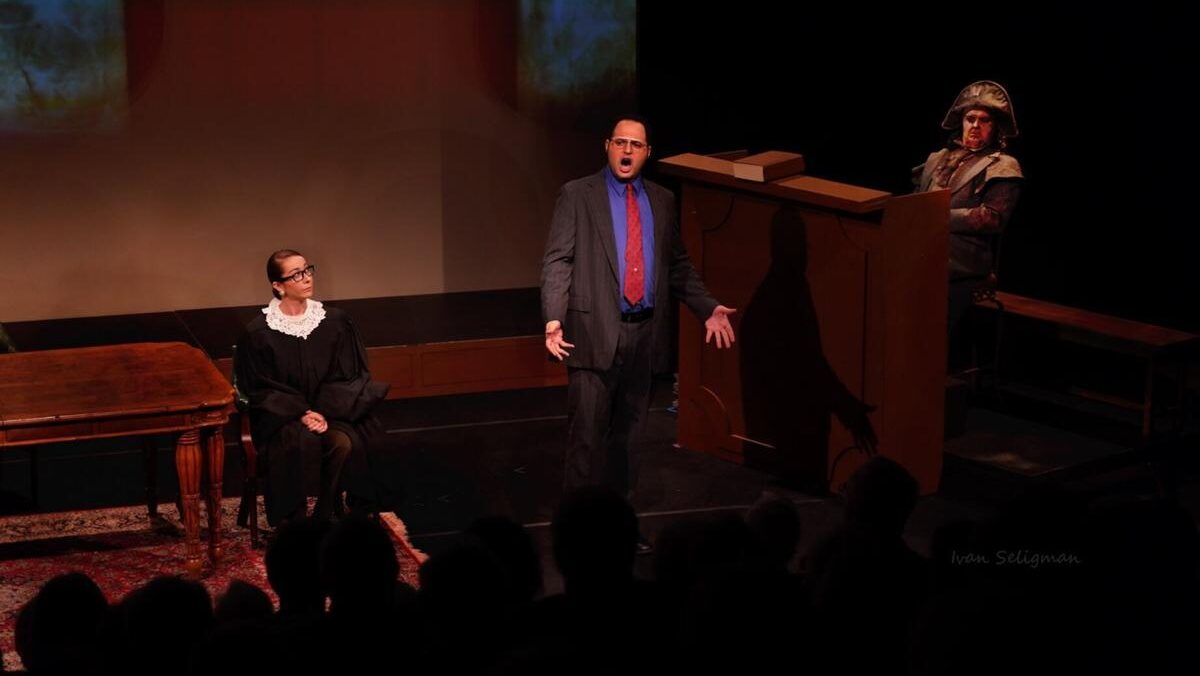
Camron Grey, Lauren Cook, and Cameron Jackson in the 2020 Opera Naples production of Scalia/Ginsburg.
Opera Naples (FL) continued its 2026 season with a performance of Derrick Wang’s Scalia/Ginsburg (2013) on 21 February at the Wang Opera Center. Chosen in part to honor the 250th anniversary of the founding of the United States, this short, comic opera in English celebrates the bond that two now deceased Supreme Court Justices forged over their shared love of opera, in spite of their polar-opposite interpretations of the Constitution. It is an approachable work for the casual or new opera fan; the young singers turned in strong performances, and the mostly older audience enthusiastically enjoyed the production.
However, I couldn’t help but reflect on the perils of choosing a topical, political subject for contemporary comic opera. Time has moved on. In just thirteen years, the idea that opera–or anything else–could bridge the political divide seems quaint if not ridiculous. Our current times are better suited for tragedy. Scalia/Ginsburg may serve as a reminder of what we have lost, if we ever truly possessed it: real collegiality and grace in our public discourse.
The plot is straightforward. After his death, Antonin Scalia is stuck in the bardo, seeking entry to his idea of the afterlife. The Commentator—a gatekeeper reminiscent of Jacob Marley in Dickens’s A Christmas Carol—questions Scalia about his often harshly worded opinions. His former colleague, Ruth Bader Ginsburg, appears to highlight the flaws in Scalia’s philosophy of originalism (the belief that the Constitution is limited to the founders’ literal words). She argues instead for a progressive view of the Constitution as a living document used to expand equal rights. Ultimately, Bader Ginsburg defends her colleague and sings of their mutual love of the art form. Redeemed, Scalia and the Commentator journey to the next world, while Bader Ginsburg returns to this one to continue her work on the Court.
Musically, Wang is no modernist. The score is a clever pastiche of “hits” from Handel, Mozart, Rossini, Verdi, Bizet, Puccini, and maybe Bernstein, with echoes of the Great American Songbook. Having studied law and practiced as an attorney, Wang has littered the libretto with references to legal concepts and Supreme Court decisions.
The singers handled this sometimes dense material with aplomb. Tenor Elijah William Brown took the role of Scalia. A big man with a powerful voice, he has sung some Wagner and it shows. There was a slight thinness at the top but this will undoubtedly improve as his voice matures. Soprano Yejin Lee was a talented singing actress in the role of Ruth Bader Ginsburg, deftly adapting her strong coloratura to the various styles required by the score. Like Brown, her upper register still has room for more fullness of tone. Baritone Steve Groth sang expressively, making the most of the smaller role of the Commentator. The cast was ably accompanied by the highly experienced pianist and music director Yelena Kurdina.
No one will confuse the Wang Opera Center with the Teatro di San Carlo. A converted commercial building in a warehouse district—slightly east of the beaches and boutiques Naples is known for—the venue offers a unique atmosphere. Director Mark Danni made excellent use of the space, delivering a level of intimacy unattainable in a larger house. The season moves outside in mid-March, featuring performances with a full orchestra of Puccini’s Turandot (11 and 13 March) and Donizetti’s The Elixir of Love (12 and 14 March) in lovely Baker Park. If you have had your fill of the northern cold or cannot snag a ticket for the Met’s Tristan, consider a trip to Naples to take in a performance by this very talented regional ensemble.


