One day before I was set to attend the Deutsche Oper’s performance of Franz Schreker’s Der Schatzgräber, I received the following email: “Dear audience, as the ver.di trade union has called for a strike on Saturday, 7 February 2026, the performance of DER SCHATZGRÄBER will have to take place without any decorations and with reduced lighting, but with full costumes and the orchestra in the pit. We will do our utmost to ensure that you still have an enjoyable evening at the opera.” The strike on February 7, which primarily impacted public sector institutions and transit, was the second strike of the week. Berliners were already accustomed to taking alternative routes to the opera house; coincidentally, exiting the U-Bahn at Richard-Wagner-Platz rather than the Deutsche Oper station!
If you ever wondered what an opera looks like without any lighting or set design, the answer is: dark! It was difficult to see the singers’ faces, which limited their ability to convey the complex emotions in Schreker’s libretto. Luckily, I was familiar with the Deutsche Oper’s production of Der Schatzgräber, which premiered in the 2021-2022 season. The production was directed by Christof Loy, the so-called “comeback agent” of long-forgotten works. Der Schatzgräber is, in fact, long-forgotten; Loy’s production is only the sixth staging since 1968. However, the opera was quite popular in the years following its premiere in 1920, having been staged 50 different times between 1920 and 1932. Unfortunately, the opera’s success was short-lived, arguably due to its Jewish composer and modernist aesthetics.
Franz Schreker was a well-established composer during his lifetime and was associated with composers including Zemlinsky, Mahler, Schoenberg, and Berg. By 1922, Schreker was the most performed living German composer; historian Michael Haas writes that “Schreker enjoyed the kind of popular recognition that Schoenberg could only dream of.” However, as the son of a Jew who converted to Protestantism, Schreker’s livelihood was threatened by the rise of antisemitic ideology and policies, his operas labelled degenerate and rejected by the Nazis. Ultimately, in 1932, Schreker was forced out of his post as director at the Berlin Academy of Music and subsequently died two years later at the age of 55 from a stress-induced stroke. Schreker’s operas were labeled as degenerate in the years that followed, not only due to Schreker’s Jewish heritage but also to their narratives of physical and psychological suffering.
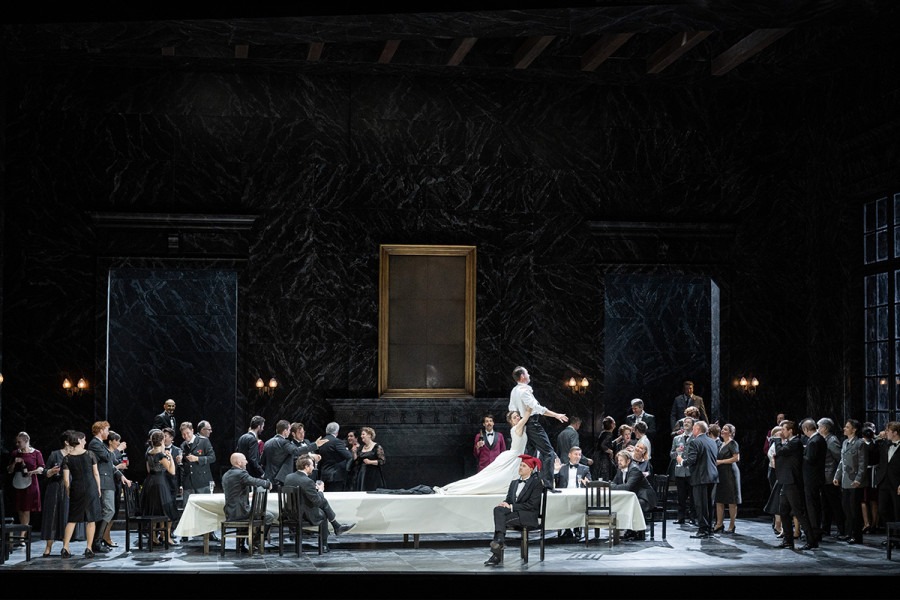
Photo by Monika Rittershaus
Sans overture, Der Schatzgräber opens on a King confiding in his fool regarding marital troubles with his wife, the Queen, who has lost her jewels (and with them, her beauty, youth, and sex drive). The fool advises the King to employ Elis, a treasure hunter who wields a magic lute, to locate the jewels. Soon, however, Elis gets sidetracked and falls in love with Els, a murderous femme fatale. It is later revealed that the jewels were originally stolen by Els’ henchman, Albi, and that Els had orchestrated the jewel heist all along. The plot soon evolves into a love story between Els and Elis with added complications of murder, theft, and betrayal.
While the plot originally centers on the King and Queen’s dilemma, the opera soon focuses primarily on the lovers, Els and Elis (why Schreker chose names so close to one another for his two leads is beyond me). Olesya Golovneva sang Els, and while her acting and body language appropriately conveyed the manic nature of the character, her vocal performance fell short. During the first two acts, Golovneva had trouble finding her grounding, perhaps due to her running around the stage organizing both a jewel heist and a murder. Luckily, following the intermission, Golovneva reset, finding her support and now able to keep up with Daniel Johansson (Elis) during their third act duets. Johansson’s voice was well-suited for the role, able to find beauty amongst the difficult vocal writing. However, I wish Johansson sang with a bit more phrasing, as his vocal performance was quite vertical, delivering each note perfectly in time but without any sense of the line. A standout vocal performance was that by Thomas Cilluffo (the fool, Narr), his energy lighting up the auditorium each time he began to sing. A character tenor, it was no surprise when he received the largest applause at the end of the evening.
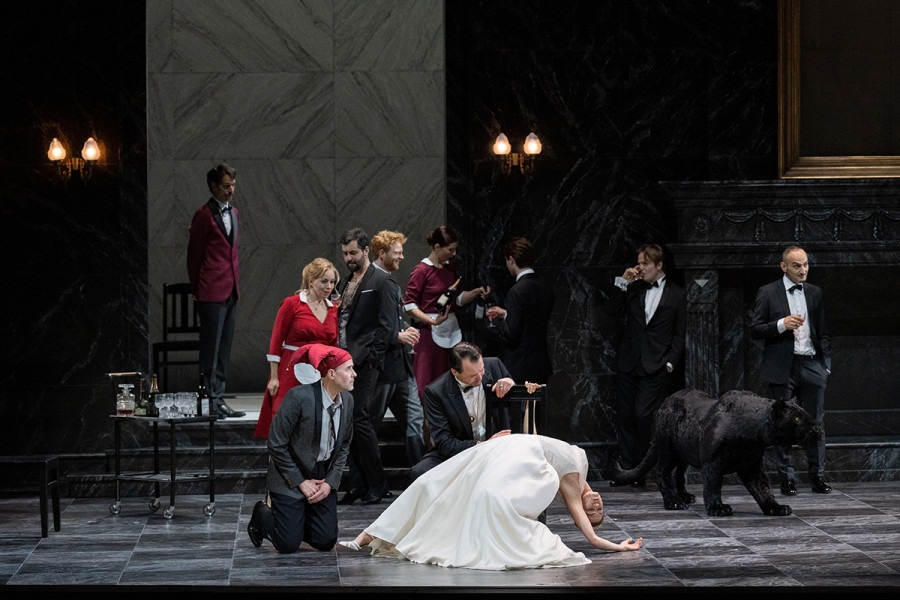
Throughout the production, a collection of chorus members and dancers loitered about. Their presence felt unnecessary, except for the rare moments when they initiated orgies. When Els first appeared wearing the Queen’s jewels during the third act, the ensemble began to climb atop one another, supposedly reacting to the sexual magic the jewels carry. Interestingly, back in the early twentieth century, the term “jewels” was understood as slang for sexual organs, as it is today. In his famed psychoanalytical study Dora, Freud noted his titular subject dreamt of a jewel-case (the German word for jewel-case, Schmuckkästchen, is also a slang expression for female genitals) and deduced that the dream represented her vagina, her virginity, and sexual intercourse. Was Loy eliciting this reading, or rather, adding a Berlin flair to his production?
A variety of scholarship on Der Schatzgräber understands the opera’s message as commentary on the value of materialism versus love in post-war Europe. I wish the production did more to highlight this. Schreker provides ample opportunity to do so, as Elis sings an aria essentially about class struggle and resistance, specifically of a dream where a deer lunged at a group of hunters and tore them to pieces. In the Nachspiel, when Els is dying (spoiler alert), Elis once again sings of the deer, reminding Els that no one is free from sin, and we must do what we can to survive in this world. In an unspecified kingdom at an unspecified time (whether due to the lack of stage design/lighting Saturday night, or if this was Loy’s interpretive choice), the message of resistance could have been relayed in a more urgent fashion.