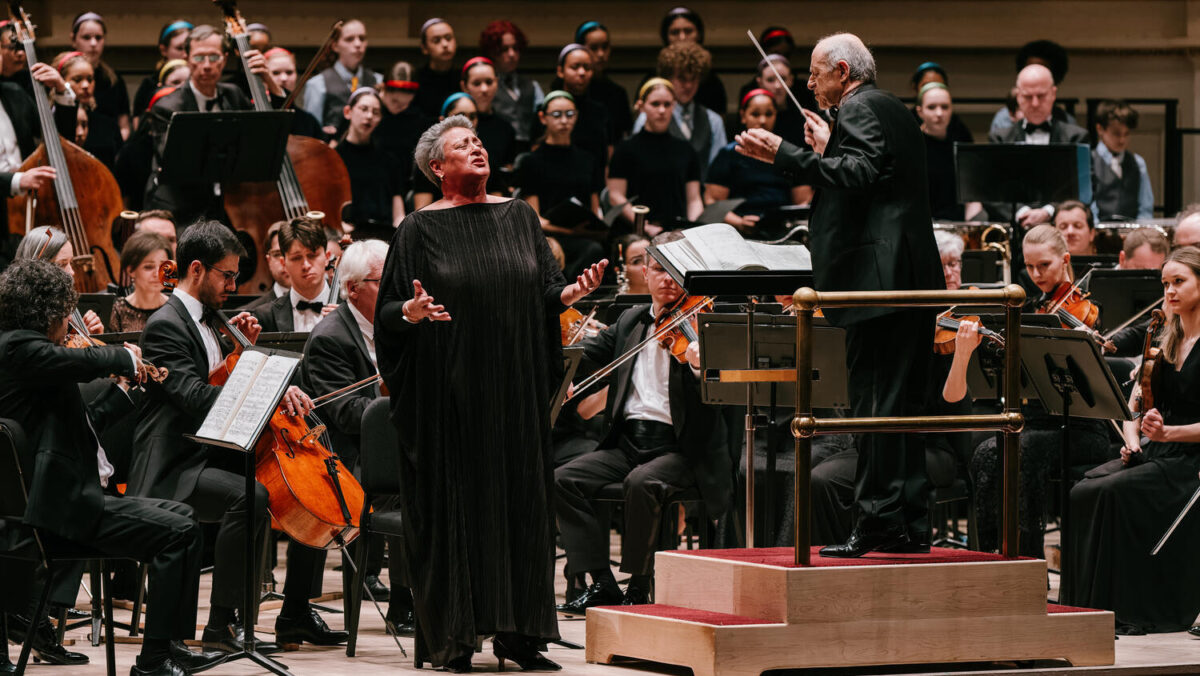
Gerhild Romberger and the Budapest Festival Orchestra at Carnegie Hall / Photo: Fadi Kheir
Budapest Festival Orchestra concluded a two-night stand at Carnegie Hall with a performance of Mahler’s Symphony No. 3 in D Major. Having heard the orchestra’s founder and chief conductor Iván Fischer deliver a thrilling Mahler 1 two summers ago with the European Union Youth Orchestra, I was interested to hear what he would bring out in the composer’s longest and most deliriously disordered symphony. Fischer’s results with the young Europeans were bold but inconsistent – perhaps to be expected with an outfit made up of rotating pre-professionals. His Mahler 3 at Carnegie was similarly rough around the edges: often gripping (and, I’ll admit, rapturously received), but with a choppy lack of cohesion that left you feeling every moment of its 110 minutes.
Up until the recapitulation, the first movement sounded like a promising dress rehearsal of an orchestra that clearly still needed a lot of work. Fischer seemed to announce that he wasn’t resting on elegance or accuracy: sections didn’t entirely blend, intonation was smudgy and some entrances were noticeably late. It proved an intriguing contrast to Fischer’s previous recording of this symphony with the BFO, from 2017, which sounded genteel to the point of boredom. There was nothing boring about the interpretation here, but I came away with greater awe at the brute force of the playing than the extravaganza of ideas that Mahler somehow makes sense.
The players seemed to hit their stride as the opening salvo returned, though, and they sailed into the tranquil idyll of the second movement. In general, the alternation between pure beauty and puckish fun embodied in these inner movements suited the BFO best, their point of view cohering into a relaxed, mellow interpretation. Their string tone sounded lighter and consistently more transparent than what I expect from American and Western European orchestras, and while I sometimes missed the rusticity here that can make Mahler so distinctive and fun, the pleasures of these sections were sui generis.
Gerhild Romberger returned for the alto soloist’s duties after having been featured on the BFO’s previous recording. Her low mezzo instrument projected effortlessly toward all corners of Stern Auditorium, and her sovereign delivery of the text rendered translations unnecessary. In recent years, though, Romberger’s voice has settled into one grayish color, which rendered the Nietzschean monologue monochromatic. Fischer seemed invested in drawing a particular tang from the oboe and English horn responses to the alto’s lament, which he did by largely ignoring the score’s call for portamento – they sounded blasted instead, memorable but crude.
The final two movements provided the evening’s unqualified triumphs, with the fifth movement’s choral demands executed gorgeously by trebles from the Westminster Symphonic Choir (prepared by Donald Nally) and the Young People’s Chorus of New York City (directed by Elizabeth Núñez). There was childlike wonder in the bell-like “bimm, bamm” calls and an uncanny otherworldliness in the women’s voices that compensated for the general lack of expressiveness in Romberger’s singing. After an evening of much rough-and-ready musicmaking, the finale unfolded with soft details and refinement.
A generous interpretation might focus on the progression from the unshorn wilderness of the first movement – which Mahler called “the maddest thing I ever wrote” – to the traditional beauty of the last, but Fischer’s helming seemed too moment-to-moment for any sort of overarching logic to be applied. The performance was sometimes exhilarating and often tedious. There were beautiful flaws and moments of dull perfection. Perhaps that’s Mahler. The Third sometimes feels like not one symphony but many, and the BFO’s performance was surely as variable as it was kaleidoscopic.