Photo: Gianni Cravedi
Stiffelio, composed in 1850, was written during Verdi’s mature period alongside the unique quartet of Luisa Miller, Rigoletto, Il trovatore and La traviata. Yet it is commonly considered one of Verdi’s immature works, artistically lacking and in poor taste. This is partly due to its very limited circulation since its inception, as its religious themes made it impossible to stage in Italian theatres. (The first performance took place in Trieste, a city that belonged to the Austro-Hungarian Empire at the time.) To save the music, Verdi and his librettist Piave tried to transform the 19th-century Protestant pastor betrayed by his wife, into a medieval crusader in a reworking entitled Aroldo (1857), but the new opera was no more successful.
And unsuccessful it remained until the 20th century when tenors such as Carreras and Domingo discovered the extraordinary dramatic power of Stiffelio and its unusual protagonist, reviving it in the major opera houses (which was more than Mario Del Monaco or Gastone Limarilli had managed to do with the work a few decades earlier in isolated performances of the opera). It’s true, the score does not reach the sophistication of Verdi’s later works, relying on that “wild virginity of ideas and feelings” which – in the words of his wife, Giuseppina Strepponi – was the raw material of Verdi’s early works. But there are so many attempts in the opera to break away from preconceived clichés that the score is nevertheless rich in both formal and expressive innovations on every page, its two short hours of music divided into three lightning-fast acts.
The new production of Stiffelio was proposed by three Italian theaters that often collaborate on unusual projects: the Teatro Municipale in Piacenza, the Teatro Comunale “Pavarotti-Freni” in Modena, and the Teatro Municipale “Romolo Valli” in Reggio Emilia, where I attended the last performance of the series earlier last month. At least two artistic figures invited interest in the show regardless of our interest in the title, two giants of opera from the 20th century whose careers seem to unfold endlessly: American tenor Gregory Kunde (72 next month) and Italian director Pier Luigi Pizzi (nearly 96), both still very much alive in their professional endeavors.
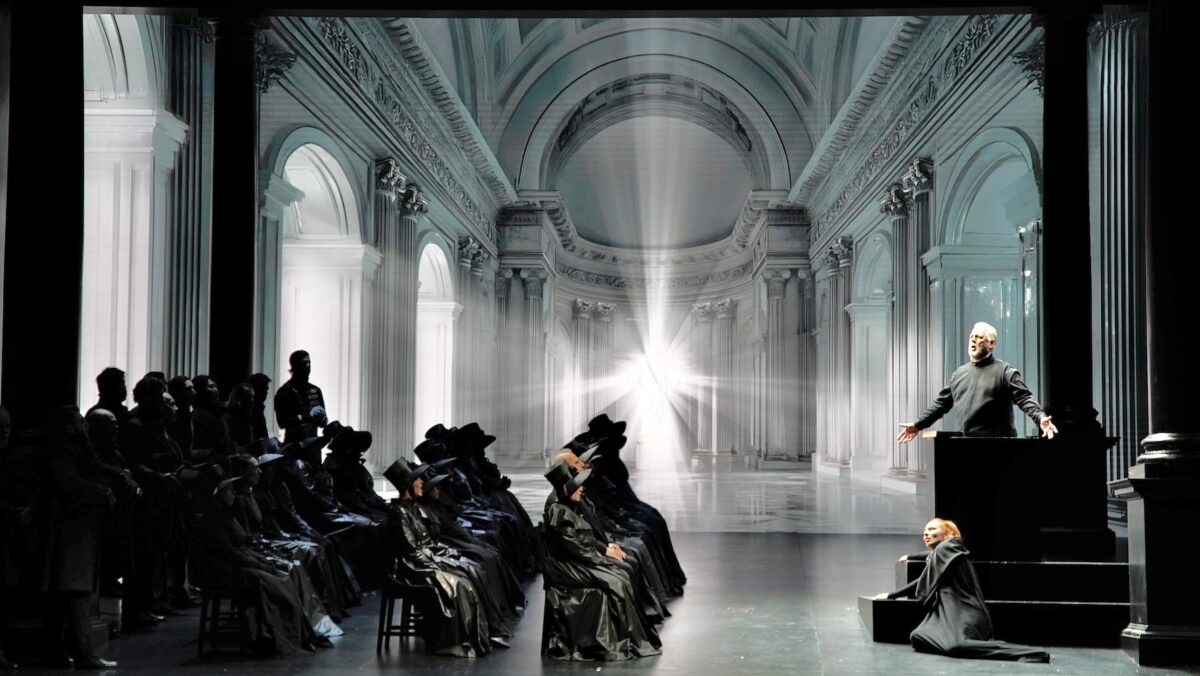
The production, for which Pizzi was responsible for the sets and costumes as usual, shone with sobriety and elegance, dazzling the eye with its beauty and visual satisfaction. Set entirely amidst black architecture with furnishings and costumes in the various shades of grey, the only color that was alien in this conformist (rather than reformist) religious society was the (natural) red hair of the prima donna — herself symbolically dressed in white — who momentarily rebels against it through marital betrayal. Once again, Pizzi helps us to decipher the original drama through the visual signs aligned on stage, making everything understandable to us without further mediation and never overloading the dramaturgy with additional symbolism unrelated to the opera being staged; this is an example of a style of opera direction that is increasingly rare and valuable today.
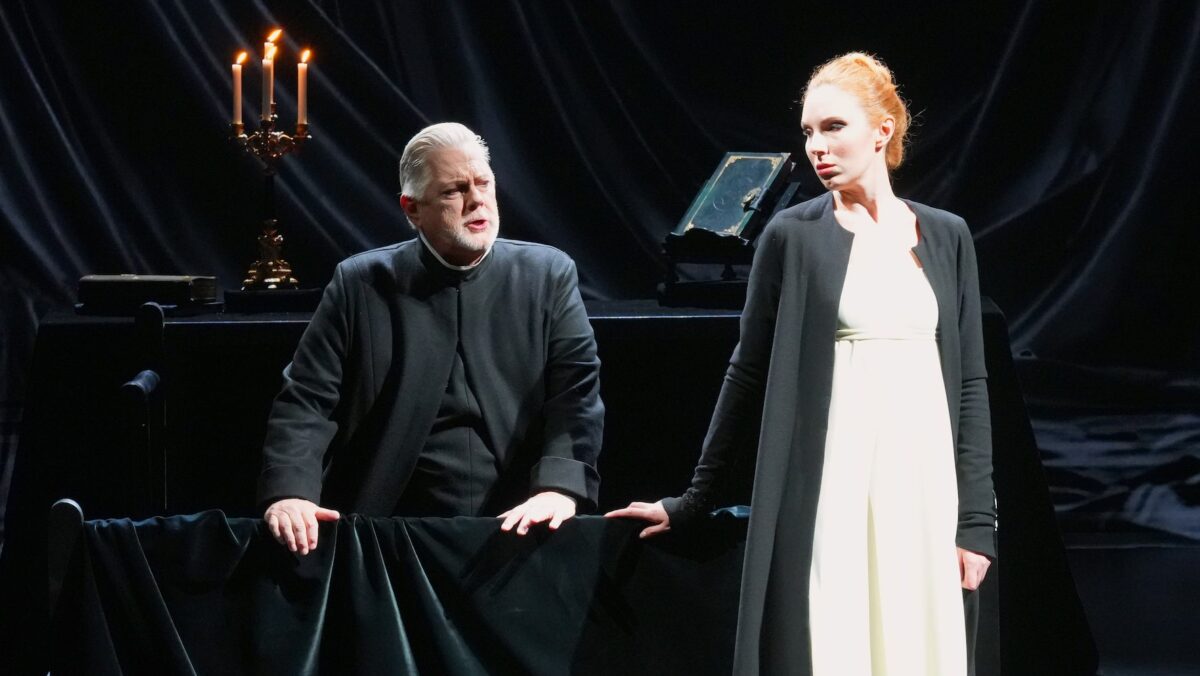
Photo: Gianni Cravedi
Kunde, 40 years since his start as a bel canto tenor, is now at the dramatic tenor stage of his career and the character of Stiffelio was yet another debut for him. Without a doubt – in comparison to three or four years ago when he sang Pagliacci, Otello, La Juive, Luisa Miller, or Ernani with a voice still in perfect condition – at 72, the first vocal difficulties are beginning to present (more so in the middle range than in the high range), but the pleasure of seeing him still treading the boards undaunted has not diminished at all.
At his side was Russian soprano Lidia Fridman, a revelation of recent years and not yet thirty years old. Her delivery suffers from a certain hollowness of sound typical of many female voices from Eastern Europe, but her ability to move the audience with it, both in pianissimo passages and in heroic flourishes, is undeniable. Bulgarian baritone Vladimir Stoyanov also has a long history with Verdi, which he puts to good use as yet another Verdi father figure with a still strong voice and beautiful timbre.
The Emilia-Romagna “Arturo Toscanini” Orchestra was conducted with skill by the young Leonardo Sini, who accompanied the singers without ever overpowering them — itself a pleasant experience not always granted.