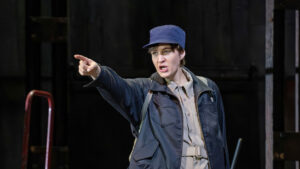
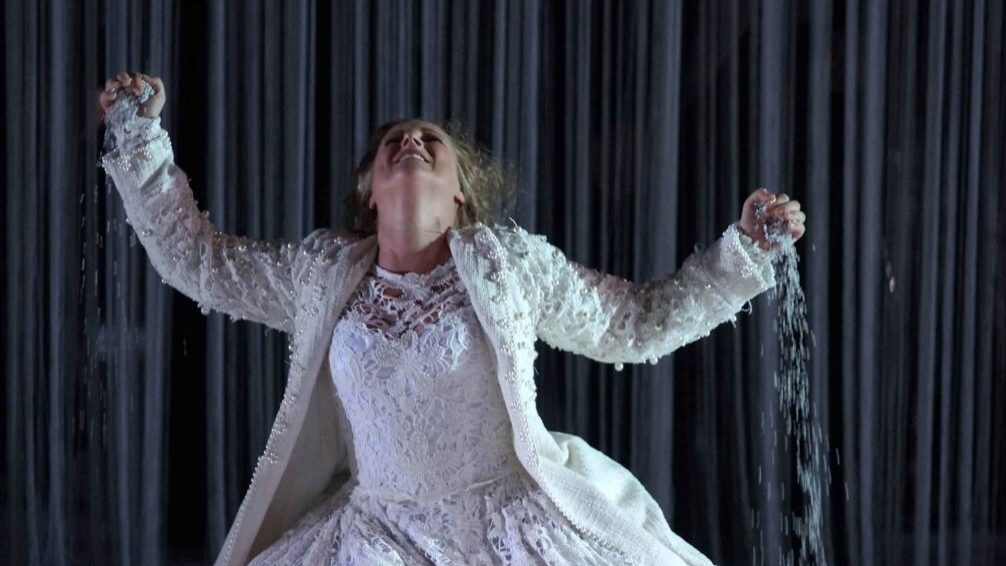
Diana Damrau in I puritani at the Teatro Real in 2016 / Photo: Javier Del Real
Tomorrow, I puritani will receive a splashy new production at the Metropolitan Opera, its first since 1976. The opera is a hard sell among even the most die-hard bel canto fans. No one denies the spellbinding beauty of Vincenzo Bellini’s score (Richard Wagner remained a lifelong fan of Bellini’s operas), but the static quality of the libretto by Carlo Pepoli can make for a dull, ponderous evening. The male role of Arturo was also designed for the talents of Giovanni Batista Rubini who had a freakish upper register and exceptional coloratura ability. Therefore, few tenors willingly sing I puritani for long: both Juan Diego Flórez and Javier Camarena dropped the role quickly. Lawrence Brownlee (the Arturo of the upcoming production) is the rare tenor who kept Arturo in his repertoire for a longer stretch.
Amongst several gorgeous melodies in I puritani, one stands out: Elvira’s mad scene, “Qui la voce… Vien, diletto, è il ciel la luna.” The melody is deceptively simple but tests a soprano’s ability to sculpt a seamless vocal line. Any fussiness or breathiness is instantly recognizable. The role’s originator, Giulia Grisi, was praised for her exceptional beauty and evenness.
| Elvira:
Qui la voce sua soave mi chiamava…e poi sparì. Qui giurava esser fedele, qui il giurava, E poi crudele, mi fuggì!Ah, mai più qui assorti insieme nella gioia dei sospir. Ah, rendetemi la speme, o lasciate, lasciatemi morir. […]Vien, diletto, è in ciel la luna! Tutto tace intorno intorno; finchè spunti in cielo il giorno, vien, ti posa sul mio cor! Deh!, t’affretta, o Arturo mio, riedi, o caro, alla tua Elvira: essa piange e ti sospira, vien, o caro, all’amore. |
Elvira:
Here his sweet voice called to me and then disappeared. Here he swore to be faithful, Here he swore, And then, scoundrel, he fled!Ah! never again here rapt together In the joy of sighs. Ah! give me hope, Or leave, let me die! […]Come, beloved, the moon is in the sky! Everything is silent all around, around; until the day leaps into the sky, Ah, come, lay on my breast! Ah! Hurry, O my Arturo, Come back, dear, to your Elvira; who cries and sighs for you, Come, dear, to love. |
Despite the melodramatic lyrics, Bellini’s music remains almost stoic. Elvira is singing about the heartbreak of being abandoned on her wedding day, but the music lacks the heart-tugging quality of, say, Amina’s sleepwalking scene in La sonnambula. And unlike the famous Lucia di Lammermoor mad scene, there is very little vocal or stage acting you can do to hide. It’s just a cruelly exposed vocal test that very few sopranos can pass.
Bellini actually self-borrowed much of the material for “Qui la voce” from an 1834 song called “La ricordanza.” The long, aching melody was just begging to be used in an actual opera, so that is what Bellini did. There are a number of wonderful recordings of “La ricordanza” and I love this one from Juan Diego Flórez. His sweet tenorino caresses the melody in a master class of bel canto singing: gorgeous legato, pinpoint note precision, an ability to connect each note to the next like a silken thread.
After the cavatina, “Vien, diletto” is a surprisingly joyful cabaletta. Nothing has changed plot-wise. Elvira just imagines that Arturo has returned to her because she’s hallucinating that Riccardo and her uncle are actually Arturo. I’m going to go out on a limb and say that the lack of external reason for the radical shift in mood is one reason I puritani isn’t in the top echelon of bel canto operas. All the drama is even more contrived than what is typical for an opera of that era — Bellini’s melody has a soaring, ascending melody that just sounds happy.
“Vien, diletto” is a two-verse cabaletta, with the second verse to be decorated at the soprano’s discretion. For whatever reason, many recordings skip the second verse and go straight to the coda. This is a horrible internal cut that, thankfully, is going out of fashion. It has also become traditional for sopranos to cap the cabaletta with an interpolated E-flat.
Let’s look at some singers who have essayed this aria and how well they passed the test. I am going to actually skip the Mt. Rushmore of renditions (Callas, Sutherland, Sills, and Gruberova), not because they aren’t great — they are!– but because their accounts are so well-known and set such a standard for excellence that there’s not much new anyone can say about them. I could, of course, quibble about the internal cuts that disfigure Callas’s recording (the second verse of “Vien, diletto” is skipped), the consonant-free dimension of Sutherland’s vocalise, the spread on Sills’s top notes, or the occasionally grating effect of Gruberova’s overly bright voice. But at the end of the day, their renditions are considered standards for a reason. People who know me know that I absolutely love the NBA, and Callas, Sutherland, Sills and Gruberova are like the pantheon players: Jordan, Lebron, Kareem, Kobe. Greatness is not in question.
Luisa Tetrazzini
Luisa Tetrazzini’s never recorded “Qui la voce,” but her recording of “Vien, diletto” was recorded in 1912 and has the vibrancy of something recorded just yesterday. Tetrazzini was a jolly, plump soprano who was not a natural tragedienne. This doesn’t matter one bit; her voice’s size and scope seem very well-replicated on the tinny acoustical horn. Listening to Tetrazzini’s rendition takes us back to an era when divas often had ornaments tailor-made for their specific talents and you were expected to make a cabaletta as unique as Ella Fitzgerald would have made a jazz standard. I love how she starts with a staccato scale but then repeats the same melody with legato. Her singing has incredible joy, character and vibrancy, and most of all, the music moves; there’s not a droopy, lugubrious moment in her singing. Many people think bel canto is boring, but the truth is, it’s often just sung in a very boring way. You can never accuse Tetrazzini of being boring. Luisa Tetrazzini’s recordings are like Anthony Edwards’s high-flying windmill dunks: thrilling, hiding skill behind fun. Tetrazzini was also as cheerfully undisciplined in her personal life, as was Anthony Edwards. (Look up his various paternity suits.)
Amelita Galli-Curci
Amelita Galli-Curci’s voice was famously phonogenic. Contemporary accounts do not indicate that this was a big voice, nor did she excel at the vocal pyrotechnics in which Luisa Tetrazzini or Nellie Melba specialized. But there is something so pure about her rendition, recorded in 1917. Her timbre is stunningly beautiful, despite the tinny, shallow acoustic sound, and the way she floats her high notes is ethereal. I love how clear her diction is, and despite her reputation as rather weak in agility (her trill came and went… mostly went), I love her staccati in the cabaletta. I think of Amelita Galli-Curci’s rendition as the Chris Paul of “Qui la voces.” Simple and unflashy, filled with solid fundamentals and a pure technique. Galli-Curci even had a vocal injury (goiter growth) that is similar to the unfortunate injuries that plagued Chris Paul’s career.
Lina Pagliughi
Lina Pagliughi recorded the complete opera in 1952. Pagliughi was a student of Luisa Tetrazzini, but her vocalism actually resembles Galli-Curci’s in its simple, understated sweetness. Her diction is a joy to hear – like Pavarotti’s, you can practically record every syllable – and I love her old-fashioned use of rather extravagant portamento. As expected, the second verse of “Vien, diletto” is gone, but one suspects that Pagliughi was not the type of singer to stun the theater with vocal pyrotechnics. Some singers hit you like a freight train with their vocalism, others seduce slowly; Pagliughi is in the latter category.
NBA metaphor: Steve Nash. Or maybe Tyrese Haliburton. Both excellent players who don’t necessarily make the flashiest moves, but are extremely intelligent in their court vision.
Leyla Gencer
Leyla Gencer, often called “Queen of Pirates,” also sang Elvira and we’re lucky enough to have a live recording from the Colon. Gencer has an instantly recognizable voice and vocal mannerisms. Beautiful float on high notes, but she engages in some odd “baby talk” singing at the beginning of the cavatina and the glottal gulps and audible gasps occasionally distract from the musical line. Unlike Callas, she’s not able to make those little breaks seem like a seamless part of the music. Her coloratura in “Vien, diletto” is a bit labored too, and as expected, the second verse is gone. Gencer here reminds me of Elgin Baylor: an undoubtedly great player, but whose prime was overshadowed by Jerry West, Wilt Chamberlain, and Bill Russell. Old-heads will talk about how incredible Baylor was before the injuries slowed him down, but evidence veers towards “you had to be there.”
Montserrat Caballé
If Callas/Sutherland/Sills/Gruberova are like Jordan/Lebron/Kareem/Magic/Kobe, then Montserrat Caballé can be considered a Kevin Durant or Steph Curry: an amazing talent who is just outside the GOAT list but clears 99.9% of people who have ever touched a basketball. Like Durant or Curry’s gorgeous rainbow-trajectory jumpers, Caballe’s vocal beauty surpasses the Big Four. The complete studio recording with Riccardo Muti shows Caballé at her vocal peak. Her instantly recognizable voice doesn’t so much sing the music as float through it. Everything sounds so light and effortless and her floating pianissimi are to die for. Only one thing irritates: she does not decorate the second verse of “Vien, diletto,” per Muti’s wishes.
Anna Netrebko
We’re going to do a huge time jump here: Moving into modern times, I puritani was revived at the Met in 2007 for Anna Netrebko, who at the time was becoming the big vocal superstar. The relationship between Netrebko and the Met ended so acrimoniously that it’s helpful to watch her earlier videos to see what the fuss was all about. Honestly, there are a million things you could criticize about her rendition. By her own admission, Netrebko’s voice had very little flexibility. The ornaments in “Vien, diletto” are sung, but without the speed and panache of, say, Sills. Her voice was always large with a rhythmic slackness that required a strong conductor to handle. And her diction, while not at Sutherland levels of droopy, is not exactly clear, either.
But the video also shows off Netrebko’s incredible charisma. Her face catching the light in all the right ways, she takes a production designed for a rather immobile late-phase Sutherland and Pavarotti turns it into something sexy and compelling. Her voice actually reminds me of Sutherland’s in how dark, round, and effortless her upper register is and I love how much float she has in her high notes and her control over her dynamics — she can taper her voice from forte to pianissimo effortlessly. Netrebko soon dropped Elvira from her repertoire and within a few years had transitioned completely to more traditional spinto roles. But this role does show off her star power, even if it is an imperfect fit for her voice.
NBA metaphor: Giannis Antetokounmpo. Somewhat unwieldy, not that skilled in florid work, but undoubtedly powerful and compelling.
Diana Damrau
Diana Damrau is another soprano who has essayed the role live in recent years and this video is taken from a live performance from Madrid in 2016. Damrau is a likable soprano who works hard. In fact, you can see in her frenetic stage interpretations where she’s trying too hard. Her crazy eyes make her look a little like Lucille Ball when she sings, but more than that, her timbre and vocalism are simply rather unappealing: cooing and breathy, with a weird emphasis on certain syllables that sounds jarring. It reminds me of my favorite actor, Nicholas Hoult, who will often put the emphasis on the wrong syllable to accentuate a character’s quirkiness. She does, however, have nice ascending trills in the second verse of “Vien, diletto.”
NBA metaphor: Karl Anthony Towns, the likable, hard-working center for the Knicks who often gets ridiculed for his goofy mannerisms and undisciplined fouls.
Jessica Pratt
One of the most reliable sopranos of recent years who has also kept Elvira in her repertoire is Jessica Pratt. Even though she doesn’t sing often in the United States, I did hear her in her Lucia di Lammermoor at the Met some years back and my impression was that of an extremely strong, capable singer who wasn’t that interesting to watch: a Sutherland temperament without the Sutherland voice.
Her recording of Puritani from 2022 confirms this impression. It’s nice, extremely capable, but the timbre is rather plain. There are some voices where you hear a few notes and you know it’s X singer – Callas, Pavarotti, Elvis. Pratt’s voice doesn’t have that ID factor. The top of her voice has a thin spread, the pitch can stray, and what’s going on with the loud snatched breaths throughout “Vien, diletto?”
NBA metaphor: Jessica Pratt is like Mikal Bridges. A solid, diverse role player wing who nonetheless is not really an all-Star or all-NBA caliber player.
This survey isn’t complete, but it does give a sampler of how different sopranos approach the same music. And it’s food for thought as we hear (and discuss) Lisette Oropesa essay this extremely challenging role on New Year’s Eve.