
Fewer than eighteen months separate Hervé’s Le petit Faust (1869) from Offenbach’s Robinson Crusoé (1867), which I saw and wrote about just two weeks ago. There are some parallels between them. Both composers were out to impress: Offenbach needed a success at the Opéra Comique after the flop there, in 1860, of Barkouf; Hervé sought to impress those in charge of the Second Empire’s official theatres.
Like Offenbach, to be sure of a first-rate libretto, rather than writing his own, he brought in Hector Crémieux, who had paired with Halévy on Orphée aux enfers, in which, incidentally, Hervé, a tenor as well as a writer and composer, would sing Jupiter. This left him free to focus on his score, and the care and attention lavished on text and music are, as with Crusoe, palpable in performance. As a result, both works were hailed in the press as marking a new stage in their composers’ musical development.
Le petit Faust is, as its title implies, a parody (in three acts) of Gounod’s Faust. Gounod’s work was, as we all know, a smash hit from the outset in 1859, and is still, according to Operabase, second only to Carmen among French operas in terms of annual performance figures. In the days when many operagoers owned— and used—a piano, not only would they have seen Faust on stage, they would have played and sung excerpts from it at home.
Moreover, Gounod’s rework of Faust for the Opéra, with the requisite sung recitatives instead of spoken dialogues, premiered in March 1869, not two months before Le petit Faust went on stage at the Théâtre des Folies-Dramatiques. Audiences would have known their Faust by heart: none of the subtleties of Hervé’s parody would be lost on them. Le petit Faust, with Hervé in the title role, was a success, running for 200 nights.
In Hervé’s shamelessly cheeky spoof of Goethe’s metaphysical tragedy, Faust is an old schoolmaster (here, with a shock of grey hair and a bushy moustache, Einstein) teaching a rowdy class of boys and girls. Marguerite (in the present case, an abundantly red-headed laundress) is introduced by her brother Valentin as he leaves for war. After turning the school topsy-turvy, she runs away. Faust, rejuvenated by Mephisto, runs after her, finds her in a dance-hall, kills her brother and kidnaps her. Valentin’s ghost appears to the guilty pair in a soup tureen (though not in this production) and drags them—along with the chorus—down to hell, condemned to dance forever.
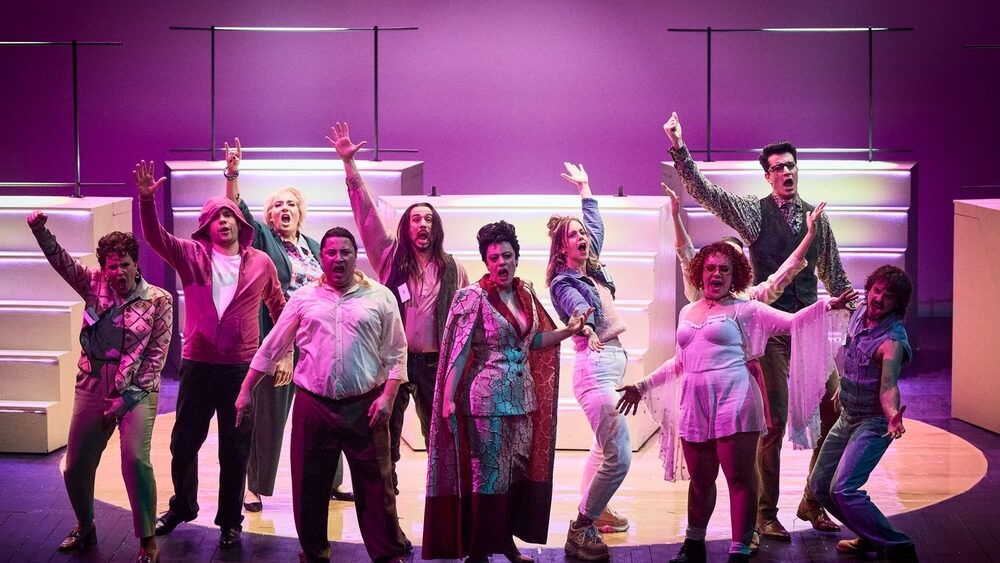
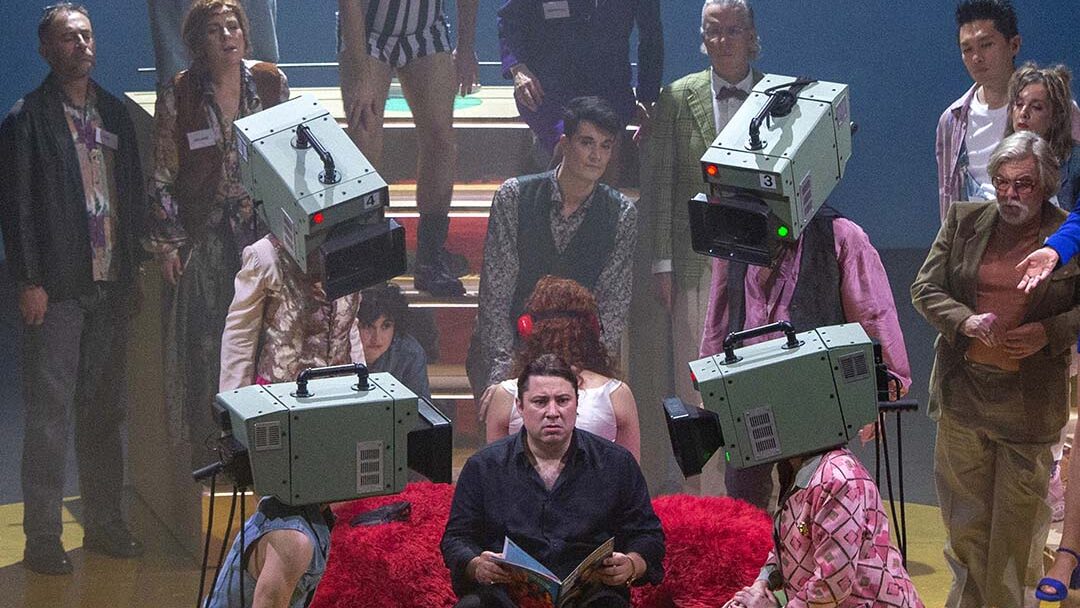
Sol Espeche’s ingenious production transposes the action to the late-80s TV studios.
In 1986, in a curious move, François Mitterrand’s socialist government called directly on Italy’s Silvio Berlusconi to create France’s first free, privately-owned, fully-commercial TV channel: La Cinq (i.e. channel 5). Berlusconi, a media mogul, would, as his country’s prime minister, be tried (and acquitted) for holding underage ‘bunga-bunga’ parties. Hervé, in the 1850s, spent eighteen months in prison for abusing a minor, but I don’t know if the director had this in mind. Anyway, as Radio France put in on Berlusconi’s death, La Cinq “propelled French TV into an era of bling-bling (…) opulence, flamboyance… and decadence,” or in Berlusconi’s own words, “not Coca-Cola TV, not spaghetti TV, but beaujolais TV, with champagne on Saturdays!” It was an era of flashy, trashy game shows, star-spangled variety acts at weekends, and tacky series (but also the French debuts of Mission: Impossible and Twin Peaks). French TV, forced to fight back in a similar vein, was never the same again. “Cinq-You La Cinq,” as the saying went.
While the audience settles in, fifteen minutes before the curtain rises, a cringeworthy “crowd-warmer” with a hand-held microphone interviews random audience members and explains how we will all know when to clap, laugh or boo. As Le petit Faust opens in a classroom, Espeche reminds us (unfortunately, as it was best forgotten) of an egregiously stupid, noisy comedy show, supposedly set in a schoolroom filled with C-list celebs, called La Classe. This is so awful it’s interrupted and heckled, from the audience, by Valentin: it’s the worst thing he’s seen, he says, since La Bohème set in space—and all this funded by the taxpayer. He muscles in with his black-leather-biker-like henchmen.
As the plot moves forward, in a gold-stepped arena, with a silver curtain in front, and a golden one behind, Espeche’s stylish, authoritative Méphisto leads us from a blind-date game to (for the Bal Mabille) the legendary Champs Elysées, a variety show that was a monument in its day. We progress, if that’s the word, to Big-Brother-style reality TV (Marguerite’s bedroom), and lastly (for the exhausting finale, in which all are spun for eternity in an “horrible farandole”) to Gym Tonic (“Toutou youtou”), a low-budget on-screen aerobics class, led, in pastel-colored spandex, by the now-legendary Véronique and Davina—officially a cult show, believe it or not. Oh, and Valentin, killed in a hilarious wrestling match, complete with striped bathing-suits and Mexican lucha libre masks, reappears, not in a soup tureen, but out of a tombola.
Espeche manages her whirlwind, all-singing, all-dancing, gag-a-second staging with admirable precision. The period (i.e. 80s) costumes, wigs, makeup and so on look as authentic as such things ever do when you actually lived through the period, when the younger production team couldn’t have. Chorus members as well as principals have individually-crafted personalities, and everyone stays unflaggingly in character, grinning and grimacing and leaping about enthusiastically, in time and as required, from start, through rapid-fire costume changes, to finish. It must be exhausting for them all. For us, it’s all great fun.
With one cavilling caveat. We’re all used, these days, to the mental gymnastics involved in matching a director’s concepts to the original plot. Here, the task is made more arduous. Not only must you match, in your mind, the rewritten dialogues, multiple references to 80s current affairs and celebrities, and game-show settings to Hervé’s own wacky storyline. But if you are to “get’” Hervé’s parody, you have also, simultaneously, to make an extra mental somersault backwards to Gounod. With an unfamiliar piece, it’s a lot of work.
Musically speaking, first, in a 500-seat house, I could have done without amplification, at least for the singing. Perhaps that’s just because I’m not used to it. But I find it almost impossible to gauge the voices. You might say that in a work like this, the voices aren’t all that count. That’s true: the principals were excellent comic actors as well as singers.
Philippe Brocard, a baritone soloist with the French Army choir and habitué of the Frivolités Parisiennes, cuts a commanding, vigorous, athletic figure—with a spiky crest of blond hair—as Valentin. Amplified, his voice is—I know people don’t like the word, but it is —stentorian.
Mathilde Ortscheidt’s black-haired, power-dressing Méphisto (yes, in Hervé’s version, Méphisto is a woman) looks like a cross between Liza Minelli, Tim Curry in The Rocky Horror Picture Show, and Roselyne Bachelot, a former French minister of culture, who may well have been in the house one evening. She sings with a chocolatey, slightly grainy voice, and acts like she’s in charge, which as Méphisto, of course, she is.
As Faust, Charles Mesrine is a little less in-your-face, vocally speaking, but acts up the necessary storm; for example in that wrestling match, during he trades places, out of sight, with a life-size rag doll to take a pounding from Valentin, before the latter is fatally distracted by taking a pinch of snuff.
He and Anaïs Merlin are, again, Frivolités-production regulars, and as the gap-toothed, gum-chewing, gold-digging Marguerite, Merlin is simply fascinating. You rarely see such a natural comic rogue so obviously own the stage. I thought back to the equally charismatic Misha Kiria as Gianni Schicchi at the Bastille. What’s more, she has a rich soprano voice, right to the top.
The Frivolités Parisiennes company is doing sterling work dusting off, and presenting, sometimes in partnership with the Palazzetto Bru Zane, French light opera of the 19th and 20th centuries: opéra-comique, opéra bouffe, opérette, vaudeville, inter-war musicals and the like.
I’ve already discovered and enjoyed Hervé’s Mam’zelle Nitouche, Offenbach’s Le Voyage dans la Lune, Hahn’s Ô mon bel inconnu, Yvain’s Gosse de Riche and Fourdrain’s Les Contes de Perrault, the last three in the same little house, thanks to them. They played with their usual zing and conspicuous joy under Sammy El Ghadab. Was amplification really necessary? I don’t think so.


