IN Series commissioned the world premiere of composer Damien Geter and librettist Jarrod Lee’s new opera The Delta King’s Blues, a compelling adaptation of the life and legend of blues pioneer and guitarist Robert Johnson.
Fresh off another world premiere this year, Virginia Opera’s debut of Loving v. Virginia this spring, Geter returned to the mid-Atlantic with another operatic adaptation of an American subject: the birth of the blues. Born in 1911 in the Mississippi Delta, Johnson had a brief yet extremely influential career in the blues before his early death at the age of 27. The scant biographical information known about Johnson has inspired myths; according to legend, Johnson sold his soul to the Devil at a crossroads in exchange for musical talents. The Delta King’s Blues offers a uniquely American spin on the Faustian bargain.
Like in Loving, Geter paints with a colorful brush in Delta King’s score. Scored for a classical string ensemble and traditional blues instruments, including bass, drums, saxophone, keyboard, and guitar, Delta King united elements of both genres. Geter’s invocations of the two distinct musical traditions effectively suggested the divisions between the two dimensions. Eerie themes from the strings characterized the liminal space where Johnson meets and bargains with the Devil, while rhythmic themes inspired by the blues evoked the juke joints where Johnson practiced his art and ultimately became a star. Geter’s conservative use of the guitar, a perhaps unexpected decision in an opera that centers on a guitarist, allowed the instrument’s steel strings to have a noticeable impact in the pivotal moments when Johnson learns to play and gives his first performance with his supernaturally enhanced skills, without the opera risking becoming a hollow imitation of the original master of the blues himself. Highlights of the score included the prelude, which transitioned from a piano melody to an unsettling strings interjection before sliding into the blues, and a jazzy waltz for the Devil. Conductor Darren Lin led the ensemble in efficiently shifting between the modes of expression in Geter’s score, though the volume drowned out the singers in the small black-box venue at times. Delta King was effective as a chamber opera, as performed by IN Series, but I would be curious to hear the score with the greater support of a larger orchestra as well.
Lee’s taut libretto kept the story moving during the opera’s approximately hour-long run time. Lee gave the character of Johnson clear motivations for his musical ambitions in a bid to honor his mother’s memory (hauntingly suggested by Geter’s allusions to hymns) and impress three onlookers: the woman he’s sweet on and two scornful musicians. The opera’s abrupt ending created some confusion but may have reflected the sudden end to Johnson’s own life and career.
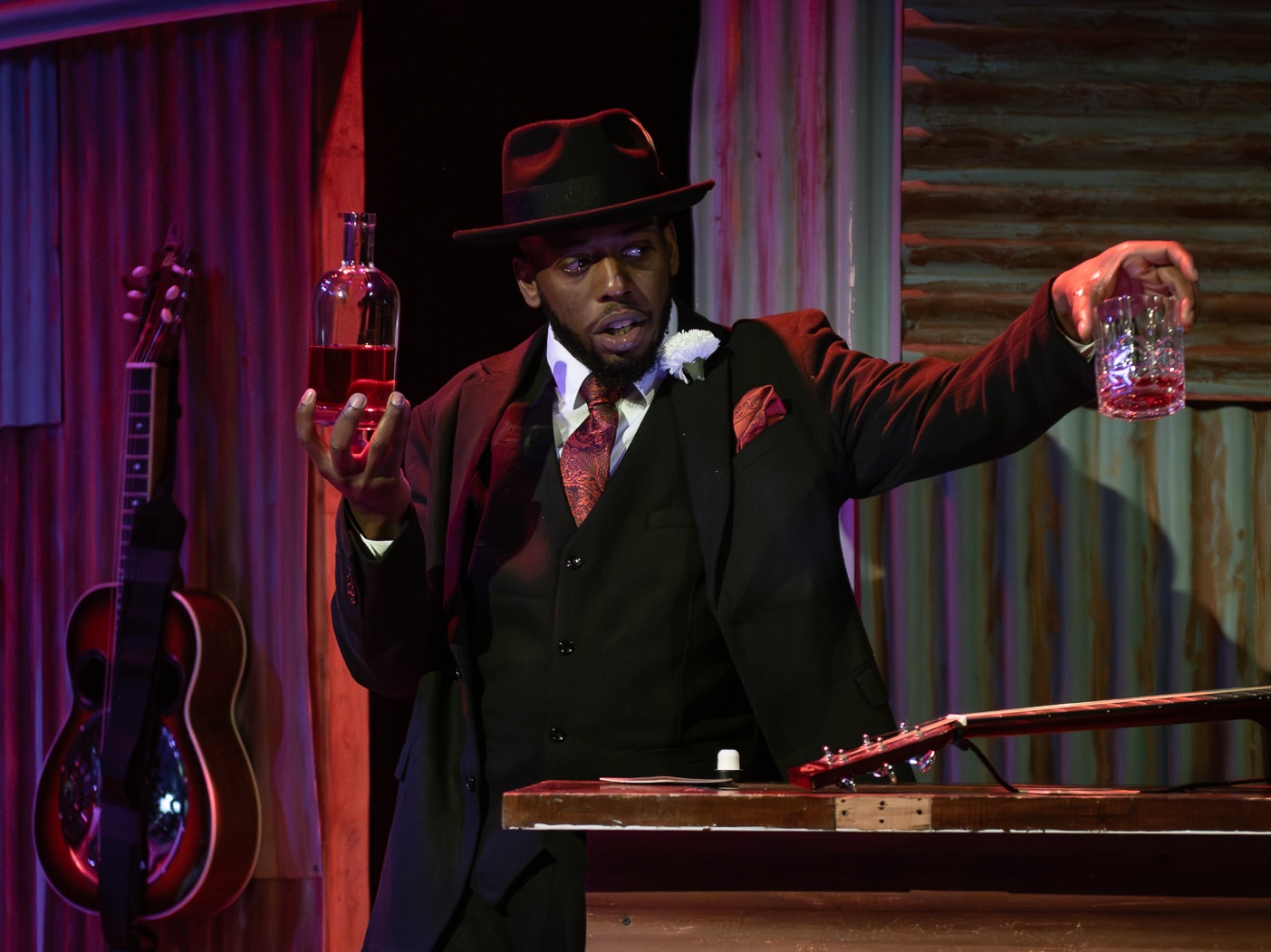
Albert R. Lee’s golden tenor and affecting stage presence helped him excel in the role of Johnson. Lee was particularly adept at conveying the “before” and “after” of the character’s musical transformation. He adopted a more rustic tone for Johnson’s performances pre-satanic intervention and showed off a smooth, suave voice afterwards. Bass-baritone Christian Simmons gave an engaging performance as a leering, confident Devil who relished his role in the transaction with Johnson. The role made effective use of his range. Soprano Melissa Wimbish was bold and sultry in the role of Virginia, the bartender who catches Johnson’s eye, and sang her aria with a fiery dose of Southern sass. Baritone Marvin Wayne and tenor Anthony Ballard as musicians Willy and Son were effective tormenters for Lee’s Johnson.
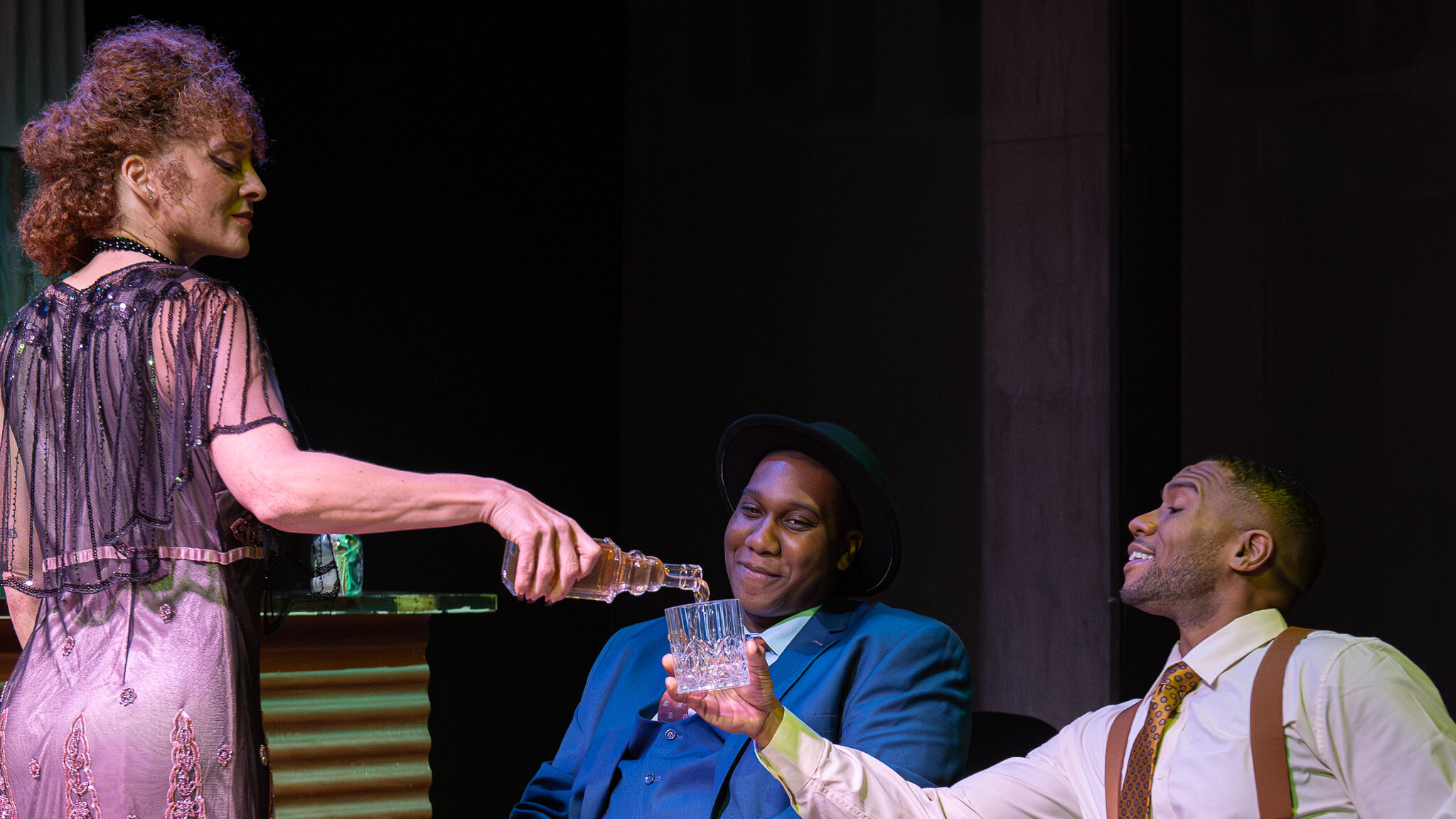
Alicia Washington’s efficient direction conveyed the story thoughtfully. Making full use of the limited space, her blocking heightened Delta King’s drama, particularly in Johnson and the Devil’s negotiations, and her deployment of the Virginia, Willy, and Son trio as silent witnesses to the exchange underlined the poignancy of Johnson’s determination to prove himself in the face of a doubting public. Joshua Sticklin’s well-structured set design fit all the story’s essentials, including the cemetery where Johnson’s mother rested, the notorious crossroads, and a juke joint, in a small venue without feeling cramped. Remarkable lighting by Paul Callahan enhanced the performance by defining the various spaces the characters inhabit and dividing the story’s supernatural and terrestrial dimensions. Period costumes by Rakell Foye evoked the early 20th-century Mississippi Delta. A virtuosic pre-opera performance by blues musician Memphis Gold gave the audience a taste of Johnson’s music.