Photo: Monika Rittershaus
As a native Floridian in Germany to catch some Russian opera last month, I was sartorially unprepared for the lone snow day that I experienced in Berlin and promptly found myself ass-over-teakettle in front of the Russian Embassy on Unter den Linden. Was it an (in)auspicious omen for my upcoming operatic experiences, or am I just a sucker for some pat literary coincidence? Probably the latter, but a visit that began with a performance of Khovanshchina at the Staatsoper Unter den Linden hit some powerful highs as well as some confusing stumbles.
Khovanshchina is an unwieldy beast. Left unfinished by Modest Mussorgsky, who died at the age of 42, the opera presents, to my mind, two major challenges, one dramatic and the other musical. Number one: how can modern audiences engage with the dense web of political machinations that comprise the so-called Khovansky Affair, a slice of 17th-century Russian history where, as a result of the tsardom’s push for Westernized reform, Prince Ivan Khovansky, head of the Streltsy militia, stages a coup to (checks notes) make Russia great again. I mean, who wouldn’t want to leap right into this thicket of power plays and quite literal backstabbing?
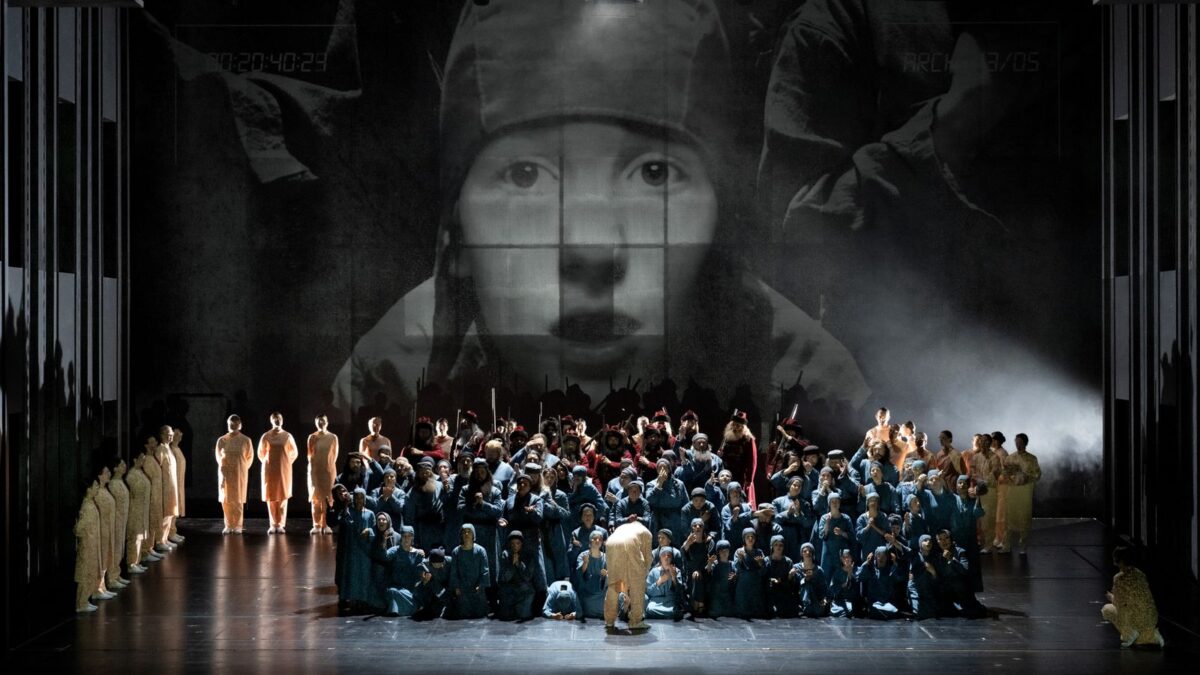
Claus Guth’s production, revived from Berlin’s previous 2024 season with an almost identical cast, helps to acclimate its audience to this subterfuge with the use of a framing device: the entire opera is seen as if through a reenacted governmental report. As the sun is supposed to be rising over the Moscow river during the opening prelude, a 21st-century stenographer types in the wings while text of historical background is projected onto the stage; with each of their entrances, our central characters freeze in place while abbreviated dossiers appear above their heads; multiple actors portraying Peter I stand against a backdrop to have their heights measured, literally showing the not-yet-“the Great” tsar as growing over the course of the events.
In a purely functional way, these decisions help the audience to gain a foothold into this famously complex opera, especially if someone is coming in without any prior familiarity with the work or Russian history. (Yours truly made sure to listen to multiple recordings and read and reread the libretto prior to the performance, so I was thankfully a whole 16% more confident about what was going on…OK, maybe more like 7%.)
However, the production, with its gaggle of bespectacled technicians milling about on the stage with lab coats and clipboards, silently observing (or even sometimes ushering choruses to and fro), posited this historical event as the first rumblings of recurring and current political turmoil… well, perhaps. Guth’s direction was at its most convincing when the “experiment” broke loose from its confines; in a particularly arresting scene, Ivan Khovansky, violently desultory after his political fall from grace, begins to murder the dancers he has summoned forth during the oft-excerpted Dance of the Persian Slaves, despite the protestations and interventions of the researchers. The production seems to suggest the cyclical nature of political turmoil and the dangers of maintaining a passive perspective on these histories of violence. What current atrocities, then, is Guth alluding to?
By using a recurring set of a palatial Kremlin office (complete with Peter the Great statue looming in the background) to open and close the opera, the director potentially offers a pointed critique of particular authoritarian governments. In practice, though, Guth sidesteps any direct condemnation of contemporary Russian warmongering. While Roland Horvath‘s projections throughout the production come mostly from the on-stage camera crew that follows the performers, occasionally historic and modern images (19th-century paintings of Old Believers, tumbling statues of Lenin) are superimposed on the sets. Is Guth commenting on the historical ramifications of Petrine reforms? Does he see today’s Russia as locked in a similar struggle for her proverbial soul? These could have been thoughtfully-posed queries, but watching projected film footage of dilapidated modern Russian settlements during Shaklovity’s plea for the fate of the country—while Ukrainian protesters were camped outside the opera house and nearby Russian embassy —made the director’s commentary feel rather toothless.
The second challenge of Khovanshchina (you thought I forgot, didn’t you?) is naturally a musical one. Any opera house that decides to mount a production of this work must decide which Khovanshchina its audiences will hear. While early Mussorgsky champion Nikolai Rimsky-Korsakov originally finished the work of his compère, this version has been considered decidedly passé and stylistically inappropriate since the 1980s. Instead, the most common solution is utilizing Dmitri Shostakovich’s more recent orchestration, commissioned for a 1959 film of the opera. And if that weren’t enough, Maurice Ravel and Igor Stravinsky also worked on a version for Diaghilev’s 1913 production at the Theâtre des Champs-Élysées, and some productions stitch Stravinsky’s eerily hushed ending onto Shostakovich’s orchestral torso like a Russian operatic version of the human centipede.
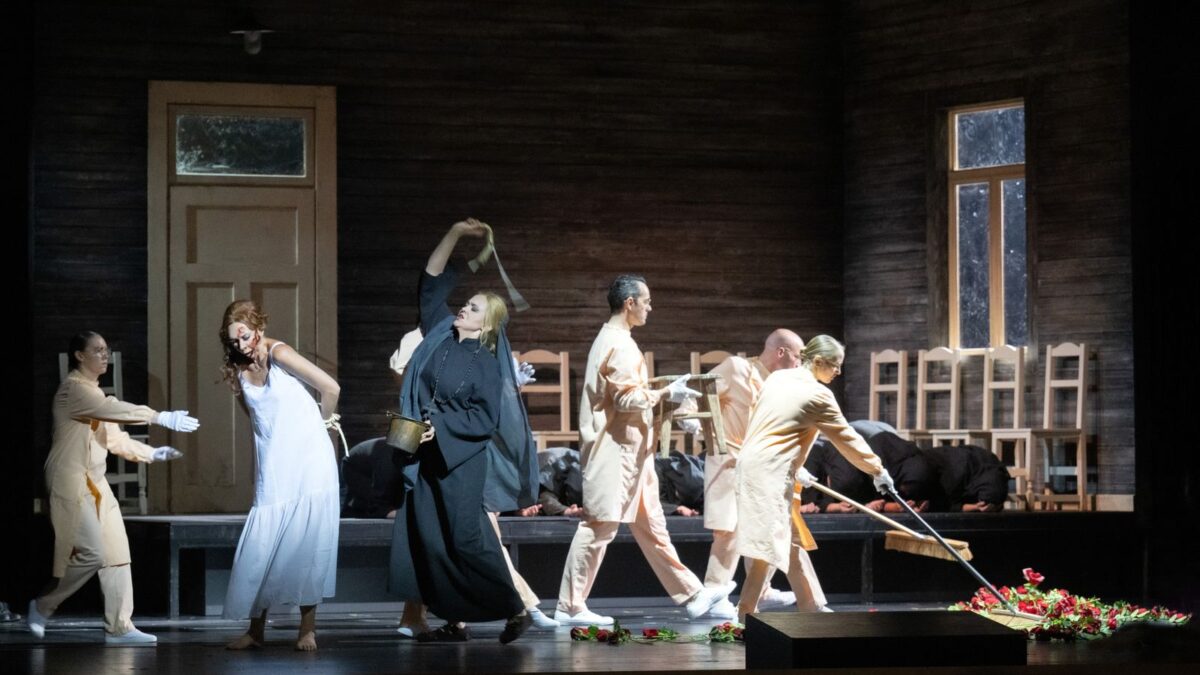
Berlin opted for this Shostakovichian orchestration and Stravinskian dénouement, and conductor Timur Zangiev expertly infused much of Mussorgsky’s unique tonal color into the later composer’s reworking. Despite Khovanshchina’s more Italianate melodic and vocal lines (especially when compared to Mussorgsky’s magnum opus, Boris Godunov), Zangiev was able to emphasize the darkness of the score, leaning into the brass growls and bass scrapes to underline the severity and violence of the narrative. Through his leadership of the Staatskapelle Berlin, Zangiev helped us to hear the Mussorgskian sound in Shostakovich’s orchestration. There were, though, occasional moments when the conductor’s attention to detail became too granular. The moody extended crescendo of Marfa’s divination scene, for instance, felt assembled phrase-by-phrase, robbing the scene of much of its cumulative power. However, Zangiev brought the evening to a stunning close with Stravinsky’s ending, casting a haunting narcotic calm over the stage as the Old Believers melted into the projected swirls of flames and ash, leaving the audience silent until the maestro finally lowered his baton.
The cast, full of various, morally ambiguous figures all jockeying for power, featured big (emphasis on big), healthy voices almost entirely across the board. As Ivan Khovansky, Finnish bass Mika Kares used his strong, molasses-dark voice to delineate both the violence and charisma of the titular character. Ukrainian bass Taras Shtonda’s voluminous sound, while sometimes wayward in pitch, brought a visceral excitement to his scenes as the leader of the Old Believers. (Oh, how I long to hear him roar as an earthier character à la Boris’s Varlaam…)
Mariinsky stalwart Evgeny Akimov was a late sub for Stephan Rügamer as Prince Vasily Golitsyn, his fluency in the character’s conversational passages was offset by occasional strain in the upper register. George Gagnidze, a commanding presence onstage, used his appropriately threatening and craggy baritone to add real menace to Tsarevna Sofia-supporter Shaklovity, though I wished he could muster more beauty in his tone for his famous Act III aria. On the other hand, as Old Believer Marfa, Marina Prudenskaya’s voice was unimpeachable, sterling in production from top to bottom. I would argue that her arias in Acts II and III were undermined by stilted conducting and some awkward pseudo-crowd-surfing staging, but the final two Acts found her at her zenith, gently—and even maternally—convincing her erstwhile lover to join her in the flames of redemption.
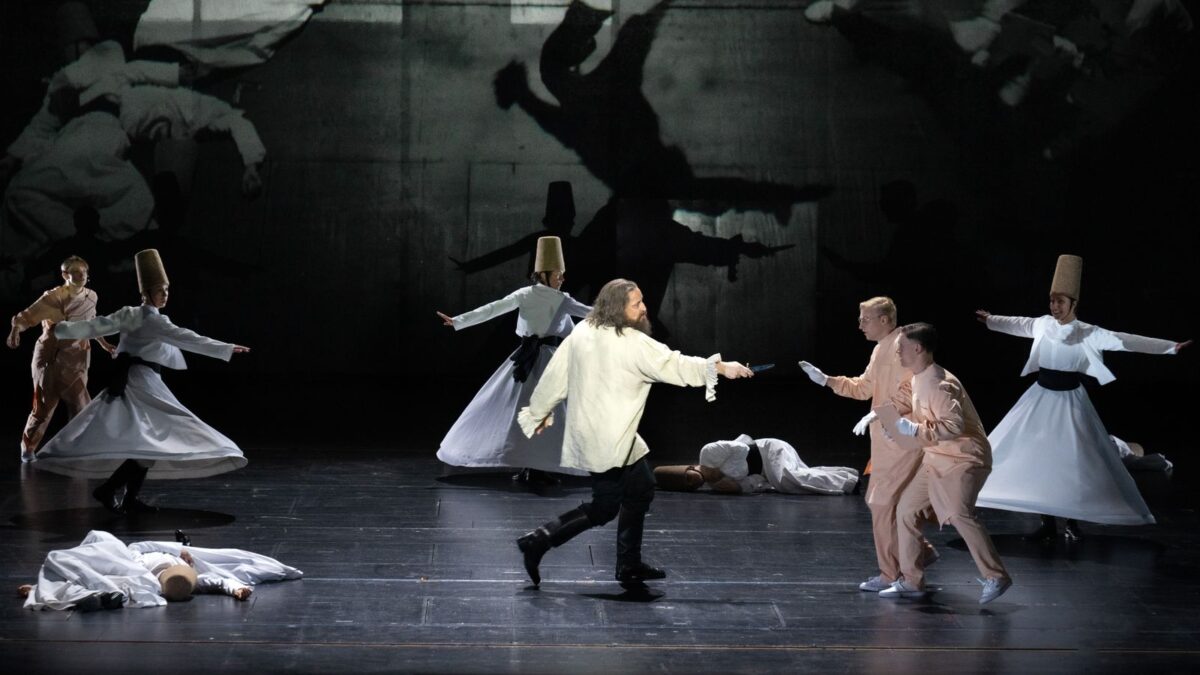
Photo: Monika Rittershaus
Speaking of said lover, while I was disappointed to learn that Wagnerian Andreas Schager had pulled out of the production a month or so earlier, my biggest surprise of the evening was New Zealand tenor Thomas Atkins as Ivan’s son Andrey. A famously unlikable character in a rogue’s gallery of already deeply flawed individuals, Prince Andrey (that’s prince # 3, if you’re keeping track) makes his entrance — not to put too fine a point on it — trying to rape a young girl.
Atkins’s voice, though, is thrilling and virile, and his youthful and handsome stage presence brings in a necessary immaturity to temper, though never excuse, his repulsive behavior. Indeed, in the later Acts, we actually feel a sense of… well, if not empathy, then at least pity for a spoiled child who has lost all of his former power and must hide himself from the Preobrazhensky Regiment hunting him down. Atkins’s delicate handling of these scenes, reigning in and sweetening his heroic tenor, brings all the pathos anyone could hope for this problematic character. And in a phenomenon unique to the operatic stage, I was pleasantly surprised to see the duo of Mika Kares and Thomas Atkins actually looking like an age-appropriate father and son (not to mention that the age difference between Andrey and now-MILF Marfa suggested a possible coercive element to their former romance, adding further depth to Andrey’s anger and Marfa’s guilt).
Rounding out the cast, Andrei Popov was weedy and characterful (in the best way) as the Scribe; Evelin Novak was effectively beleaguered as Prince Andrey’s victim, Emma; and Anna Samuil was vocally uneven and unpleasant (unfortunately not in the best way) as Marfa’s Old Believer sister, Susanna. Lastly, special mention must be made for the chorus, which, as in Boris, is its own multifaceted character. The Staatsopernchor Berlin expertly embodied whatever Mussorgsky (and choral director Dani Juris) asked of them: tenderness, fervor, rage, and much more.