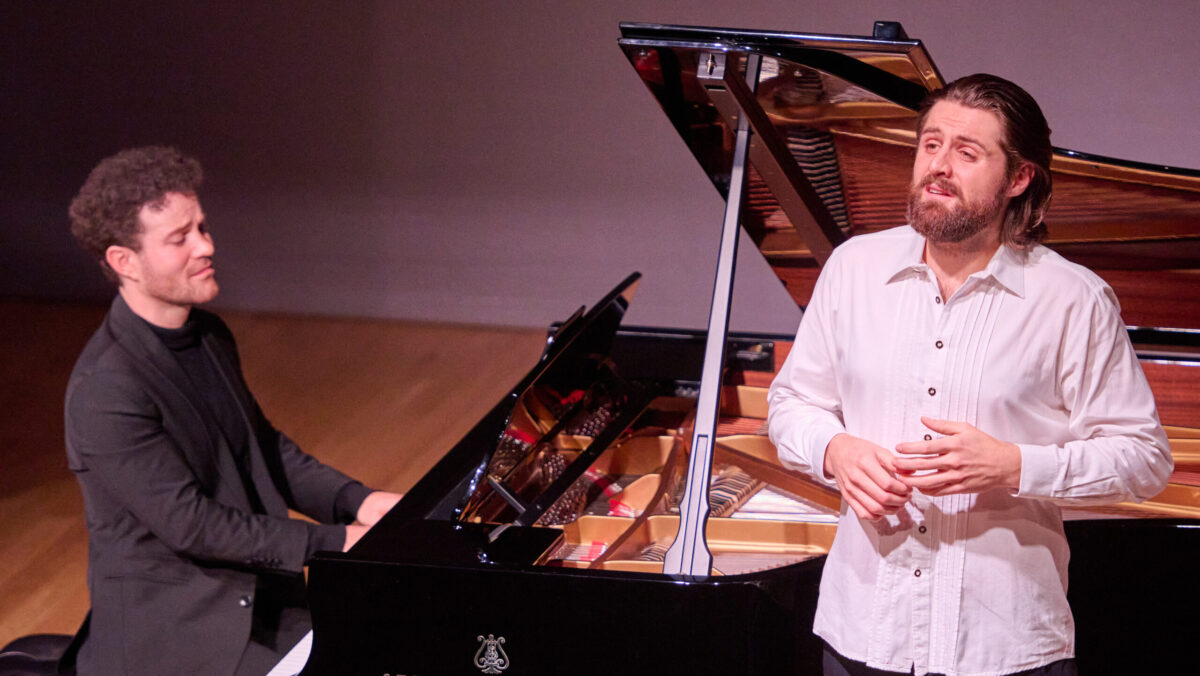
Konstantin Krimmel, baritone and Ammiel Bushakevitz, piano
There are those who expect their Lieder recitals to be Dietrich Fischer-Dieskau–Gerald Moore tribute acts. Or more polished simulacra of musical evenings in 19th-century drawing rooms. Recent trends have seen the Lieder recital accommodate various konzepts: projections, frame narratives, and other theatrical gestures.
Entering the intimate Buttenwieser Hall at the 92nd Street Y, you would have been forgiven for thinking Konstantin Krimmel and Ammiel Bushakevitz were conforming to the former categories. Over the course of three nights, baritone and pianist traversed Schubert’s song cycles— Die schöne Müllerin, Winterreise, and Schwanengesang—all stalwarts of the Lieder repertoire. Krimmel, dressed in a tuxedo shirt and a simple pair of slacks for the first two nights, seldom strayed from the crook of the piano. His gestures remained compact, largely tracing the line of his torso. The unclasping of his hands took on immense gravity. Grimaces from behind the keyboard were kept to a minimum. Add some ties and tails, and the traditionalists would have been pleased.
Yet, the intensity of their interpretation dispelled the notion that a bag of tricks is needed to redeem this repertoire from polite routine. This was three nights of blood-and-guts Lieder—and it required nothing more than two committed artists.
Each performance saw baritone and pianist take distinctive, yet complementary interpretative roles; it was a conversation between two equal partners, rather than one merely supporting the other. “Das Wandern,” in which the journeyman miller of Die schöne Müllerin sets out along the rambling brook towards his ruin, contrasted Krimmel’s lightness and ease of delivery with Bushakevitz’s agitated playing. The accompaniment’s broken traids, evoking water wheels, churned against the blitheness of the vocal line.
The stormy introduction of “Am Feierabend” drove Krimmel into more operatic territory, as his sound took on greater forcefulness and a more liberal use of vibrato. The earnestness of the second verse turned to anguish as he flattened his voice for the closing “gute Nacht,” echoed by a final, stinging chord. In the space of a moment, his voice regained its amber cast in “Der Neugierige,” and Bushakevitz responded in kind with a lush sound. And while light dappled into “Morgengruß” through the accompaniment, the assertiveness with which Krimmel handled the melody foreshadowed the manic quality of the middle songs, in which the miller briefly claims the maiden’s affections. Indeed, whether from singer or pianist, a darkness seemed to encroach on these moments of joy.
Confronted by a rival in “Der Jäger,” the miller’s dark possessiveness manifested through Krimmel’s snarling, nasal tone, which had the distinctiveness of Strauss’s more unpleasant operatic creations. Throughout “Trockne Blumen,” this furor melted into pity, matched by Bushakevitz’s gloomy chords. By the end of “Der Müller und der Bach,” the two had reached an ironic equilibrium; Krimmel reduced his sound to a thread as the miller lamented to the brook, and Bushakevitz joined him in that quietness. From there, both emerged into a limpid, gentle “Des Baches Wiegenlied.”
Unlike the journeyman miller of the previous cycle, we do not see the unnamed traveler of Winterreise fall in love. Any fleeting moment of joy can only be accessed through the backwards glance of an unhappy man, and his mental state only goes from bleak to bleaker. Consequently, the songs are more unified in tone and temperament. Despite this relative uniformity, Krimmel and Bushakevitz revealed a spectrum of textures and moods within the bleakness.
“Gute nacht” began softly at a measured pace. Krimmel’s eyes widened as if straining to take in that final glimpse of his beloved’s house. Then Bushakevitz’s left hand gradually gained more prominence, layering darkness onto what was wistful sweetness, and Krimmel attacked the second verse at a fortissimo—a cry of impotence and despair. There were many such moments of heightened expressivity; “Erstarrung” flew by in a fit of Romantic neuroticism, while “Auf dem Flusse” displayed Krimmel’s ability to quickly flip from the tender to the bracing, as he ended the piece in a near growl. What was most impressive was that these moments did not come across as theatrical affectations but rather as expressions of interiority rooted in the text.
His phrasing became almost conversational in “Die Post,” as Bushakevitz’s abruptly jolly evocation of the post horn elicited a chuckle or two—a welcome moment of levity after their bitter, brooding “Einsamkeit.” Their handling of “Der greise Kopf” was contemplatively paced, resembling a recitative in the spareness of the accompaniment and the subtlety of the vocal delivery. “Täuschung” melded the bleak and beautiful in Krimmel’s warm, expansive tone. “Das Wirtshaus” had the solemnity and contemplativeness of plainsong, with Bushakhevitz’s playing having the stateliness of a church organ.
Schwanengesang represented Krimmel and Bushakevitz’s sole break with traditional performance practice; they changed the order the Rellstab and Heine songs significantly, pairing thematically similar pieces, and added four Seidl songs to go along with “Die Taubenpost”: “Sehnsucht,” “Bei dir allein,” “Der Wanderer an den Mond”, and “Das Zügenglöcklein.” These changes gave program a clearer arc—Schwanengesang, after all, has no unifying narrative—and allowed the tension to gradually build throughout the evening. The Siedl additions, which dealt largely with subjects of longing and wandering, also helped to form a more definite link with the preceding cycles.
Liberated somewhat from the demands of his wandering protagonists, Krimmel infused a sweetness and purity to the opening “Liebesbotschaft” that had not been present in the previous nights. Bushakevitz’s pedal work brought out a variety of hues in “Ständchen,” as Krimmel lingered very slightly at the ends of his phrases, as if caressing them. “Kriegers Ahnung” marked a return to gloom; at moments, it seemed that the force of his longing was drawing the breath from him. The glowing warmth with which both artists evoked the soldier’s dream contrasted sharply with the harried, cavalry-inflected final verse. The Siedl songs were lovely, and even the gloomier “Am Meer” had a shine to it.
Krimmel and Bushakevitz chose to end with the grimmest songs in the cycle, placing the audience squarely in the eye of Sturm und Drang. The piano rumbled straight into “Die Stadt,” like the wind through the abandoned streets, and Krimmel’s baritone took on an eerie cast. “Der Doppelgänger” was paced as a creeping crescendo, growing into a frightening roar from both pianist and baritone at the recognition of the wraithlike double. A look of possession came over Krimmel. The piece resolved into a heart-wrenching moan. A bravura “Der Atlas” ensured that the series went out with a bang, not a whimper. (Not wanting to leave the audience on such a heavy note, the two then treated the audience to the only encore of the series: a ravishing “Silent Noon” by Ralph Vaughan Williams.)
Exiting the hall into the biting evening air after the final evening, I was tempted to wander the emptying streets and see if I could experience firsthand the sublime loneliness that both artists had so ably conjured. Being sensible, I did not. But the temptation has not left me.