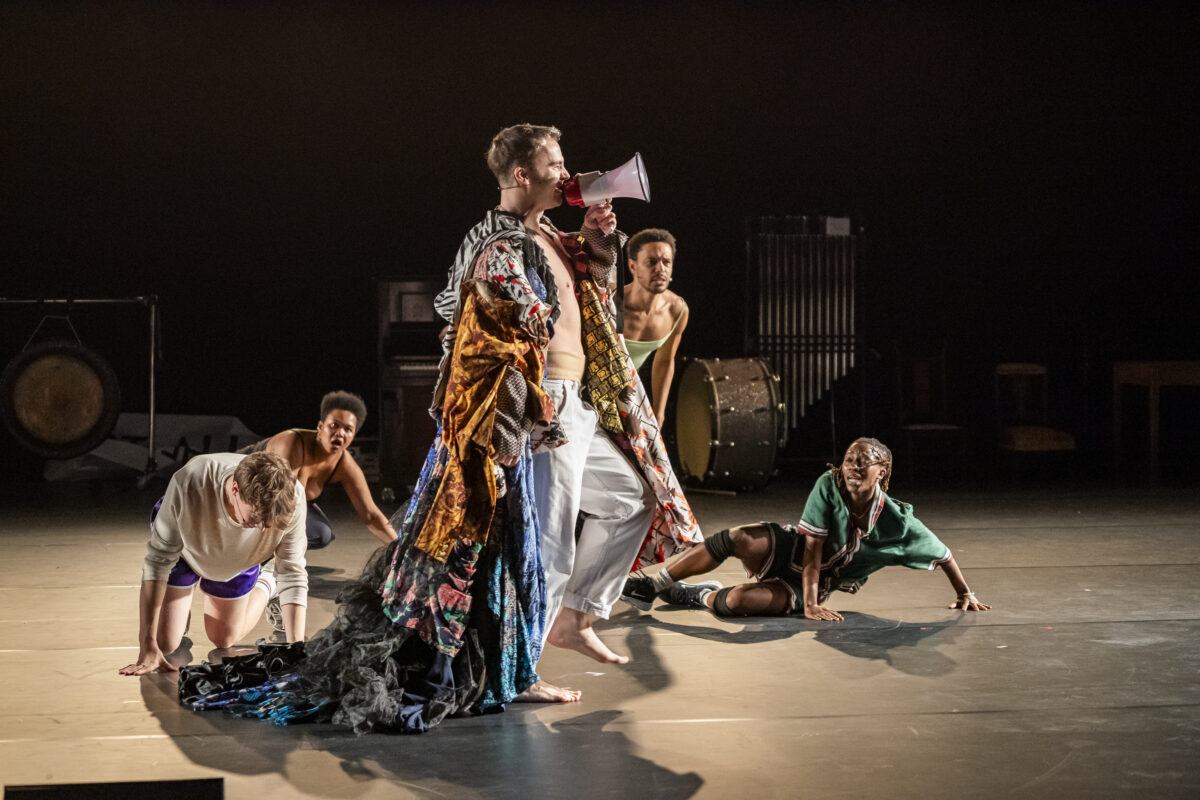
Collin Shay (center) and ensemble in The Faggots and Their Friends Between Revolutions at Park Avenue Armory, 2025
Photo: Stephanie Berger
The show had a scrappy DIY vibe even before we took our seats: no proscenium, no wings, no pit, and no set. All the props, changes of costume, and instruments were lined up at the edge of the empty stage while the performers lounged, stretched, and conversed out of character in full sight of the audience. If this stage and bleacher seating hadn’t been erected at full size in the Drill Hall of the Park Avenue Armory, the setup wouldn’t have felt out of place in a tiny black box somewhere downtown.
How else could this opera have started? The show was composer Philip Venables’ and librettist/director Ted Huffman’s adaptation of The Faggots and Their Friends Between Revolutions, the 1977 cult novel/manifesto/scripture that has only lately returned to print. Of course it had to reject conventional stagecraft, just as the book by Larry Mitchell and illustrator Ned Asta—a retelling of queer history as a series of post-apocalyptic parables—had to reject conventional novelistic form, telling a story in which the “main character” is not any he or she but a community, a movement, a way of being that is itself defined by its rejection of cisheteropatriarchal forms.
The performance instead relied upon a kind of queer self-sufficiency. Think of how a Fosse show might have used presentational forms of stagecraft and minimalist set dressing to make a Broadway theater feel like the wagon of a minstrel troupe or the stage of an intimate nightclub—then subtract the action, the plot, the characters, and the showtunes.
You don’t need “action” or “plot” for an evening of compelling musical theater—think of it as a revue. What The Faggots offers instead is episodes, narrated through song, dance, and spoken word, of a conflict between two opposing forces: on one side, the Men, who rule over the “devastated city” of Ramrod, and on the other, the Women, the Faggots, the Fairies, the Queers, the Queens, and so on. This isn’t an opera that touches on queer themes; it’s a bundle of queer themes tied up in an opera.
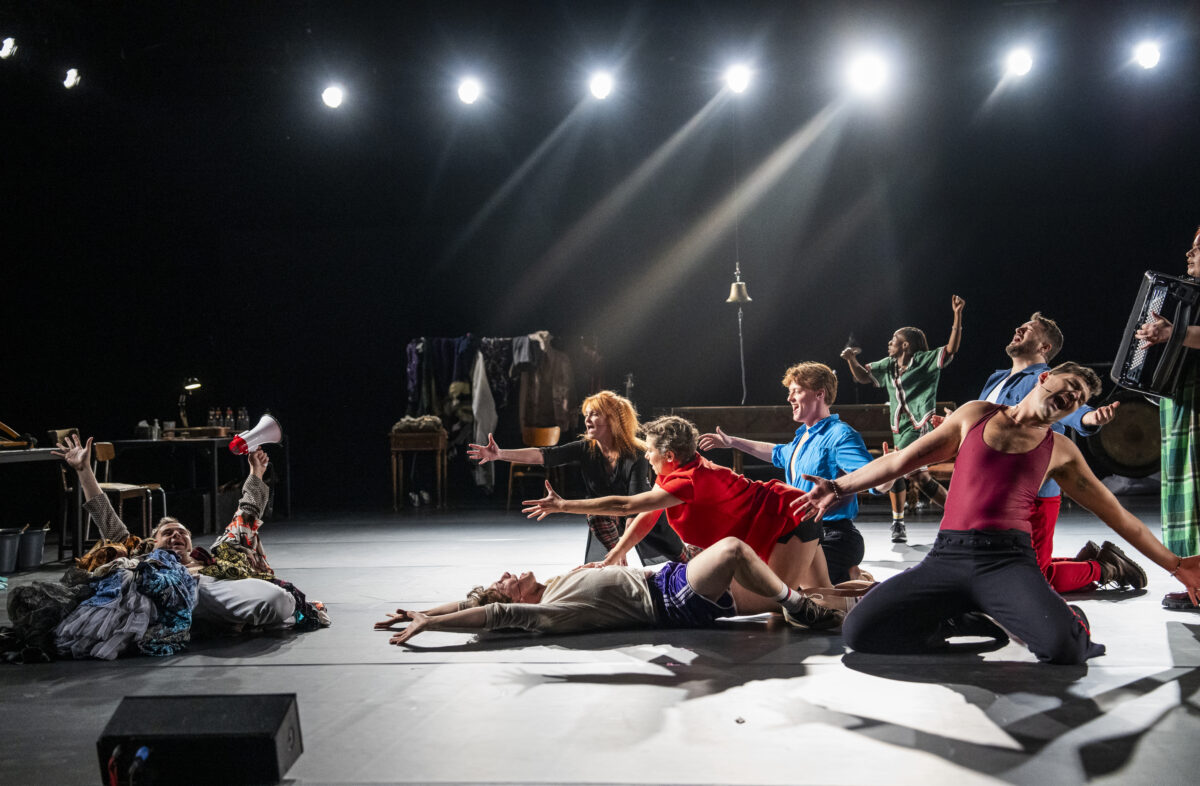
The Faggots and Their Friends Between Revolutions at Park Avenue Armory, 2025
Photo: Stephanie Berger
And just because you don’t have characters, that doesn’t mean you can’t have stars. While the production, in keeping with the piece’s anarchistic ethos, gave every member of the ensemble a chance to shine—most if not all of them (and I do believe all of them) did quadruple-duty, singing, dancing, acting, and playing instruments—the show was literally and figuratively stopped by narrator Kit Green, the closest thing the cast had to a lead. At a key moment in the show, she broke the fourth wall to lead the audience in a sing-along about mental pathologies as a tool of social control, using a hilarious, off-the-cuff monologue to tie the theme into her own experiences with transmedicalism. Another star: the mononymous Yandass, whose intensely expressive freestyle hip-hop movement burned with quasar-levels of brilliance and intensity.
Oh, right, there were opera singers, too! I said “no showtunes,” and I meant it: the solo vocal writing in The Faggots is often wilfully prosaic, all about communicating the text simply and directly. But there were often moments of pure, four-chord pop songwriting—especially when the ensemble mock the Men with songs about their love affair with paperwork.
And then, occasionally, the ensemble effloresces into a decadent Baroque. The instrumentation includes lutes, gamba, harpsichord, baroque fiddle, and organ, and the vocal performances that most caught my attention were Collin Shay’s mock opera seria countertenor aria—heavy on coloratura—about Warren-And-His-Fuckpole, the vicious leader of Ramrod, and the gentle lutesong tenor Kerry Bursey sang and played in a strange antiphony against a chorus in an entirely different meter.
That’s the thing, though—that strange antiphony. The musical aesthetic of the piece is all about total clarity and directness, suiting the bedtime-story simplicity of the text. But all of those simple parts are so deftly put together. Every number seemed to be a variation on the same 3-note motif, introduced in the first few bars, spun out into an extravagant number, and then warped and woven into the next variation. That three-note motif, I eventually realized, represents the faggots and their friends, while the music of the Men is overwhelmingly made up of martial percussion and brutal stomping.
(I was well into the piece, honestly way too far into the piece, before I realized that the Faggots’ three-note motif spells out—oh, you’re already ahead of me, aren’t you?—F-A-G.)
So, how did I feel about The Faggots & Their Friends? Well, first of all, it’s a shocking amount of fun. I keep comparing it to Broadway shows because honestly, I think it would go over almost as well with certain species of theater gays as with the art gays infesting the premiere. It feels a little like one of those hippie-dippy ‘60s rock operas reimagined with a deeper radicalism and, at the same time, a queer elegance and sophistication.
And its political message—expressed through the novel’s themes of queer resistance, liberation, and survival, embodied in the show through a meaningfully diverse cast of performers, and even lightly updated in Huffman’s libretto to include references to the traps of gay assimilation—is all too relevant to our historical moment. The book’s tales of queer survival already seemed prophetic in light of the AIDS crisis that followed; now, as the US slips into the darkness of fascism, and even the liberal mainstream of Venable’s native UK turns its back on the trans community, a joyous and defiant celebration of queer community feels deeply necessary, and maybe even a little brave.