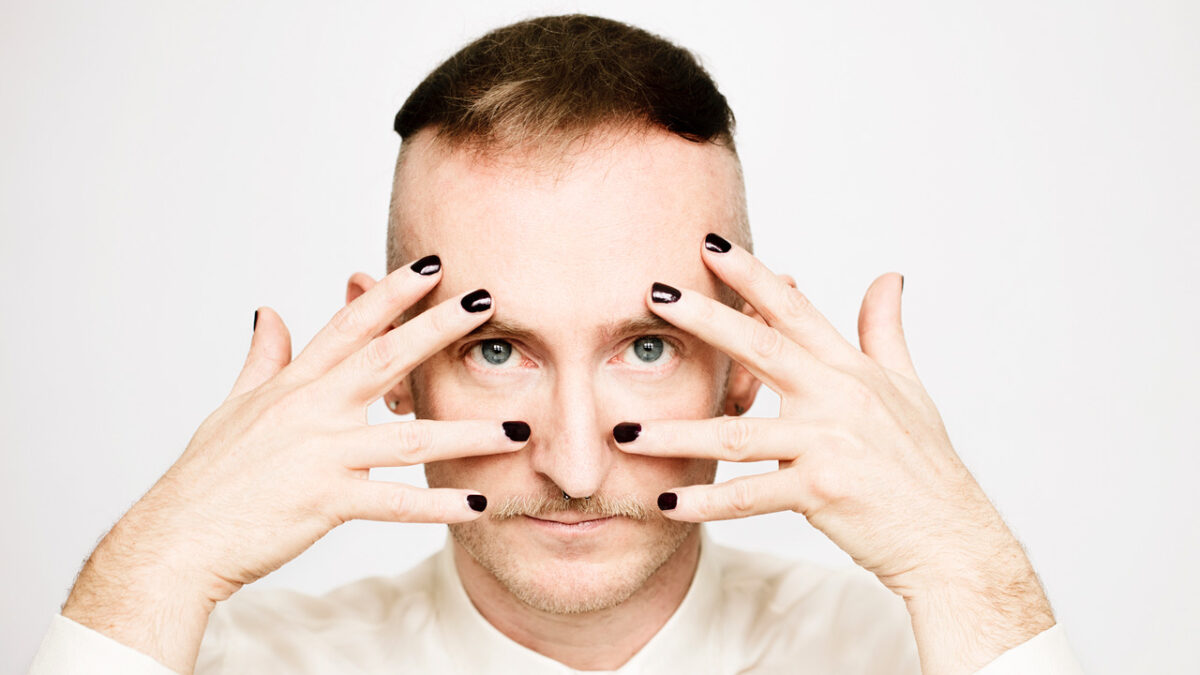
Composer Philip Venables / Photo: Harald Hoffmann
Brat Summer is over — it’s time for Faggot Fall. First there was Jordan Tannahill’s Prince Faggot, currently finishing its second Off-Broadway run. Then came Kevin Carillo’s Figaro/Faggots, a mashup of Mozart’s opera with Larry Kramer’s 1978 Faggots. The latest addition is British composer Philip Venables’s The Faggots and Their Friends Between Revolutions, which receives 10 performances starting this week at the Park Avenue Armory. “I like using that term to provoke,” Venables tells me, “as a response and as a pushback against the increasing feeling of us being pushed back into the shadows.”
Faggots and Their Friends is based on Larry Mitchell’s 1977 book, which intersperses vignettes on queer communal living under patriarchal rule with whimsical drawings by Ned Asta. “I first read the book in 2013, and I must have given it to Ted [Huffman, the director and librettist] in 2016,” he says. “It resonated very strongly with both of us, in its naive, almost children’s book description of queer history. It’s so brutal but also so joyful, and both of us immediately felt how it could come off the page and onto the stage.”
Huffman has been a collaborator on all of Venables’s operas to date. They first collaborated on 2016’s 4.48 Psychosis, based on Sarah Kane’s final play. The opera is a remarkable piece of theatre, transforming Kane’s fragmented, plotless text into a musical language that is at once violent and meditative. They would go on to explore similar themes of psychology and voyeurism in Denis and Katya, which premiered at Opera Philadelphia in 2019, and earlier this year premiered We Are The Lucky Ones at the Dutch National Opera, exploring themes of nostalgia and identity.
“It’s a wonderful collaboration,” Venables enthuses. “We’ve been working together for ten years, and we’re really good friends. We have similar tastes and goals in what we want to achieve, and in the way that we want text and music and theatre interact with each other. We always just talk and swap ideas for what might make good music theatre — that’s how this project came about!”
There are several standard traits across Venables and Huffman’s oeuvre: non-narrative structure, singers playing multiple roles, the juxtaposition between baroque or renaissance sound worlds with contemporary, digitized settings, and explorations of queerness, identity, and evolution. Faggots and Their Friends follows in this lineage, cast with fifteen performers who do quadruple duty as singers, instrumentalists, dancers, and actors. Venables and Huffman are seen, particularly by British audiences, as the forefront of the operatic avant-garde — in line with Sarah Kane’s role in the British theatre canon, perhaps — but Faggots and Their Friends marks a thematic departure.
Perhaps more than anything, its whimsy sets it apart from the rest of the operatic canon. Everyone onstage, whether singer or instrumentalist, sings; the audience is invited to sing along as well. It’s hard to imagine this trend carrying over to, say, the Met’s upcoming Tristan, with all of us singing along to Lise Davidsen’s Liebestod. The Park Avenue Armory doesn’t even market Faggots and Their Friends as an opera at all, instead referring to it as a “musical stage work.”
“It doesn’t really matter to me whether we call it an opera or not,” Venables says. “We’re just trying to make the theatre we want. Ted and I have always tried to explore theatrical forms less common in mainstream opera. We do have operatic voices in the cast and there are loads of musical references to opera, but we have non-operatic voices too — I don’t think describing it as an opera gives the right expectations for the audience.”
The blurring of artistic roles is a deliberate one. Mitchell’s book explores queer taxonomy: along with the titular faggots, there are the “women who love women,” the “queens,” the “faeries,” and the “strong women.” From a 2025 perspective, some of Mitchell’s gender politics can feel dated — Venables and Huffman are explicit in subverting some of these categorizations. “Although Mitchell had a categorized view of identity and community, the book also deals with allyship and commonality. It’s about lots of different people with different kinds of experiences of oppression coming together and resisting together. In our show we have these fifteen incredibly skilled people onstage, and each one of them has a kind of virtuosic skill. But they all do everything: they all sing, they all dance, they all speak.”
“To me,” he continues, “the virtuosity of the ensemble is in how they do things they’re not trained to do. For instance, there’s one scene where they all pick up violins and play, even though there’s only one professional violinist onstage. It feels really beautiful as a symbol of what inclusion means. That, hopefully, is the metaphor.”
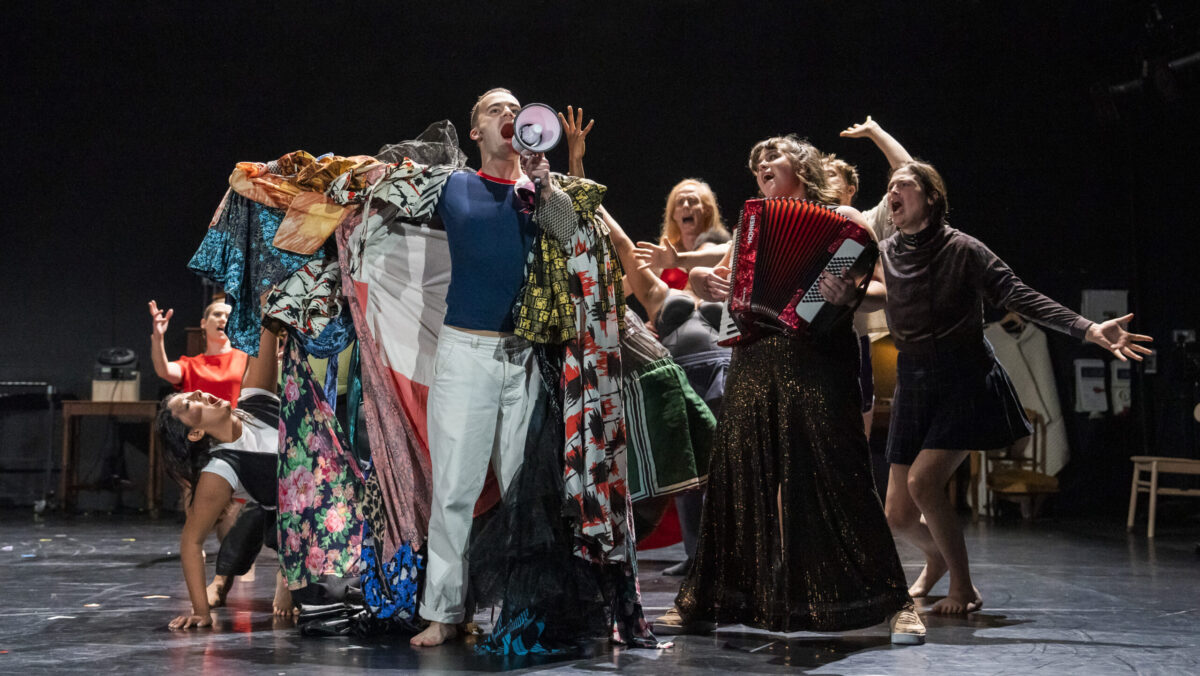
A scene from The Faggots and Their Friends Between Revolutions @ Home, Manchester. Part of Manchester International Festival 2023
©Tristram Kenton
This utopian vision, though, is not without its practical challenges. “The casting process was really long,” Venables comments. “We knew we were looking for multi-skilled people, and we knew we wanted period instruments to capture this Renaissance-to-Baroque musical character. The exact instrumentation formed during the casting process, and I was able to write specifically for the secondary skills that people had. The consequence of that, of course, is that it’s a show that’s very tailor-made for this cast, and it does make it very hard to recast. We’ve had a few cast members we’ve had to recast through the last two years because of availability, but we’ve always managed to find people with the right skills.”
The practical challenges extend onstage, where the performers self-organize and perform without a conductor. “We’re lucky to have a musical director, Yshani Perinpanayagam, who directs the rehearsal process but is also onstage and part of the ensemble. There are times when she’s directing onstage, and there are other times where other members direct in a call-and-response manner. There’s also a lot that is undirected onstage, which feels like chamber music or ensemble theatre. It was a conscious theatrical decision to reduce these hierarchical relationships, but we couldn’t have gotten to that stage without Yshani facilitating the rehearsals. Ted and I have worked without a conductor before in Denis & Katya, which was led by click tracks and was very tightly controlled. In a way, Faggots and Their Friends is exactly the opposite: it’s like a free fall, and it’s self-guided by the ensemble onstage.”
Mitchell’s text is itself stylistically diverse, alternating between whimsy and polemics. “We were always talking about the idea of code switching,” Venables explains, “and expressing that metaphorically through switching genres. The text is full of little vignettes, and we wanted to convey that through different musical forms or genres. The musical references are as varied as the range of people onstage, and the range of skills that they bring to the table. It becomes a collection of tableaux in a way — it feels like a cabaret, or like being around a campfire where people are doing their party tricks. Larry’s book talks a lot about the switching of identity, where you have all these types of gays and what they wear and how they behave, and the idea of identity as a costume depending on your context. Whether you’re in the world of men or whether you’re with your peers, musical genre and theatrical form can act like masks.”
Faggots and Their Friends premiered in 2023 at the Manchester International Festival and was revived at the Aix-en-Provence Festival, which Huffman takes over as general director this January. But its upcoming New York run has a special resonance. “There’s a real buzz, and it feels like a homecoming for the piece. The book is rooted in the New York scene of the 70’s, both in the city and upstate where the communes were. We’ve had people who knew Larry, who were friends with him or even in the Lavender Hill commune, contacting us to say how excited they are about the piece. I think one or two of them are going to do a pre- or post-performance talk with us, which is really exciting!”
It also comes at a time where LGBTQ+ rights are under attack, particularly in the US. “It feels like we’re going into an era where queer people, trans people, and other minorities are being increasingly excluded. I wasn’t around in 1977, but at the time Faggots and Their Friends came out queerness was marginalized and it must have felt like a sort of resistance or rebellion. Queer culture hadn’t had the kind of mass assimilation that we had in the 2000’s, and now it feels like were going backwards. Just look at what’s happened with the Kennedy Center and what’s happening in universities. All of this art, all of these voices are being pushed back into the shadows.”
So how does Venables feel about art as a form of resistance? “I’m under no illusion that art is going to change the world politically — for that we need to be out on the streets and taking more direct action. But I think it’s important for queer lives and trans lives to be a part of public discourse in an era when those stories, identities, and lives are being actively erased. If our voices, our faces, and our ideas and stories are absent from public discourse, that goes hand in hand with there being less space for us in the public realm, both politically and in terms of our safety in the streets. Those problems are very connected.”
Mitchell’s Faggots and Their Friends came out in 1977; a year later, Larry Kramer’s Faggots was published. Mitchell’s utopian, almost nihilistic response to patriarchal oppression is a stark contrast to Kramer’s confrontational activism. “Mitchell was quite zen, let’s say, about what he thought the answer was, which was by opting out of participation in society. Ted and I wanted to update the piece by addressing the intervening fifty years of queer activism, and we both think that non-participation isn’t enough of a response and that we need to engage in active resistance and active solidarity. But Mitchell’s text does deal with violence in its own way: he talks about the violent history of queer people, and we try and engage with that brutality in the staging and music.”
But is there some respite, or even resistance, in joyful art? “I think so. It was really important for us, for many reasons, to bring out the sense of solidarity and joy. Having this kind of naiveté or joyfulness means that when you talk about the violent, dark stuff, it hits even harder. We also didn’t want to patronize the audience: we kind of assume that the audience is largely queer and we’re talking to one another, and those who are not are here as guests and are being included in our ceremonies, our stories, our theatre. The goal is to make theatre as a safe space for queer people and that we celebrate that during the show.”