
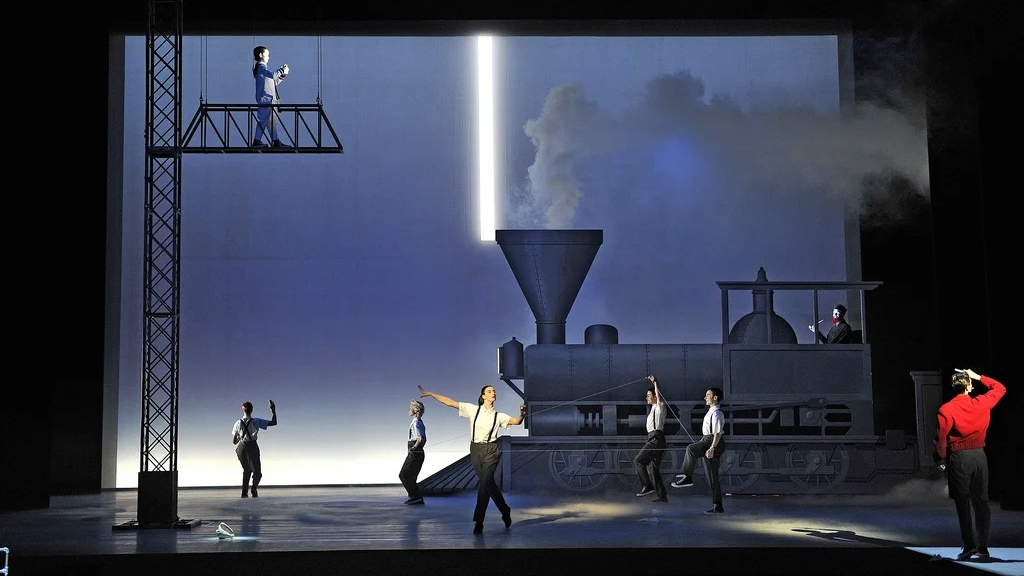
Einstein on the Beach at Opéra Berlioz, Montpellier (2012) / Photo: Lucie Jansch
Beauty crowds me till I die,
Beauty, mercy have on me,
But if I expire today
Let it be in sight of thee.– Emily Dickinson
All that he saw, as all he cherished, was never hidden from us – this may have been the essence of the performer and stage director Robert Wilson in interpretating life and art. What was seemingly introverted and esoteric betrayed a wish for the audience to share in the emotion of observing truths as they unfolded before our eyes. In Wilson’s imagination, to be a theatrical event is to be embedded in our past as a rare form of memory. We might recall one space or beyond, his stage offering no perspectives — just an ambiance lacking any known reality, as if a third dimension in which a second one was lurking. Characters and objects seemed immobile as if in their right place, captured at the only moment they themselves could identify with, perhaps understanding or even questioning their raison d’etre. The performance itself was an act of denial, offering less than the essential, the minimal. Yet there was always an abundance of illusions, a glance across a refined phantasmagoric panorama so as to evoke a ‘performance’ through a sense of both the pre-realistic and a Piaget-like drifting into the pre-conscious. And this was often accomplished without video effects, computerized mechanical movements, rotating stage platforms, or Augmented Reality universes.
Yet, there was no attempt at mythical intervention, even when treating such Ancient or Renaissance personages as Ulysses or Orfeo. History, enclosed within a stage’s three walls, simply disappears from itself, leaving us with the present. All in Wilson is timeless, anachronistic in a way. It is spaceless-ness engulfing the spaceless. And when all appeared sparse, as if Wilson were ignoring text and dramatic situation, we often heard many others as describing his Art through discourses on Time and Space, whether wishing to relate the scientific and literary to a theatrical milieu or to a greater sense of reality in any dimension.
“Shakespeare should be full of Time,” Wilson said while preparing his 1995 Hamlet, A Monologue, (perhaps one of the greatest Shakesperean interpretations ever). Indeed, there is the relentlessness of beauty in both his philosophical and theatrical parameters. Shamanistic voyages drift by, penetrating the distances which might even be just behind us. And so we remain haunted by Wilson’s images because much of what we seek to codify during a performance is never brought to conclusion, as if a drawn circle not yet totally closed. The relationship between poetry and dream images exists in this sense of déjà-vu, and the more one saw repeated performances of his shows, the more it became clear. His use of stage blocking was hypnotic – moments of tranquility ebb homewards, as do pivotal turns of dramatic effect erupting unexpectedly from inner recesses. Wilson ever-balanced these two situations, encompassing and enrapturing us for the entire journey.
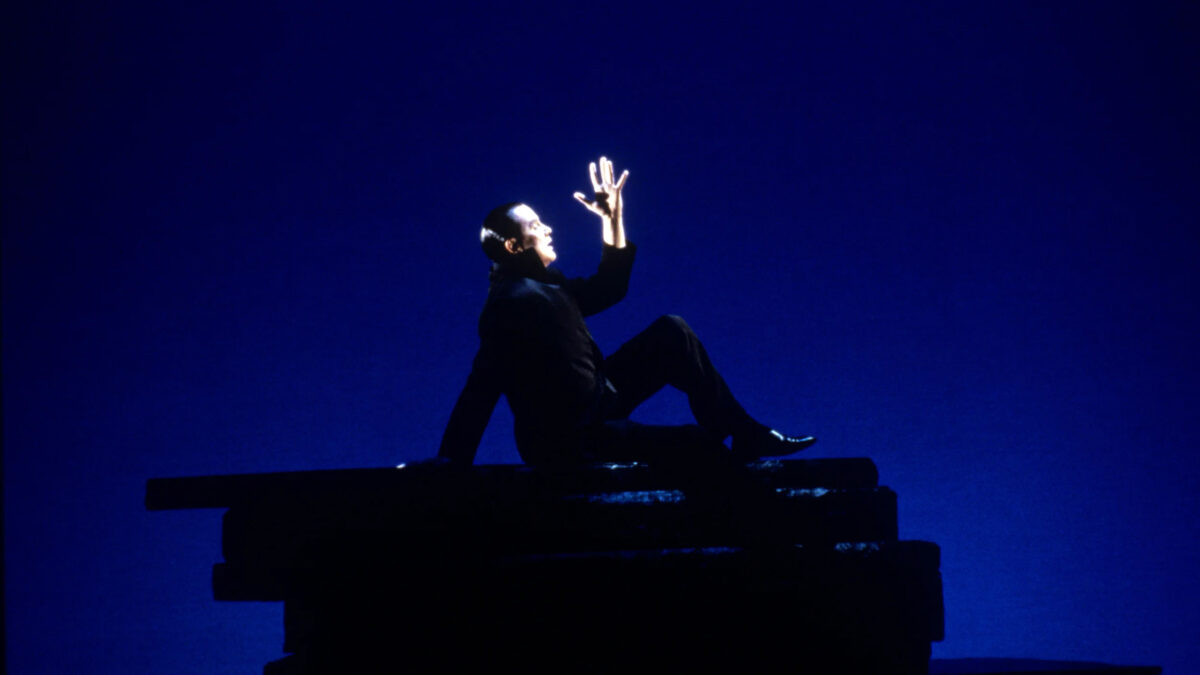
Hamlet, A Monologue (1995) / Photo: Charles T. Erickson
Time as Improvisation
It seems we are closing in on defining what is characteristic of Wilson’s 60 years of activity. All told, his stage creations were Wagnerian in a sense, though not necessarily operatic in any recognizable form. There is much that is choral through choreographic gesture, but hardly any arias, and the unities of classical Greek theater are almost always abandoned. All the works are truly unique as judged by one from another yet seem to be linked by a sense of the ‘placeless’ unreal, constructed through mystery of motivation alone. Almost too much has been made of the ‘Gesamtkunstwerk’ concept in Wilson’s contexts which presupposes an attempt to create a ‘total art’ experience through the amalgamation of any and all possible forms. As emblematic of his visions within a singular work, Wilson’s floating, somnambulistic tapestries bring about moments of stasis within a performance, often incongruent and anachronistic and thus embodying what is surreal. Herein, striking stage images manifest the beauty of a double sense of emotions, as when in Einstein on the Beach, the actors mix present and past tense phrases, doubled by recordings from rehearsals or even previous performances.
Wilson hinted at this when speaking of the actor’s realization of their movement; if self-consciously slow, then the effect is lost. But if we can behold its slowness as such, then all explodes and new realities abound. These are the Leitmotifs, bits of musical phrases or melodies that, caught in space, offer traces of dramatic truths associated with a particular character, place, or imagined idea. But this is related to the ‘audience,’ and not the ‘performer.’ Wilson’s Leitmotifs occur instead at the moment the performer begins to realize where they truly are, be it through a hop, a freeze, a glance towards a distant object. This does not necessarily resolve an existential inquiry; we, in observance, sense that an epiphany may have bloomed, but understand no further than that. This is why it may be that any moment, pose, image, sound, or lighting cue may remain fixed in our memories. Those who have seen various Wilson pieces over the years may grasp these images again, those flashbacks bound within a flashback, recreating those very same intensities of light, volume of music or speech, and movement.
All told, the effects of a Wilson performance on a spectator hint at Wilson’s innate relationship to the aesthetics of Beauty as the amalgam of Culture and Art. It is challenging to capture the breadth of Wilson’s entire contribution, which was his sense of a theatrical performance as an all-encompassing work-in-progress presented with a radical, self-declared ‘classicism.’ This visual artist, a designer at heart, moves towards the manifestation of incongruent ‘stream of consciousness’ actions onstage, suggesting those moving images are reflections of whatever surrounds our daily life. Wilson’s choice of historical, famous figures is at times just a pretext for investigating our past and our involvement with it. The cinematic quality of a live performance through fascinating, vibrant, somewhat dream-like ‘tableaux vivants,’ holds our attention through sheer curiosity at first, through the surfacing of emotions, and then through a sensation of having been captured by the total effect. All this parallels a form we have come to know as ‘opera.’ Wilson, in creating these works, has created what we might call a ‘Theater of Innocence,’ lacking in superficial intention, a ‘stepping back’ as we penetrate a world imbued in artificial darkness. This is more than a ‘Gesamtkunstwerk;’ it contains the seeds that led Wilson to the world of Opera which he initially detested.
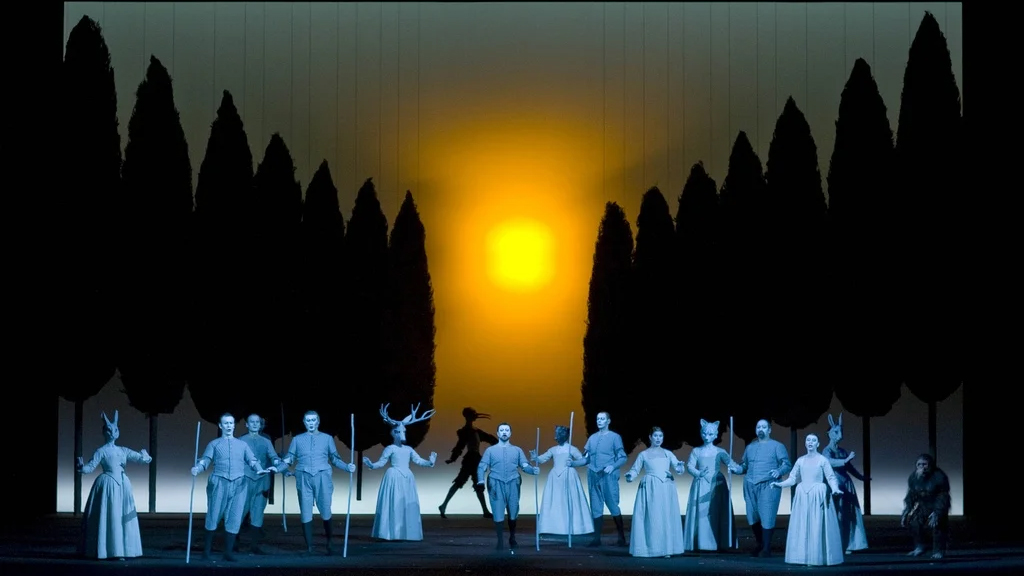
Orfeo, Teatro alla Scala
Opera, and Its Archetypes
Wilson approached opera as we know it, or thought we did, in over twenty productions of repertoire pieces, beginning with Charpentier’s Medea in 1984. Mesmerized by this mythical sorceress, Wilson maintained absolute fidelity to her inherent conflicts which would, as with Antigone, jeopardize her place within society. In Wilson’s Medea, we have an almost immobile figure before us, one whose crisis remains a seemingly recondite one. Ironically, the actor reveals bits of his ‘interior monologue’ but only through poses and restrained movements, ever-accompanied by constant interior tension. As spectators, we remain riveted to aspects of undefined dramatic moments, yet sense the archetype’s obligations to text, to interactions perhaps directed more at the audience than at the other figures upon the stage. This requires us to become completely absorbed in the performance, and what we do not see or intuit fills our imaginations with that unique theatrical phenomenon, those visual perspectives of an ‘illo tempore’ which will remain with us long after leaving the theatre.
The timeless, social implications found in all opera, even those of a comic nature, are often parallel to Wilson’s own ‘operatic’ creations as they relate to the use of music. Whether it be a work of the baroque Scarlatti or minimalist Philip Glass, the sonic ambiance always feels strangely distant and we are thus held in a moment of re-discovery. Something greater is moving beneath the surface. The titles of such works as Civil warS: A tree is best measured when it is down, and Death, Destruction and Detroit appear as tragic harbingers to the apocalyptic. In more subtle ways, Wilson almost always puts a spotlight on a cold, bourgeoise society. Edison, one of his greatest works, shows that some of the ‘advantages’ of supplying electricity to society were justified by the pompous chandelier at the Paris Opera, as well as projected newsreel footage of a historic fin de siècle boxing match. Years later, Wilson was to give boxing gloves to the protagonists of Le trouvère for the 2018 Festival Verdi in Parma.
As for Wilson’s iconic operatic productions, one may suspect that Wilson entered into worlds of musical landscapes wherein his scenic language could find a home. La Scala’s 1987 Salome was radically bent out of shape and placed within incongruent temporal and spatial realities: Salome was portrayed through three figures, one being Alice in Wonderland, complete with a rabbit in a cage suspended over the orchestra pit. And in the ‘Dance of the Seven Veils,’ Salome was seated in a formal black dress to the side of the stage while a frustrated, clawing devil rolled by on a medieval flat wagon following after a da Vinci-esque flapping angel on tall wooden wings.
Then there was a Renaissance Orfeo, part of the Claudio Monteverdi trilogy done for La Scala (2009); Wilson’s use of gesture, costuming, and especially lighting shed contemporary light on how hubristic Man related to his Gods. The poignant scene in which a Messenger tells Orfeo of his beloved’s death by serpent bite, one of the most moving in all opera, had Orfeo freeze, the fingers of his left hand splaying as if to strangle destiny were brought to his face, as seven lady peasants imitated that gesture. There followed the scene with the Ferryman, Charon who at first in shadows and dressed almost Elizabethan and all-too-human, changed his hand gestures in reaction to Orfeo’s pleas to visit his wife in the underworld — a handbook for pantomimists. Then, at another moment, Charon’s peace-bringing, open-palm ‘Abhaya Mudra’ Buddhistic gesture united the human with supernatural world with such eloquence that spectators would be moved like the stones that Orfeo was said to move to tears through his music.
And it was constantly through kinesics that Wilson brought us moments of overwhelming emotion, crossing over less abstractly than expected into the world of melodrama. Madama Butterfly (Paris, 1993) ended her life standing, drawing her hand across her neck in the gesture of ‘seppuku,’ which we might always expect in any production. But Wilson adds more emotion, having Butterfly stare into Pinkerton’s eyes deliberately, spitefully, as if to shift the blame. Then, falling slowly backwards, she waves to her child and then faces her insensitive husband before dying like an insect, a butterfly flapping its wings poetically, bidding farewell with honor.
Wagner’s Ring in Zurich (2000) was certainly a great challenge for Wilson, but not because of its complexity and length, nor for its mixing of the mythical and the human. It was an adventure in Gestalt psychology, inviting us to identify at will with the characters who, in every passing moment, were integrated with what was happening in the here and now. The figures bathed in barely perceptible changes of lighting representing moods and inner drives, we might recall Adolphe Appia’s recreation of the universe as followed by Weiland Wagner’s 1951 staging. The Ring might seem arduous to sustain over four evenings, yet Wilson’s highlighting proved engrossing, extremely poetic and subtly dramatic. His genius here was to remain within the boundaries of the ‘classical’ (as he had done before), bringing to light all the nuance of Wagner’s intimate portrayal of his characters’ tragic unresolved present as they were held prisoners of their past errors.
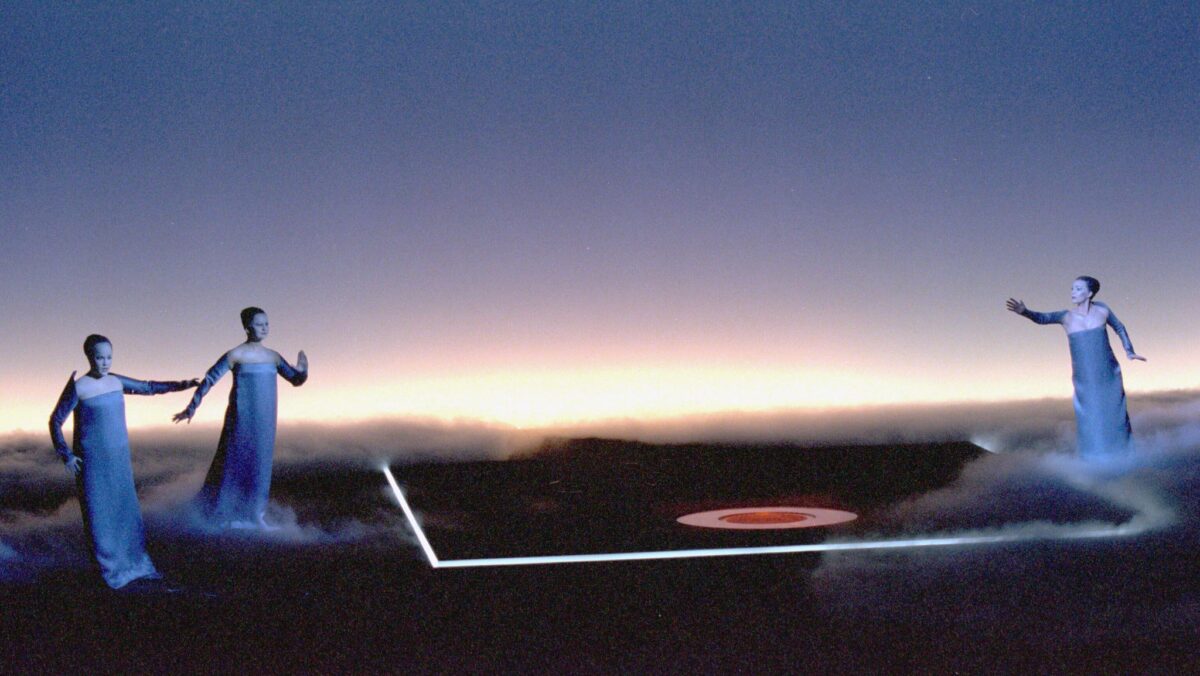
Das Rheingold, Opernhaus Zurich 2020
Light is in itself a presence.
An upstage bar of light glows as a trademark of a great many of Wilson’s stagings. Incandescent in its purity, even more than dawn’s light and more melancholy than day’s retirement, all eventually molded into beams that were often perpendicular, parallel, fading, or blurting out as lightning. For some of us, this represented Wilson more than anything, a metaphor for the director himself as a steady beam upon the stage. Wilson’s essential communication allowed us to recognize the language of his spirit facing an immense journey through both his vision and through our own nature as ever-changing. It is a wonderful, fulfilling experience, an unconscious flow whilst standing still. This is the sensitivity life offers us.


