Enrique Mazzola and the Lyric Opera Orchestra and Chorus. Photo by Kyle Flubacker.
We all know Carmina Burana, or rather, we all know the first movement, “O Fortuna.” But after that grand opening, you’d likely struggle to identify another melody from Carl Orff’s cantata. Part of this lies in its composition history. Steeped in the antiquated Latin and Middle High German of Johann Andreas Schmeller’s 1847 edition of Carmina Burana, a medieval manuscript mainly containing earthy, bawdy texts from the 11th through 13th centuries penned by disenchanted students and clergy, Orff’s 1936 cantata recasts that satirical history in sonic form. After its premiere at the Lyric Opera of Chicago on November 14, I’m convinced only a country as steeped in philology and medievalism as Germany could produce it.
Framed on both ends by the thunderous “O Fortuna,” the cantata moves through five major sections: Primo vere (In Springtime), Uf dem anger (On the Green), In Taberna (In the Tavern), Cours d’amours (The Court of Love), and Blanziflor et Helena (Blanziflor and Helena). But before you let the titles bore you, this is no mere regressive pastoral. Although the simple melodies and theatrical orchestration were taken up by the Nazi regime, Orff’s engagement with the past is far stranger and more ambivalent than propaganda would suggest. I’m not here to rehabilitate Orff’s image or sweep this history away, but the music is full of irreverence and parody: qualities that make it a reluctant participant in the official and vicious medievalism of the Nazi party.
Take, for instance, the repeated “ah” statements heard in the chorus during “Veris leta facies” that tease at but never deliver the expected congregational “amen.” Or the farcical bassoon line that opens the tenor solo “Olim lacus colueram,” mimicking the dying, roasting swan the tenor is tasked with embodying. With some help from Orff, who generously set the beginning of each phrase with a high A or C, the effect isn’t difficult to achieve. David Portillo charmingly carried the vocal weight of this moment with a sophisticated sense of the absurd burden shouldered by a swan sizzling in a tavern full of drunks.
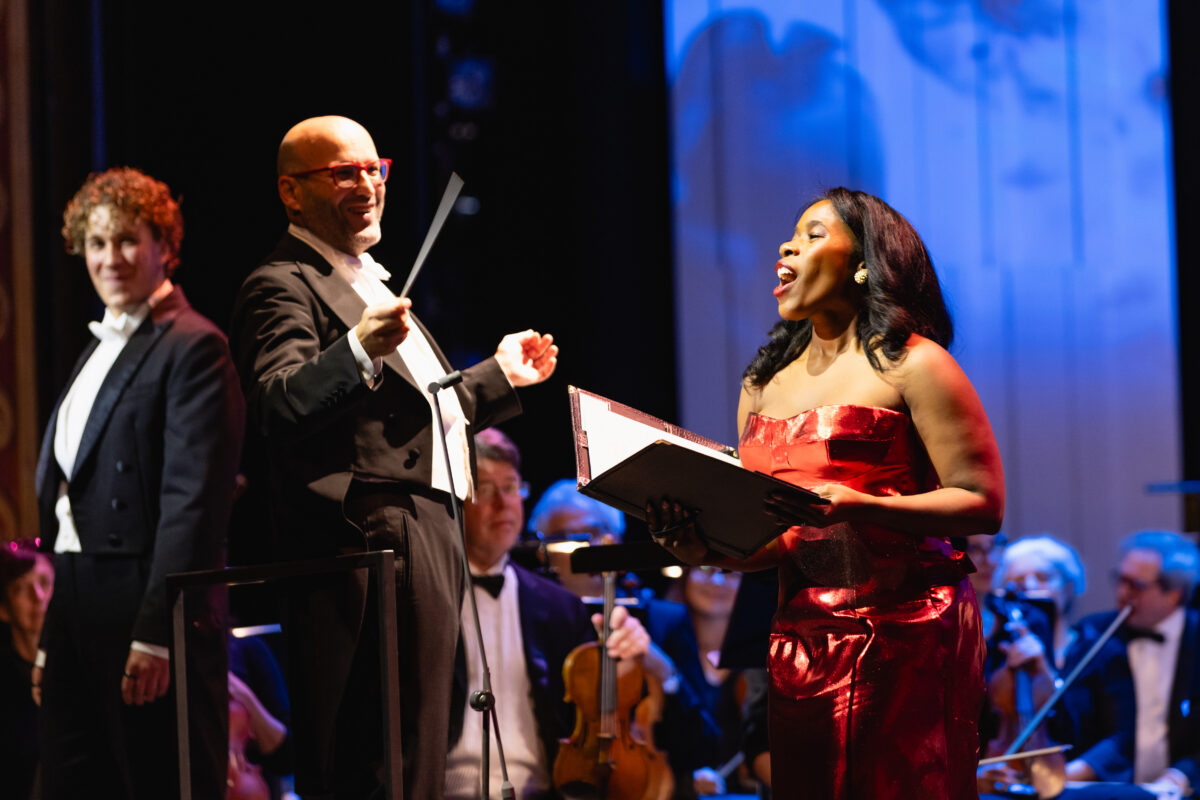
Jasmine Habersham. Photo by Kyle Flubacker.
The tenor isn’t alone in his struggle. For all of the straightforward melodies in the chorus, the soloists bear the brunt of Orff’s musical vision. Jasmine Habersham dutifully sang the feared soprano solo “Dulcissime.” But the real treat of the night was Ian Rucker, whose baritone was impressively polished and controlled with an expansive range just as assured in the fiery text-heavy “Estuans interius” and the delicate high coloratura in “Dies, nox et omnia.” If you told me the Lyric programmed Carmina Burana in season purely to accommodate him, I’d believe you.
Throughout the twenty-five movements, Enrique Mazzola was in sprightly form, taking a rare turn above the stage rather than buried in the pit. Adam Larsen’s projection design, although at times quite literal, kept the choral movements and instrumental dances alive. Although Orff called it a “scenic” cantata, most productions, including this one, don’t really rise to the expectations of that title and perform it in a concert version. It would have been nice to see what the Lyric could have done with a proper staging, but soloists supplied enough spark to cut through the static choral stretches.