Image courtesy of HowlAria
If there’s anything opera is obsessed with, it’s the mask.
Characters are always disguising themselves and assuming different identities. Singers are always trying to get into the mind of their characters, or their alternate selves that have taken root within the characters. We as an audience project onto what we see onstage. All of these different alter-egos fall in line with the id, Freud’s concept of that secretive, unconscious part of our minds ruled by instinct and passion. Opera is the portal through which we come to understand our desires, its exaggerated reality serving as a Rorschach test to our own.
Furthermore, it’s not unusual for opera’s depiction of the id to take shape as an animal. Throughout history, animals have been used as representations of the desires at opera’s core. When Mozart grew listless he would pretend to be a cat. The titular sorceress of Handel’s Alcina turns her former lovers into animals, symbolizing their lost agency in their erotic pursuit of her. For The Cunning Little Vixen Janáček chose foxes as his emotional conduits. Not only are animals a bit of theatrical spectacle, but they serve as both an escape from the bores of humanity and as a reckoning with the self- who are you when you are not bound by convention?
Opera isn’t the only art subculture on the block where animals represent alter-egos, though. In fact, an entire artistic community has grown from that one idea — and that community has come to our art form, bringing an entirely new group of opera lovers with them. That community is the furry fandom.
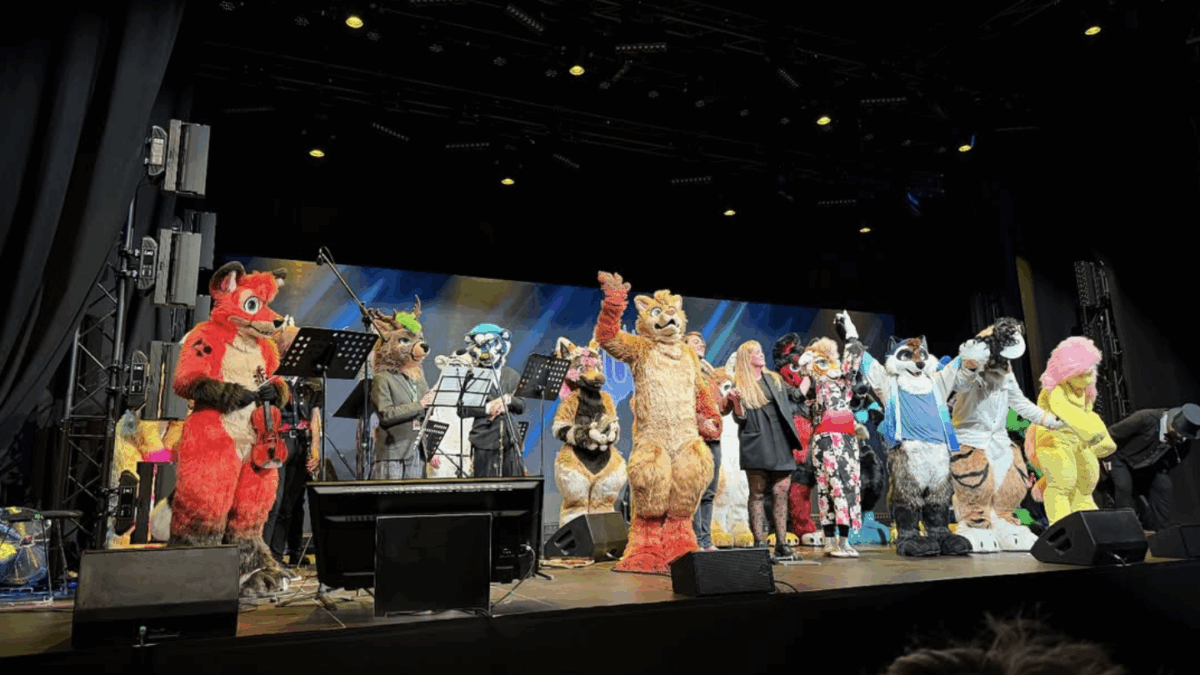
My non-opera friends know me primarily as their “opera guy” and my opera friends know me as their “opera guy who is specifically into offbeat/kitschy stuff,” which puts me in a great position because it means that they always send me whatever interesting new things are happening in the opera world. Recently I’ve been sent clips of people in animal suits singing opera; “FURRY OPERA,” the titles on the videos read in various fashions. These are the work of HowlAria, a classical music performance group focused within the furry fandom… a place that may seem bizarre at first but is not too far from our own.
The furry fandom is an artistic subculture focused on anthropomorphic animals. While participating in the fandom takes many forms, many furries role-play as ‘fursonas’ (avatars of cartoon animals) as a way of representing themselves. Some simply draw themselves as these characters, while others wear animal costumes (‘fursuits’) as further means of expression. Art in the furry community is everywhere and highly valued. Many artists are able to make solid livings off of elaborate commissioned artwork and custom-made fursuits. Furry characters are essentially humanoids with exaggerated animal features, so a lot of that art focuses on catharsis in a unique and often visceral way.
To learn more about HowlAria’s work, and furries as a whole, I reached out to them and got in contact with Coda Thayle, part of the group’s orchestral ensemble. Thayle told me more about how the group’s fusion of opera with furry art creates new ways to think about how pieces are staged. Interestingly, most of the ensemble happened to be drawn to both classical music and furry art, instead of there being separate groups of one vs. the other. “Most of the members of the ensemble are already skilled and passionate musicians that by chance are also furries, so the musical aspect is often relatively easy to master,” Thayle said; he also noted that self-expression was something he was drawn to in both classical music and the furry fandom- presumably that commonality also drew in many in the rest of the ensemble.
“There is also a performative and visual side that is more visible when working with the furry community,” Thayle continues. “Their focus on visual art makes the performance require a lot more visual input, often requiring the musicians to be more visible or even acting alongside the singers.” Finally, Thayle noted that the ensemble’s furry side permitted them to draw in more audiences, audiences that might not otherwise be interested in classical music or opera. “At least from my ‘normie’ community, opera is often seen as high culture and associated with ‘high-brows,’ champagne and fancy clothing. By showing opera in a less high-cultural way (even deemed by some communities as unwanted), we can appeal to those who are curious of the aesthetics of furry culture, and on top get a new view on what opera can be. Younger audiences are especially a main audience group – bright, colourful suits tend to draw in kids (and mayhaps their parents along with them) which may expose them to a genre they never would have thought of (or could have afforded) exploring for themselves.”
First off, to get the obvious out of the way: this is camp. The punny My Little Pony-derived title. The suits. The wide variety of musical selections. The genuine talent of the artists on display. A special shoutout has to go to Pinkerton, who is not only a Siberian tiger but also has a sailor suit and hat tailored to fit the fursuit. I find everything about this so incredible. But beyond the visual aspects, I’m fascinated by how this performance almost serves as a liminal space for the works in question. Madama Butterfly and The Mikado are both sampled in this concert, and besides the American sailor suit and kimonos, which serve to pay campy homage to the operas more than anything else, the racial context of the original works is otherwise removed. The fact everyone here is an animal- without a given racial allegory in mind and wholly based on how each individual chooses to express themselves- serves as a genuinely interesting way to depict problematically racialized works. It presents them in a more neutral light that is, while not outright removed from the culture surrounding them, rooted in how people perceive themselves instead of how others perceive them. Every artist in this concert has full control over the way they are visually seen, which I personally find an extremely arresting on a stage.
In broader media, furries sometimes get something of a bad rap. Media coverage focuses on furries as strange and oversexualized; while eroticism is certainly there in the furry fandom, it is only as present as it would be in any other artistic subculture. In recent years, American conservatives have decried furries as a child-corrupting force, (falsely) claiming that they manipulate children into using litterboxes in schools. A large portion of furries identify as LGBT+, according to studies by the International Anthropomorphic Research Project (a team of social scientists who study the subculture). The furry fandom therefore becomes both a safe place for LGBT individuals to express their identities… and a way for non-furries to thinly veil their homophobia. Even as I was searching for interviews for this piece, I received messages decrying furries as ‘weird,’ with some baffled why I would consider them valuable enough to research because of their perceived sexual and societal deviancy.
But, of course, the opera fandom, of all places, must know what that feels like.
Given the nature of this platform, I assume we all know opera has always been a home for wild queers, and I also assume we all have at least some handle on why. Opera has always been a safe place for all those feelings to go. Desire and isolation are soul-deep pains only the tremendousness of opera can soothe. You go to the opera and you are not entirely yourself, but someone else who is paradoxically yourself, with whom you can come to understand things a little better. And for a long time, like how furries are currently mocked, opera queens were mocked for that same sense of deviancy.
Even now that gay marriage is legalized in some countries and LGBT identities are, on the whole, more accepted than they were a century or two ago, feelings can still overwhelm. People need a place where you can become that Other self — it’s the same reason children need play, and both opera and the furry fandom have provided that to queers of the past and present.
So it may be that one man’s Callas recording collection is another man’s fursuit.
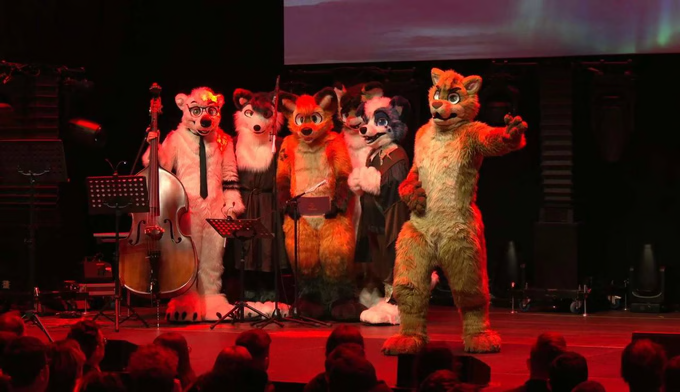
Image courtesy of HowlAria
In addition to interviewing HowlAria I set up an anonymous tipline-style poll for opera fans and furries to respond to questions about their respective subcultures. Their responses were startlingly similar. “[I love] the over-the-top theatrics of it,” one fan responded when talking about opera. Another chimed in appreciating “the unique way it can deliver a story while being so over the top.” Furries had similar things to say about their chosen subculture, with creativity, queerness, and a sense of belonging being highlighted in their responses. One summed it up succinctly: “You can be an animal. And there are other animals. And everyone is gay.” And where one opera lover enthusiastically noted love for the taboo topics of “insane women and murder,” a furry explained how erotic content within their fandom respects feminine and non-binary identities in ways other erotic arts do not. Both sides talked about the sense of community in their subcultures and how the worlds of classical music and/or the furry subculture foster something of a second family to them.
“I think most people feel pressured to present themselves publicly in ways that often are far less quirky and interesting than what exists in their internal lives,” one response read. “I know that I certainly become very attached to fictional characters that outwardly express facets of myself that I don’t feel I can personally display in public, and I imagine that that’s probably true for many others. It’s always cathartic to see other people live truths that you personally don’t feel you can live totally publicly, and it always makes me feel a little less alone to encounter a character that I find relatable, and to know by extension that someone else has resonated with what I’ve privately felt.”
Catharsis. It’s what opera is all about, isn’t it? I’ve been phrasing the union of opera and the furry fandom seen in HowlAria’s works as something new for much of this article- but is it really? Or is it opera being as itself as it ever was?
Recently there’s been this big push to make opera ‘more’ marketable and mainstream with Instagram videos of ‘millennials describing opera’ that make fun of the ‘weird plots’ and ‘strange names’ or opera companies’ bending over backwards to claim that an opera is “just like” some broad media trend or another. But I think HowlAria’s work shows that what younger audiences really want is authenticity. People want niche. People want something sincere even if — especially if! — it might look kooky from the outside.
Instead of trying to refute the idea of opera being strange and its own subculture, radicalize it: opera has always been its own specific subculture and probably always will be. It isn’t mass media. It will never be that popular and maybe it never has been. And that’s a good thing. The furry fandom of the present and the opera queens of the past show people (especially those already regarded as beyond society’s norms) need worlds different from our own to project themselves into, and the fact that furries- who skew much younger than operagoers do as a broad demographic- are getting into opera through this angle shows how young audiences connect with this notion.
Especially as the world around us becomes more automated, we crave that sense of human craft and connection. And opera has always been a home for the strange and quote-unquote “deviant,” who increasingly find themselves isolated as mass media becomes to edge out other forms of entertainment. The furry audience may never become a sustainable one for opera company marketing departments, but opera’s power to transcend social borders deserves acknowledgement.
We come to the opera to find ourselves. And as long as there is imagination, and hope, and unquenchable longing, and that same, indescribable instinct that draws someone to their other self — be that self Floria Tosca or a cartoon wolf — opera can be as alive as it has ever been.